
Diversity has inspired collectors to collect, travelers to travel and the researchers to do the research on this precious wealth. Vegetation is one of the precious gift, nature has provided so as to meet all sorts of basic essential necessities of the humans mainly in the form of food, fodder, fuel, medicine, timber, resins and oils etc.(Gaur, 1999). “Biodiversity generally refers to the natural variety and the physical organization or pattern of variability amongst the living organisms (Putz et al., 2000).
It includes diversity within species, between species and of ecosystems. Biodiversity includes all ecosystems- manmade natural (forests, nature preserves or national parks) and represents the wealth of biological resources available to human beings. The diversity of life on earth is essential for the healthy functioning of ecosystems and it is biodiversity that boosts ecosystem productivity. The sum of a region’s genes, species, and ecosystems varies widely over the world rather than being spread uniformly (Schulze et al., 2019). It also varies at both altitudinal and latitudinal gradients, always higher in tropical climates as compared to the other climatic zones and depends on mainly altitude, soil, geography, topography, temperature, precipitation, humidity, and biotic interactions (Tito et al., 2020; Martinez-Camilo et al., 2018).
However, ecological role the biodiversity plays and genetic richness it contains became a buzz word abruptly especially during the last few decades (Wilcox, 1984). Strong and multidimensional evolutionary and geological processes and linkages within and amongst these aspects play an important and determinant role in structural and functional aspects of biological diversity in a range of the living system.
It is believed that as many as 500 million species of plants, animals and microorganisms inhabited the earth ever since life began on this planet about more than 3.5 billion years ago. Biodiversity certainly is the natural biological capital of the earth and provides all important and equal opportunities for the nations to prosper by providing goods and services essential to support the livelihood issues and aspirations of the living beings and certainly is an elementary requirement for the long term sustainability of the environment, continuity of life on the earth and the maintenance of its integrity.
Important and inter-related causes of biodiversity loss also include increasing human population, deforestation, forest fires, pollution and climate change (MEA, 2005). It can be conserved by in-situ conservation and ex-situ conservation. Human activities like agricultural expansion, road construction, urbanization, and other developmental activities are supposed to be major threats to biodiversity and wildlife and therefore, the most effective and efficient mechanisms for conserving biodiversity is to prevent further destruction of degradation of habitats. Biodiversity at all its levels, genetic species and as intact ecosystems, can be best preserved in-situ by setting up ‘Protected Areas’. These should consist of a network of National Parks and Wildlife Sanctuaries with each distinctive ecosystem included in the network.
This type of network would preserve the total diversity of life of a region. Conserving natural terrestrial, freshwater and marine ecosystems and their constituent species and restoration of damaged and degraded ecosystems including their genetic and biological diversity are important for the sustainable development of the society and nation’s economy (Sandifer et al., 2015). There are an increasing number of regional, national, and international awareness raising and policy activities aimed at protecting biodiversity as a result of the threat of species extinction due to habitat loss and degradation, global climate change, and human population pressure (Kullberg and Moilanen, 2014).
Various initiatives had been taken by IUCN in 1994 which proved to be essential for the development of different tools and equipment for the conservation of biodiversity and other natural resources on both national and international grounds (Lamoreux et al., 2003). On December 29, 1993, the Convention on Biological Diversity (CBD) came into effect, with the primary goals of conserving biodiversity, its sustainable uses, and fair and equitable sharing of the benefits (CBD, 2012). About 87% of CBD signatories have produced National Biodiversity Strategies and Action Plans, providing frameworks for addressing biodiversity loss on a national level. The United Nations Convention on Biological Diversity, developed the Aichi Biodiversity Targets, a 10-year strategic plan for 2011–2020 that recognizes the importance of the link between biodiversity and bio-economy.
Four strategies required for the biodiversity management are in situ strategy, ex situ strategy, reduction of anthropogenic pressure and rehabilitation of endangered species. Wildlife management consists of habitat evaluation and assessment, periodic monitoring of vegetation cover and animal population status, identification of habitat factors favourable to growth and which act against the population. Welfare factors are promoted, adverse factors are arrested and limiting factors mitigated so that habitat carrying capacity is optimized and populations attain the equilibrium point intrinsic to the species. Participation and support of local public is enlisted to make the conservation plan work so that the outcome becomes sustainable.
Biodiversity is not only crucial to ecosystem functioning, but also plays a role in protection from natural disasters. Extreme weather events such as storms and flooding are projected to become more pervasive threats due to climate change, as is sea level rise. Adger et al. (2005) emphasize the importance of building resilience to natural disasters, particularly in coastal regions. Munang et al. (2013) listed natural hazard mitigation as an important regulating service that ecosystems offer, especially now, when weather patterns are becoming increasingly unpredictable due to climate change.
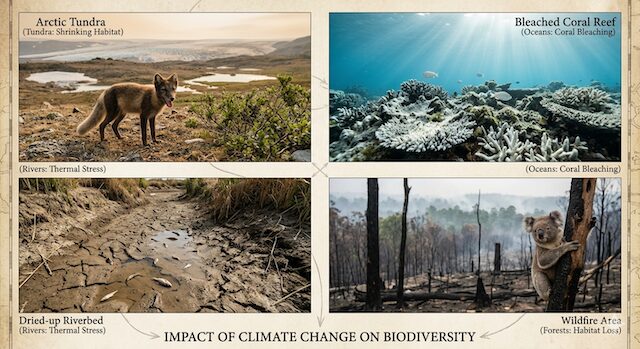
If ecosystems are managed in a way that conserves biodiversity, the effects of flooding, landslides, wildfires, droughts and storm surges can be mitigated more effectively. Climate change and biodiversity are closely linked. Climate change is having predominantly adverse and often irreversible impacts on many ecosystems and their services, with significant negative social, cultural and economic consequences. However, the links between biodiversity and climate change flow both ways.
Conserving natural terrestrial, freshwater and marine ecosystems and restoring degraded ecosystems (including their genetic and species diversity) is essential for the overall goals of both the Convention on Biological Diversity and the United Nations Framework Convention on Climate Change because ecosystems play a key role in the global carbon cycle and in adapting to climate change, while also providing a wide range of ecosystem services that are essential for human well-being and the achievement of the Sustainable Development Goals.
Ecosystem-based approaches to climate change adaptation, which integrates the use of biodiversity and ecosystem services into an overall adaptation strategy, can be cost-effective and generate social, economic and cultural co-benefits and contribute to the conservation of biodiversity.
Global temperatures are projected to increase by 1.5°C above pre-industrial levels in the next two decades (IPCC 2018). There is mounting evidence that the scientific community has underestimated the sensitivity of earth’s ecosystems to small increases in temperature, and the consensus is that efforts must be made now to limit warming to 1.5°C instead of 2°C (IPCC 2018; Resplandy et al. 2018). Interactions between the impacts of changing temperature, precipitation and land use have also led to downslope or non-poleward range shifts (Tingley et al. 2012; Settele et al. 2014).
There is a large variation in observed species’ range responses, both across and within taxonomic groups (Chen et al. 2011). Despite the complexity in species responses, it is clear that some groups (e.g. insects and birds) have shifted their ranges substantially in response to climate change (Settele et al. 2014). Freshwater resources are also expected to be affected by climate change.
Studies have shown that soil and water nutrients are more effectively mobilized in ecosystems that support more species, compared to those that support fewer species (Tilman et al. 1996; Bracken and Stachowicz 2006). Climate change threatens water resources via changes in flow regimes and increased air temperature (Heino et al. 2009; Whitehead et al. 2009).

A scientist with Himalayan Forest Research Institute, Shimla, Shilpa works as the Chief Technological Officer with the Forest Ecology and Climate Change Division.
