
For millions of young Indians, NEET is more than just an entrance examination. It is the doorway to their dream of becoming a doctor. For many families, especially those from middle- and lower-income backgrounds, a government medical seat is the only affordable way to study medicine.
Many parents make huge sacrifices to support their children’s preparation. It is common for families to spend ?3–4 lakh or even more on coaching, often using their savings or taking loans. They do this with the hope that hard work and merit will be rewarded fairly.
NEET has certainly made medical admissions more uniform across the country. At the same time, its growing competition has led to a rapid increase in coaching centres. While these centres have helped many students, their mushrooming also raises an important question: Has expensive coaching become an unwritten requirement for success? If students feel they must spend several lakhs just to compete on equal terms, we need to ask whether the examination is giving enough importance to what they learn in school.
Recent controversies over alleged paper leaks and other examination irregularities have increased public concern. Whatever the final outcome of the investigations, such incidents weaken people’s trust in the examination system. For students who have spent years preparing honestly, even the feeling that some may have gained an unfair advantage is deeply upsetting.
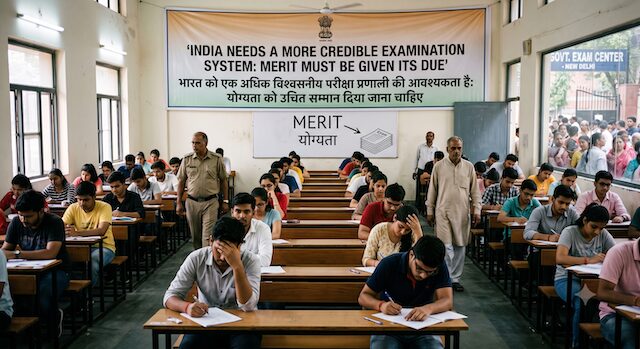
The pressure of such a high-stakes examination is also enormous. Every year, news reports tell us of students who die by suicide after struggling with examination stress or disappointment. Mental health experts rightly point out that such tragedies have many causes and cannot be blamed on one examination alone. Even so, doubts about the fairness of an examination can add to the stress and anxiety already faced by students and their families.
An examination of this importance must earn the complete trust of students and parents. Students can accept a tough examination, and even accept failure, if they know that everyone competed under the same fair conditions. What is much harder to accept is the possibility that honesty and hard work could be affected by malpractice or weaknesses in the system.
The solution is not to do away with NEET. A common national entrance examination has many benefits. It brings uniform standards and promotes merit-based admissions. However, it must continue to improve. Examination confidentiality and security should be strengthened, any irregularities should be investigated quickly and transparently, and greater efforts should be made to ensure that success depends mainly on school education rather than expensive coaching.
India’s future doctors deserve an admission process that everyone can trust. Merit must remain the foundation of medical education, and every student, regardless of their family’s financial background, should feel confident that dedication, honesty, and ability not privilege or unfair means will decide the outcome.
The true success of NEET will not be judged only by the number of students it selects, but by the confidence it gives every student who walks into the examination hall believing that the system is fair.

Dr Omarlin Kyndiah is an Associate Professor in the Department of Biochemistry at St. Edmund’s College, Shillong, India, where he has been teaching since 1997. Beyond academia, he served as General Secretary of Sein Raij Niamtre Shillong (Meghalaya) from 2008 to 2024, a congregation representing the indigenous Niamtre faith