
Every place has a story, and Shillong is no exception. Today, it is the capital city of Meghalaya and one of the most popular tourist destinations in Northeast India, admired for its scenic landscapes, pleasant climate, and rich cultural heritage. Yet the origins of its name lie at the intersection of documented history and cherished oral tradition. While colonial records explain how Shillong emerged as an administrative centre, indigenous narratives reach much further back, recalling migrations, sacred landscapes and legendary ruler
The modern history of Shillong began during the British colonial period. In 1835, the headquarters of the British Political Officer was shifted from Nongkhlaw to Cherrapunjee. However, Cherrapunjee’s humid climate and its lack of strategic advantage soon proved unsuitable. The need for a more accessible administrative centre became even more pressing in light of military operations associated with the Jaintia Rebellion led by U Kiang Nangbah.
A committee was appointed in 1862 to identify a suitable site for the district headquarters. After careful consideration, it recommended the high plateau of Shillong as the location for the headquarters and sanatorium. It further suggested that the Yeodo Valley (present-day Iewduh) be reserved as a depot for sick European troops and for a cantonment. The Shillong plateau, being approximately 900 feet higher than Yeodo, offered a cooler climate and a noticeable difference in temperature, making it more favourable for settlement.
Despite the Committee’s recommendation, the Government of Bengal initially approved the removal of the Suddar station of the Khasi and Jaintia Hills district from Cherrapunjee to Yeodo. A detailed survey of Shillong and Yeodo was subsequently ordered, with the Topographical Survey Department entrusted with the task. Meanwhile, increasing numbers of people began applying to the Commissioner of Assam, Colonel Henry Hopkinson, and the Deputy Commissioner of the Khasi and Jaintia Hills, Major H. S. Bivar, for allotment of building sites at Yeodo.
The Agent to the Governor-General of the North Eastern Region informed the Bengal Government about the steps taken for acquiring land for civil and military stations and a sanatorium at Shillong and Yeodo, located within the Mylliem Syiemship. In anticipation of approval from the Government of India, the Bengal Government sanctioned the arrangements made by Colonel Hopkinson for acquiring 2,499 acres of land for the Shillong station at a cost of Rs 8,433.
This amount included Rs 1,000 paid to the family of the Rajah of Mylliem to remove all claims over the selected tracts of land, Rs 500 paid to negotiators involved in the agreement, and Rs 500 for conservancy, plantation work, and marking of lots. Thus, an important advantage was secured for the government at a moderate cost and with the consent of all concerned.
Colonel Hopkinson later suggested to Colonel Haughton, who was responsible for allotments at Yeodo, that a maximum area of 10 acres should be allotted for building purposes, following the practice at Murree Hill Station. The price was fixed at Rs 50 per acre, a rate that remained in force until 1889. Gradually, allotments were made and Yeodo began taking shape as a new station.
However, the final order of the Government of Bengal regarding the Shillong scheme did not arrive until early 1862. Meanwhile, Major D.Vriggs, Superintendent of Works, had already begun construction of the Shillong–Yeodo road. Progress accelerated after the Lieutenant Governor of Bengal visited Yeodo in August 1865. The Suddar station of the Khasi and Jaintia Hills had not yet shifted from Cherrapunjee to Yeodo because the cutcherry was not ready to accommodate public offices, especially the Treasury.
Eventually, the remaining difficulties were resolved. After Captain Clarvus completed the necessary work on the cutcherry in April 1866, the transfer of civil departments from Cherrapunjee to Yeodo was carried out smoothly.
On the evening of 28 April 1866, Colonel Henry Hopkinson renamed Yeodo as Shillong, as the name Yeodo was considered likely to create confusion. Thus, Shillong-the dream child of Colonel Hopkinson was born.
Yet the story of Shillong stretches far beyond colonial records.
According to oral tradition, a section of the Austric people known as the T’sin-taing or T’sin-tein migrated from China. Over time, they became known as the Zyntein or Synteng, and are today recognised as the Jaintia.
The Jaintias first settled in Kamrup, present-day Guwahati. Pressured by repeated raids and the expansion of the Indo-Aryan Brahmans, they gradually moved eastwards to the banks of the Kolong River. From there, they journeyed south and established an agricultural civilisation in the fertile valley of the Kupli River situated in present-day North Cachar Hills.
As the population of Kupli Valley increased and pressure on land and water resources intensified, the Jaintias sought new territory. Under the leadership of U Long Chyllong, a group crossed the Kupli River and journeyed on foot until they reached the foot of the mountain now known as Shillong Peak. They named this new land Saphohlynrum, where they established a settlement that marked the beginning of a new chapter in their history.
The region was rich in wild fruits and vegetables, blessed with fertile soil, and abundant in water-an ideal location for settlement. While a section of the Jaintias established themselves there, the larger community remained in the Kupli Valley under the leadership of U Long Chyllong’s nephew, U Synriang, the son of Ka Lisan Chyllong. U Long Chyllong’s other siblings were U Siñ Chyllong and Ka Rah Chyllong. Over time, the settlers cultivated the land and built an agricultural community.
Nature worship occupied a central place in the spiritual life of the Jaintia people. Mountains and rivers were revered as sacred beings, each surrounded by myths, rituals, sacrifices, and ceremonial practices. These traditions remain essential to understanding Hynniewtrep cosmology and mythology.
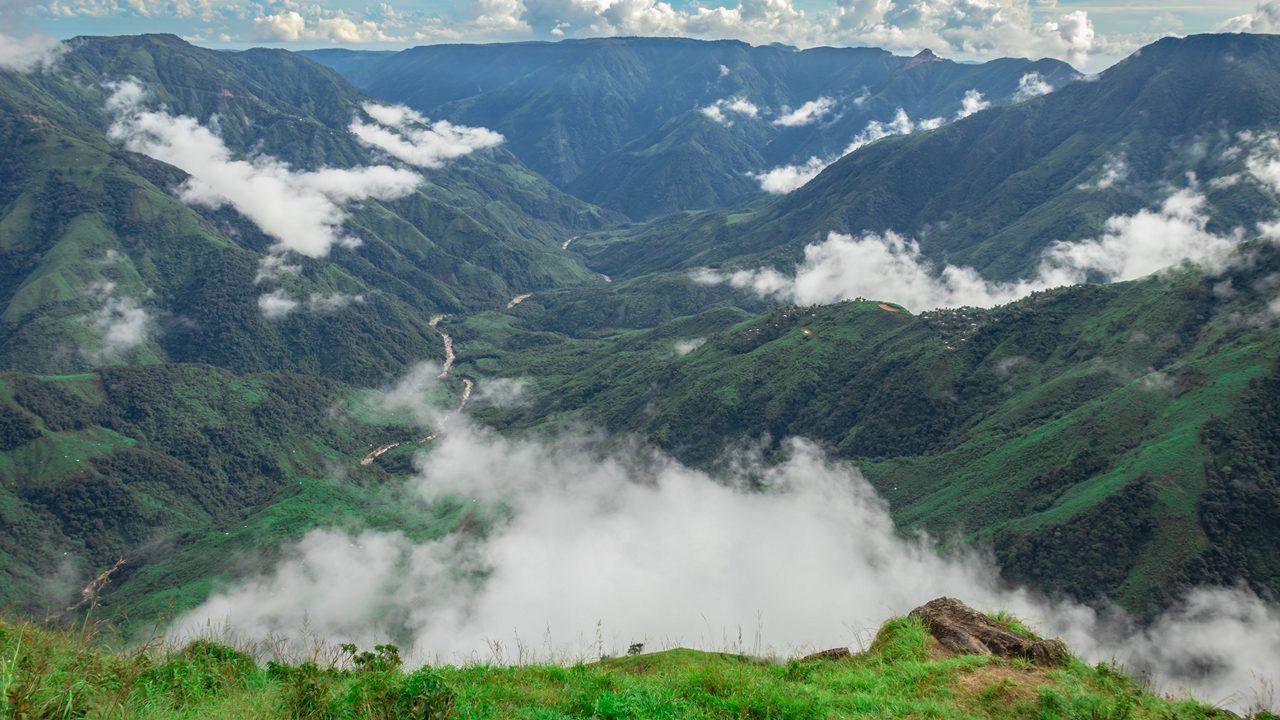
According to tradition, U Long Chyllong established a sacred place of worship atop Lum Chyllong, now known as Shillong Peak. Today, Shillong Peak has become one of the most popular tourist spots in Meghalaya, attracting visitors with its breathtaking panoramic views, natural beauty, and deep cultural and spiritual significance. In time, the mountain itself came to be revered as sacred, while U Long Chyllong was elevated as Syiem Chyllong-a king whose legacy transcended earthly rule and entered the realm of the divine.
As often happens in history and legend alike, harmony did not last. A dispute arose between the Jaintias and the people of Mylliem over the ownership of the sacred place of worship. Oral tradition recounts that both communities agreed to resolve the matter through prayer and libation before the deity. The people of Mylliem, however, are said to have cleverly manipulated the ceremonial rites. Although they had been the earliest settlers of Saphohlynrum, the Jaintias ultimately chose to return to their ancestral homeland in the Kupli Valley.
Their return reshaped the settlement history of the region. Along the journey, clans and clan clusters established new villages, or chnong, across what are now the Jaintia Hills. Oral tradition attributes the founding of Changpung to migrants from Saphohlynrum. Others continued towards present-day Laitlyngkot before moving further south to Mawphanrang, Sohra, Mawphu, Thied-dieng, and Jadien. These movements gradually redistributed the Jaintia population across the Khasi Hills, Jaintia Hills, and the Jaintia Plains.
It is from this tradition that the name Shillong is believed to originate. The city is thought to bear the name of its legendary founder and first ruler, U Chyllong. Oral narratives further recount that U Long Chyllong met a tragic end when he was killed by his nephew, U Synriang, during a fierce battle.
Whether viewed through the lens of recorded history or remembered through generations of storytelling, the story of Shillong is inseparable from the cultural heritage of its people. These narratives, preserved through oral tradition, continue to reflect their beliefs, values, emotions, and understanding of the past. They remain one of the enduring versions of the story of Shillong Peak and the origin of the city’s name-a reminder that the identity of a place is shaped as much by heritage and legend as by history itself.

Dr Omarlin Kyndiah is an Associate Professor in the Department of Biochemistry at St. Edmund’s College, Shillong, India, where he has been teaching since 1997. Beyond academia, he served as General Secretary of Sein Raij Niamtre Shillong (Meghalaya) from 2008 to 2024, a congregation representing the indigenous Niamtre faith