
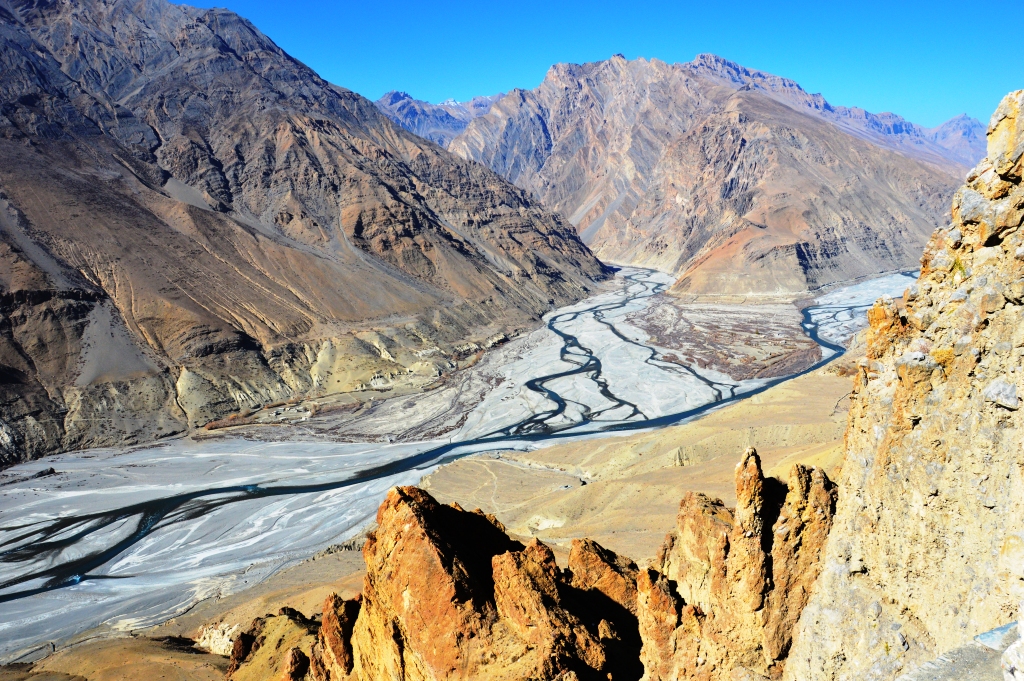
Spiti and Leh have stood for centuries as places of raw beauty and quiet endurance. Where monks once found solitude in monasteries perched on cliff-faces, and traders navigated treacherous high passes, today’s travellers seek dramatic landscapes, spiritual respite, and a profound sense of escape from modern life.
Yet these iconic Himalayan destinations are changing. As scientists and policy voices raise alarms about the climate crisis in the Greater Himalayas, one question grows increasingly urgent: will these breathtaking valleys remain favourable for tourism in the years ahead?
A rigorous study drawing on NASA POWER daily climate records spanning 1981 to 2025 now offers a clearer — and somewhat sobering — picture. By examining four key variables — temperature, precipitation, humidity, and solar radiation — the study introduces the Himalayan Tourism Climate Suitability Index (HTCSI), a practical, empirically grounded measure designed to reflect how welcoming the mountains feel for visitors on any given day.
How the Index Was Built
The HTCSI was crafted to mirror real human experiences at high altitude. It assigns weights based on what genuinely shapes a traveller’s experience in the mountains.
Temperature carries the greatest weight at 40 per cent. Days between 5°C and 20°C score highest — ideal for trekking and high-altitude exploration. Mild cold between ?5°C and 5°C earns partial credit, while extremes drag the score down significantly.
Precipitation accounts for 30 per cent of the index. Even moderate rainfall can make trails slippery, trigger landslides on mountain roads, and obscure dramatic vistas that photographers and trekkers travel thousands of kilometres to witness. Days below 3 mm score full points.
Sunshine contributes 20 per cent. High solar radiation greatly enhances the visitor experience — illuminating the vivid ochre and rust tones of the barren Himalayan landscapes that define the identity of these destinations.
Humidity rounds out the index at 10 per cent. Lower humidity below 60 per cent makes the crisp mountain air feel pleasant and easier to breathe, particularly for visitors ascending from India’s plains. These four factors combine into a single score between 0 and 1, with days scoring 0.7 or above classified as highly suitable for tourism.
Key Findings: Leh Leads, Both Valleys Face Turbulence
The data reveals a clear hierarchy. Leh consistently outperforms Spiti in climate suitability, offering between 180 and 220 favourable tourism days in many years — making it the more reliable proposition for tour operators and travellers who depend on weather certainty.
Yet both valleys share a troubling trajectory. Since approximately 2015, average suitability scores have shown a gradual but discernible decline. More critically, the variability of climate conditions has increased markedly. The once-predictable patterns that operators built seasonal calendars around are becoming unstable, posing real planning risks across the tourism ecosystem.
July and August remain the strongest peak months in both destinations. However, the shoulder seasons surrounding these core months — historically an opportunity for extended tourism windows — are becoming increasingly unpredictable. Forward-looking models projecting through 2050 reinforce this concern: while brief new opportunities may emerge, greater fluctuations will demand fundamentally different approaches from all stakeholders.
Even with gradual warming, temperatures in both destinations remain well below physiologically stressful levels — the maximum recorded stands at approximately 16°C. The real risk, therefore, is not extreme heat but the growing unpredictability of suitable weather windows — a subtler but operationally more damaging challenge for destination managers.
“The real risk is not extreme heat, but the growing unpredictability of suitable weather windows — a far subtler but operationally more damaging challenge.”
A Perspective on Responsible Development
As someone who has studied tourism and humanity’s deep connection with nature — and who has conducted fieldwork across Spiti and the broader Trans-Himalayan region — I find these results both insightful and urgent. The data sends a clear message to every stakeholder in India’s mountain tourism sector: true success in tourism is not about attracting the largest number of visitors, but about creating experiences that genuinely benefit local communities while preserving the soul of these extraordinary places.
When we overcrowd the shrinking windows of good weather, we unintentionally strain limited resources, damage fragile mountain trails, and erode the very peace and wonder that draws people to the Himalayas. The HTCSI provides a vital planning tool — helping destinations, operators, and policymakers understand when the mountains are most ready to welcome visitors.
What the Data Demands of Us
The findings point toward three clear imperatives. First, climate-informed destination marketing: state tourism boards in Himachal Pradesh and Ladakh should integrate HTCSI-derived suitability windows into visitor communication, helping travellers choose times when their journey is most likely to be rewarding.
Second, adaptive product design: tour operators must build flexibility and climate contingency into itineraries. Fixed departure schedules built around historical weather norms are increasingly risky. Dynamic, weather-responsive itineraries represent the future of responsible high-altitude tourism.
Third, investment in monitoring infrastructure: the analysis relied on remote-sensing data from NASA POWER, reflecting India’s continuing deficit in high-altitude weather monitoring. Expanding ground-level climate observation networks across Spiti, Lahaul, and Leh would dramatically improve the precision of future climate-tourism assessments.
The performance of Spiti and Leh on the Himalayan Tourism Climate Index is, ultimately, a story of resilience — but also of urgency. With thoughtful action today — choosing climate-aligned travel windows, supporting responsible local businesses, and building policy frameworks that treat climate data as a core planning input — we can ensure these extraordinary landscapes remain sources of inspiration and livelihood for generations to come.
“The mountains are speaking through the data. It is up to us to listen.”
‘The views expressed in this column are those of the author, and may or may not be endorsed by the publication.’
Behind the Analysis: Conducted in Google Colab (Python). Tools: pandas for data processing, Matplotlib and Seaborn for visualisations, Prophet for forecasting. Primary data: NASA POWER daily climate variables, 1981–2025.

Pankaj Sharma, a PhD in Tourism, teaches Tourism and Hospitality Management. A native of Bilaspur, Himachal Pradesh, he has extensive fieldwork experience across Spiti Valley, Kinnaur, and the broader Trans-Himalayan region. His research focuses on adventure tourism, destination competitiveness, and climate-tourism linkages in the Himalayas.