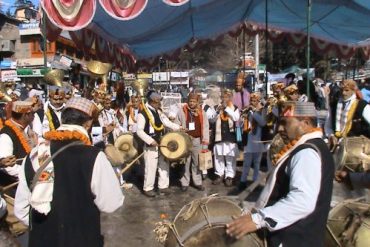
As the monsoon approach Jowai prepares once again to host one of its most profound cultural and spiritual expressions-Behdeinkhlam, celebrated this year from 6th to 9th July 2026. Beneath the rhythm of drums, the splendour of decorated rong or rots, and the energy of thousands gathered at Aitnar, lies a deeper story that continues to shape the identity of the Pnar people: a story of divine covenant, ancestral memory, and the enduring philosophy of Niamtre.
To witness Behdeinkhlam is to witness more than a festival. It is to encounter a living worldview in which mythology, morality, kinship, and community converge. At its heart stands the ancient narrative of U Syiem Lakriah, the chosen intermediary between U Tre Kirot, the Supreme Creator, and humanity.
According to Pnar oral tradition, when U Tre Kirot first entrusted the Niaw Wasa with the earth, the land was barren and unyielding. Life was fragile, uncertain, and without form. In the words of a Jaintia saying, “Chna Yung i step pat i miet, chna yung i miet pat i step,” meaning that in such a rocky and soil-less landscape, no house (yung) could stand securely whether built by day or by night because the earth itself offered no stable foundation for human settlement.
In compassion, U Tre Kirot responded to the prayers of U Lakriah, commanding Ka Bei Rymaw, the Earth Mother, to offer three basketfuls of soil known as ka le khoh le sun so that the earth might become fertile and habitable. Through this divine act, land became life, and humanity found its footing upon creation.
From this sacred beginning emerged not only survival, but a moral order. In the celestial realm, it is believed, U Tre Kirot convened a Dorbar Blai, a divine council that established the principles by which life on earth must be guided. This sacred order became the foundation of Niamtre, the indigenous faith of the Jaintia and Khasi peoples-less a doctrine of rituals, and more a philosophy of right living. Yet the divine narrative did not end there.
As humanity settled and flourished, U Lakriah was chosen to guide the people as the bearer of divine instruction. Through him, the connection between heaven and earth was sustained, often symbolised in tradition by the appearance of a rainbow-a sign of peace, continuity, and divine presence. But when the purpose of creation had been fulfilled, U Tre Kirot declared that He would no longer appear among the people in visible form.
Seeing the sorrow of humanity, a covenant was made. U Lakriah interceded, and it was agreed that the Creator would return once every year to dwell among the people for four days and three nights, during which humanity would honour Him not through sacrifice alone, but through joy, dance, gratitude, and unity. This sacred promise became the spiritual seed of Ka Chad Soo Sngi Le Iaw, the ancient form of what is now known as Behdeinkhlam.
The festival, whose name literally means “driving away the plague,” evolved through centuries of lived experience. Oral tradition recalls that during outbreaks of cholera (ka Khlam prai pynhiar) in the plains of Jaintiapur, fear and devastation spread into the hills. In response, the community gave form to its collective prayer through ritual, transforming symbolic action into cultural memory. What was once a response to suffering became a timeless expression of resilience.
Agrarian societies across the world mark their relationship with nature through harvest festivals. In the Northeast, Bihu stands as one of the most widely celebrated expressions of gratitude for the earth’s abundance. Among the Khasi, Jaintia, and Garo peoples, Shad Suk Mynsiem, Behdeinkhlam, and Wangala similarly embody thanksgiving to nature and the Creator for sustenance and renewal. Over time, these festivals have become woven into folklore, carrying within them incantations, myths, and moral codes that reflect the deep relationship between human life and the natural world.
In its earlier form, Behdeinkhlam was known as Ka Chad Soo Sngi Le Iaw, a dance lasting four days, of which three coincided with market days. As population and settlement patterns expanded across the Jaintia Hills, the festival evolved and became organised around the Ki Soo Langdoh- the four priestly villages of Chyrmang, Jowai, Tuber, and Ialong-each carrying its own ritual responsibilities.
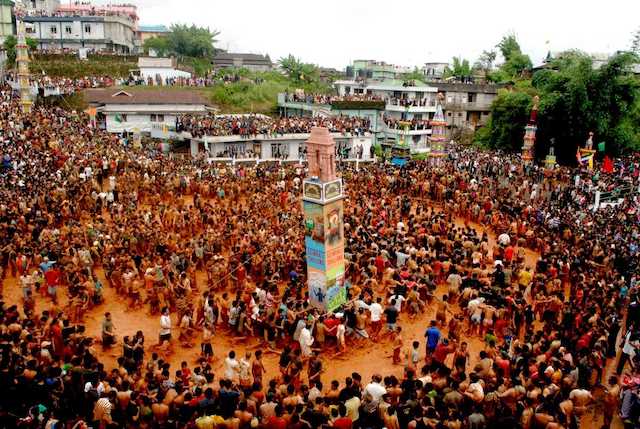
Over time, symbolic elements were added. The Ki Rong, elaborately decorated tableaux, once featured headless animal forms representing the presence of disease and misfortune, later transformed into artistic expressions of community identity. At the centre of the ritual remains Aitnar, the sacred pond of Jowai, where the rots are ultimately immersed signifying the return of disorder to the depths and the restoration of harmony on earth.
But Behdeinkhlam is not only a ritual response to disease or misfortune. It is also deeply rooted in kinship and creation. According to tradition, after the descent of humanity through the golden ladder (Ka Tangnoob Tangjri), U Lakriah was appointed as the custodian of divine instruction, ensuring that the laws of life were communicated to the people. At the same time, divine companions descended to earth. The Thunder God, Syiem Pyrthat, along with sacred stone deities and river spirits establishing a cosmic order in which nature itself participates in the well-being of humanity.
Within this sacred unfolding, the story of the Four Sisters- Ka Bon, Ka Teiñ, Ka Wet, and Ka Doh occupies a central place. As progenitrix of the principal clans, they represent the foundations of kinship upon which Pnar society rests. Their journey to Loom Sooyung in Jowai is remembered as the moment when divine order took root in human society, giving rise to the founding clans known collectively as the Phra Kur Phra Kmai.
From these ancestral roots emerged the social institutions that continue to define community life-the Dalloi, Pator, Langdoh, and other traditional custodians of faith and governance. In this way, kinship is not merely genealogical; it is moral and spiritual, binding individuals into a shared responsibility for one another.
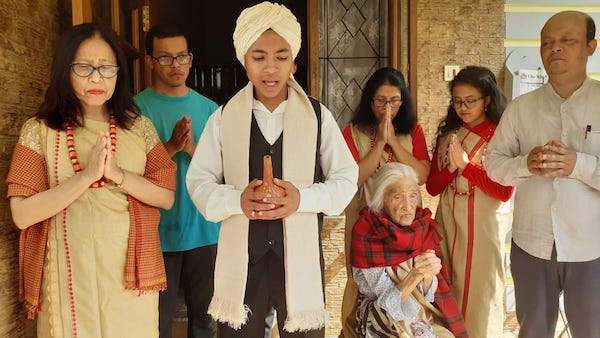
This philosophy is expressed most clearly in the teachings of Niamtre, which rests on three enduring principles: Kamai Yei Hok-to earn honestly and righteously; Tip Bru Tip Blai-to serve humanity as a path to knowing God; and Tip Kur Tip Kha-to honour one’s maternal and paternal kin. These principles affirm that spirituality is inseparable from daily life. One’s relationship with the Divine is reflected in how one lives with others.
The social ethics of Niamtre find further expression in Ka Sngi Kylliang Ka Nongkylliang, the obligation of mutual care within the community. This is not an abstract ideal but a lived practice, once beautifully illustrated in the tradition of E Ja Khonbo, where neighbours collectively supported a young mother nursing two infants. In such moments, compassion became social law, and care became worship.
Behdeinkhlam embodies these teachings in action. Every dong participates in the making of the rots. Every household contributes to preparation. Ritual offerings, libations, and ancestral remembrance reinforce the bonds between the living and the departed. The immersion of the rots at Aitnar is not merely symbolic; it is a collective acknowledgment that disorder must return to where it came from, allowing renewal to take place.
The festival unfolds over four sacred days, beginning with acts of collection and preparation, followed by sacrificial offerings at Aitnar, the cutting and erection of sacred wooden structures, and culminating in prayers, dances, and the final immersion ritual. At every stage, the presence of ancestors, deities, and community members is invoked, reinforcing a worldview in which life is continuous and interconnected.
In the modern world, new forms of khlam have emerged-loneliness amidst connectivity, disconnection within families, environmental degradation, and the erosion of cultural values. Against this backdrop, Behdeinkhlam acquires renewed relevance. It reminds us that true progress is not measured only in material terms, but in the strength of relationships, the integrity of values, and the depth of communal life.
As the drums once again echo across Jowai this July, they carry the memory of U Lakriah’s covenant, the blessings of the Four Sisters, and the enduring wisdom of Niamtre. They call upon a people not only to remember their past, but to live their values in the present.
For in the end, Behdeinkhlam is not merely a festival to be witnessed. It is a philosophy to be lived and a reminder that humanity flourishes when it lives in harmony with the Divine, with nature, and with one another.
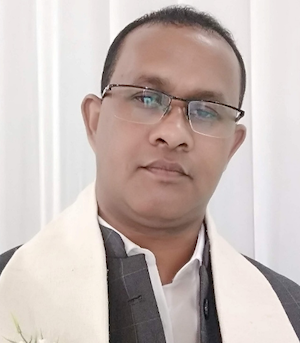
Dr Omarlin Kyndiah is an Associate Professor in the Department of Biochemistry at St. Edmund’s College, Shillong, India, where he has been teaching since 1997. Beyond academia, he served as General Secretary of Sein Raij Niamtre Shillong (Meghalaya) from 2008 to 2024, a congregation representing the indigenous Niamtre faith