
How does Himachal Pradesh perform in terms of women’s health when compared with its three neighboring states of Haryana, Punjab, Uttarakhand? (Uttar Pradesh is not accounted here because it shares a very narrow strip of border less than 15 kms. with Himachal Pradesh).
We look at the recently released sixth round of National Family & Health Survey (2023-24) report that provides data on the health condition of women in all the states and UTs.
The survey is a year-long mammoth data collection exercise that covers more than 6,50,000 households and interviews with over seven lakh adult women in 715 districts of the country. The scientifically conducted survey allows health experts and policymakers to gauge how each state and its districts have performed on 101 parameters. District level data of each state is yet to be released.
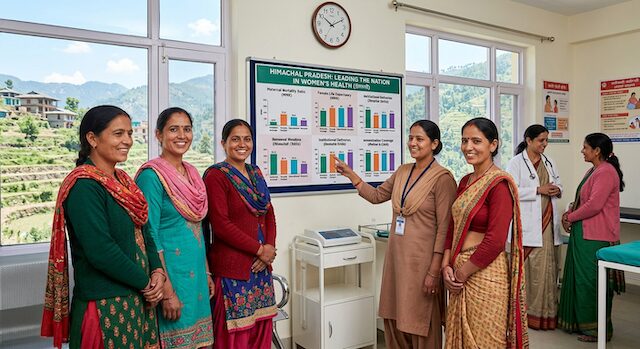
Overall, the performance of Himachal Pradesh is exemplary. On most health indicators related to women, the state does much better than the national average including the three states adjoining it. Only the five South Indian states of AP, Karnataka, Kerala, Tamil Nadu and Telangana perform better than HP on several health indicators.
The total fertility rate (TFR) in HP is one of the lowest in the country at 1.8 percent. In fact, this is much better than India’s TFR of 2.0. The three adjoining states have a TFR less than the national average with Punjab’s TFR being 1.6. TFR refers to the average number of children during a woman’s reproductive lifetime. It is a critical metric to understand population dynamics and forecast future growth or decline.
Wherever you live in India, some facts never really seem to change. In the case of Indian women, there are three intractable facts: fertilization, deliveries happening in private or public health facilities, and consumption of iron folic acid.
As for the first, female fertilization always exceeds male fertilization by a huge margin. In most states, male fertilization rates hover around 1 percent (or even less), but female fertilization rates jump to much higher levels. It is almost 37 percent in India, but scales up to 70 percent in AP, only to slither down to 33 percent in HP and 22 percent in Punjab. The reasons for the high female fertilization rate visa-vis male fertilization could be many, but why should a state such as HP also show the pattern that exists elsewhere is worth exploring.
The second fact has to do with deliveries. In all the big states of the country, deliveries by caesarean section is invariably higher in private health facilities than in public health facilities. For instance, the all-India average is 54 and 17 percent respectively; in HP it is 64 and 24 percent. The pattern repeats itself in the three adjoining states. Why should this be so? Is it because of the type of facility or is it because the clients prefer it?
Consumption of iron folic acid remains an enigma of sorts. The government mandates that a pregnant woman must consume it from the second trimester onwards for 180 days or more because of a growing fetus and tackling the problem of anemia in both women and the child. But this hardly happens. The data shows that at the all-India level only about 55 percent of women consume IFA supplementation for 100 days or more. That percentage drops woefully to low levels for consumption for 180 days or more. In HP, the drop is from about 82 percent to about 63 percent. The drop of about 20 percent is seen across Haryana, Punjab and Uttarakhand. In AP and Telangana — both Telugu-speaking states in South India, the drop is sharper.
The status of women, especially their body mass index (BMI) is an indication of the trajectory of development of the state. Like many developing states of the country, HP is also caught in what the WHO calls, the ‘double burden of malnutrition’.
While about 15 percent of the women in HP have a BMI below normal (that is, less than 18.5 kg/m2), more than double (38.2 percent) of that percentage of women are obese with a body mass index equal to or more than 25 kg/m2. Haryana (37.3) is in the same boat as HP but Punjab’s situation is worse with almost 45 percent of women being obese.
Women in HP and adjoining states do not fare better with high or very high blood sugar and elevated blood pressure. Like Punjab, the percentage of such women is about 20 percent. It is more or less the same situation with women with elevated blood pressure.
All these data clearly show that the country and states such as Himachal Pradesh have largely succeeded in addressing conventional health issues, but have to tighten up their efforts to now face the growing number of non-communicable diseases (NCDs).
is professor at IFHE University, Hyderabad.
Earlier he was the Research Director at Johns Hopkins Center for Communication Programs (JHUCCP) in New Delhi.