
How do children in Gujarat fare when compared to children from some other Indian states? The data from the recently released NFHS-6 (2023-24) for all the states and Union Territories is unequivocal.
Currently, over 35 percent of children in Gujarat under age 5 is stunted, meaning that the children’s height is shorter for their age. No other major state in the country except Bihar (35.6) and Meghalaya (36.8) surpasses Gujarat. Across the country, about 29 percent of children under 5 are stunted. In simple terms, Gujarat’s percentage is higher than India’s.
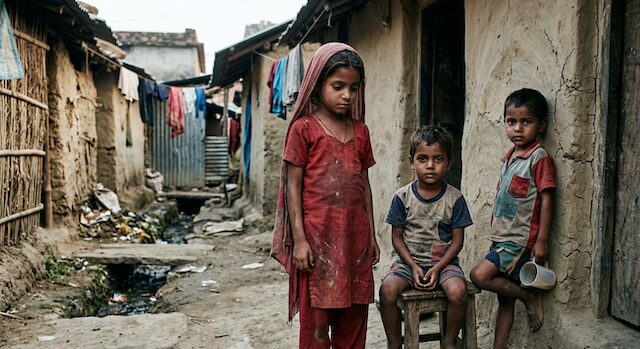
The reasons for stunting among young children are many but it is essentially a result of a combination of factors such as extreme poverty, early-life undernutrition and lack of sanitation. It is worth exploring why Gujarat and Bihar have about the same percentage of stunted children when the former is more advanced, industrially and economically, and the latter is not.
Gujarat does not fare too well in the case of ‘wasted’ children, meaning children under 5 whose weight is less for their height. According to NFHS-6, the all-India average of wasted children is 19 percent. This is slightly better than Gujarat’s percentage of wasted children (20.2). In Gujarat, about one child out of five under 5 is wasted. West Bengal’s case (20.3 percent) is no different from that of Gujarat.
On the other hand, all the five major south Indian states (AP, Karnataka, Kerala, Tamil Nadu and Telangana) do much better than either Gujarat or West Bengal in terms of young children that are stunted as well as wasted. As far as wasting among young children is concerned, the lowest percentage is found in Kerala (about 11 percent) with the highest in Karnataka (about 19 percent) — close to the national average. The reasons are more or less the same as for stunting and it is possible that in the case of wasting the child has had bouts of infectious disease(s).
In addition, NFHS also identified children under age 5 who are ‘severely wasted’ i.e. children who are dangerously thin for their height. In the entire country, 5.2 percentage of children belong to this category. Gujarat exceeds this percentage slightly (5.4 percent) as do Maharashtra (7.6), West Bengal (5.8) and Odisha (5.8). None of the five major southern states does so. These children or their families form the ‘invisible’ group. Neither media nor politics or policymakers refer to their condition. Whether stunted or wasted, children are the first victim of a development model that gives short shrift to deep-seated systemic inequality.
About 32 percent of the young children in the country are underweight. Gujarat again exceeds this percentage by four points (about 36). No other major state in the country exceeds this percentage except Jharkhand (41 percent) and Madhya Pradesh (40 percent). West Bengal does better at 28.5 as do other states such as Odisha (31.6) and Maharashtra (31.4). Bihar’s percentage of underweight children is about the same as Gujarat’s. Expectedly, the five South Indian states also do better. Why should Gujarat be found in the company of Jharkhand and Madhya Pradesh is a question worth asking.
The silent performer among the all the major states is Himachal Pradesh. The percentage of children in the state under 5 who are wasted, severely wasted, and underweight is less than half that of Gujarat’s. The percentage of stunted children is not half but considerably less at 20.6 percent and nearly matches the percentage of Kerala and Tamil Nadu.
Gujarat is a conundrum that is not easy to explain. It is hemmed in by states that on many counts are much better off. So why should Gujarat not do better than its neighbors?
Co-authors of the article are:
Sangeeta Shrivatava, a former researcher at John Hopkins Center for Communication Programs, New Delhi, is Co-author of the article.

is professor at IFHE University, Hyderabad.
Earlier he was the Research Director at Johns Hopkins Center for Communication Programs (JHUCCP) in New Delhi.