
 The Himalayas hailed as ‘Abode of Snow’ represent world’s youngest and highest mountains. Himalayan rivers like the Indus, Ganges, and Brahmaputra originating from lofty peaks are revered and considered as cradle of civilisations. These perennial rivers are lifeline of large populace spread across Himalayan realm and downstream areas. Moreover, mesmerising Himalayan Moutains are widely acclaimed for extremity, cultural diversity, spiritual significance, biodiversity, wilderness and amazing woodlands.
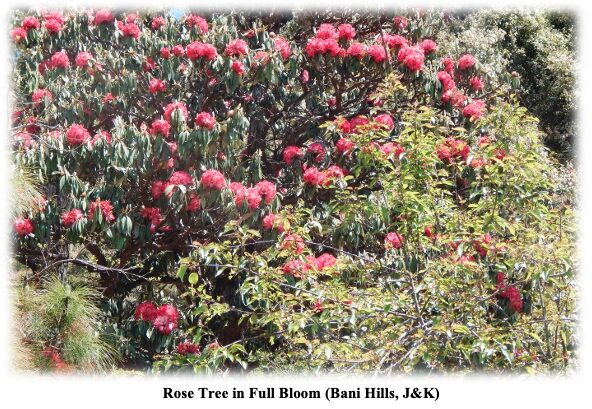
Indian Himalayan region (IHR) spans over a vast geographical area from west to east. Credited as crown of the country, majestic Himalayas are storehouse of plentiful biodiversity and harbours vast tracts of woodlands teeming with several arboreal species. Of these, some tree species stand alone due to distinct floral features. After adieuing harsh winters, the advent of spring stirs new life in nature. The season marks end of dormancy and initiation of fresh foliage, flowers buds in vegetation. Gradually, the entire plant kingdom rejuvenate with vibrant colours and fabulous flamboyance. Concomitantly, slopes and trails in Himalayan hills ablaze with crimson red flowers of Rose Tree (Lal Burans), taxonomically named as Rhododendron arboretum. March – April is the peak flowering season of this species. Rhodo tress loaded with full bloomed bright red flowers and trails dotted with trusses present spectacular view. It seems as Himalayan woodlands are celebrating nature’s carnival.
Diverse world of Rhodos in Himalaya
Indian Himalayan region (IHR) is a rich repository of rhodo species. Scientific studies report eighty species and twenty five sub-species from IHR. Rhodo species thrive in mountains of Jammu & Kashmir, Himachal Pradesh, Uttarakhand, Arunachal Pradesh, Sikkim, Manipur, Meghalaya, Mizoram, and Nagaland. Actually, north eastern part of IHR is more Rhodo rich in comparison to its western counterpart. States like Arunachal Pradesh and Sikkim harbours unbelievable diversity. Sikkim is the finest stopover to watch the rhodo spectacle in India. It has specially designated protected areas for rhododendron – Barsey rhododendron sanctuary in West Sikkim and Shingba rhododenderon Sanctuary in north Sikkim.
Rhodos……. as …………beautiful………. botanical Riddle
Distinctly, rhodos exhibits remarkable diversity, wide distribution, adaption and unique phenological/floral characters. Rhododendron represents largest genus of Heath (Ericaceae) family having above thousand spcecies. It shows high degree of hybridisation leading to occurrence of multiple variants even in natural settings. Thus Complex and confusing taxonomy makes it a paradoxical taxon.
Red Rhodo (Lal Burans) …….. Celebrity status …………..Ecological significance
Attributing to dazzling floral beauty, Lal Burans (Rhododendron arboretum) holds iconic status in IHR and vicinity. Rhododendron arboretum is the state flower of Nagaland (earlier of Himachal as well) and state tree Uttarakhand. A 108 feet tall Rhodo tree in Kohima hills is recorded as World’s Largest Rhododendron in Guinness World Records. Besides, the species is national flower of Nepal. In forest ecosystems red rhodos co-exist with oaks, myrtles, and conifers forming a robust tree community structure. It is the keystone species of Himalayan ecosystem which provides habitat for wild life, main-stains watershed health and stabilises soils. Rhododendron arboretum (Lal Burans) is also deemed as indicator species of climate change.
Rhodos of Himachal Himalayas
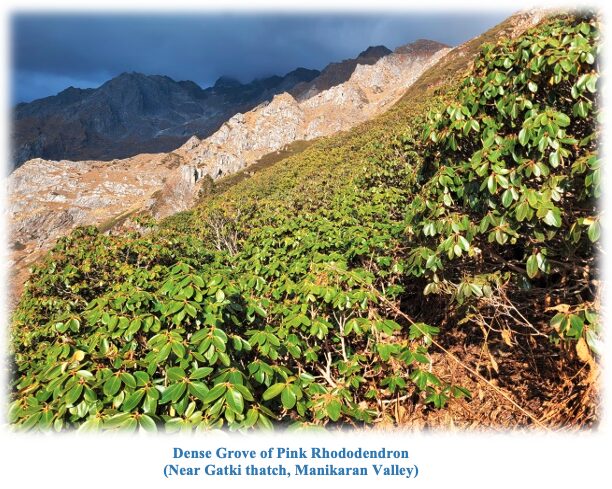
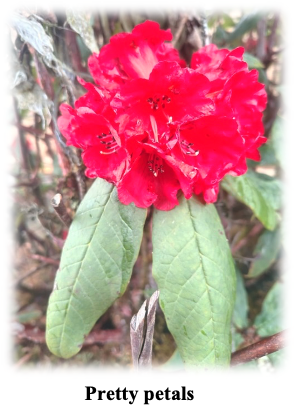 Himachal Hills are adorned with four species of rhodos (Rhododendron) distributed from temperate to alpine zones. Chansal Valley, Barot Valley, Great Himalayan National Park (GHNP), Parbati Valley and Chamba-Pangi Valley are prime locations. Triund trek in Dharamshala is very popular destination to experience the colourful Rhodo magic in Himachal Hills. Of the four species only Lal Burans (Rhododendron arboretum) is most widely found and other three occur in high altitude areas. Rhododendron anthopogon and Rhododendron lepidotum is dwarf species of rhododendron found in alpine regions.
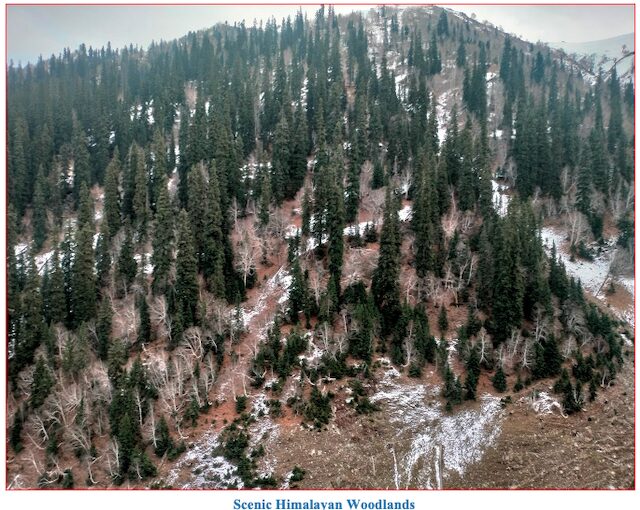
Rightly, Rhodos are integral component of montane forests. Else than aesthetic aspects, rhododendron are culturally and ecologically very important. Actually, rhodos symbolise rich biodiverisity of Himalayan Woodlands. Stepping into Himalayan woodlands unfolds the resplendence of rhodos.

With over 15 years of experience in Forest Ecology, Soil Analysis, and Herbarium methods, Dushyant Kumar, from Himalayan Forest Research Institute (HFRI), Shimla, has published research and technical papers related to Plant diversity, Forest Soil Properties and Medicinal plants.
Preferring to stay close to nature life cycles, he is a staunch supporter of sustainable management of nature’s resources of forests, land and rivers.

This beautifully written piece captures the soul of Himalayan spring with remarkable clarity.
A thoughtful and evocative reflection that lingers like the fragrance of the blooms.