
Last week, my kitchen—and a part of my routine—fell silent. My maid of ten years, Hazra, went back to her hometown and didn’t return. It was all planned—she had even arranged a replacement—but during the handover, the new maid decided the work was “too much.” Since then, I’ve had a revolving door of maids—number three and counting—each more unpredictable than the last.
Suddenly, I’m doing everything myself again. It feels like the COVID days—only this time, without the novelty or the patience.
“A robot vacuum would never do this,” friends tell me. “And it won’t vanish right before festive cleaning—or just as guests are about to walk in.” They call it freedom—machines that quietly work, no leave, no excuses, no drama. Efficient, dependable, emotionless.
Tempting… and yet, something feels missing for me.
Machines stay. People show up.
Childhood: When Care Became Companionship
In Shimla, my brother and I were often left at home while our parents attended social gatherings. Those evenings could have felt long and empty, but they never did—because we had Parasram.
He didn’t just watch over us; he stepped into our world. Ramlila outings, Ravana burning, and most importantly, stories—endless, vivid, and magical. I can still see us sitting beside him, completely absorbed, waiting for the next twist.
He didn’t just pass the time—he shaped it. Childhood, after all, is built on moments like these.
I watched him cook, fascinated. In a burst of curiosity, I once tried smoking a beedi, copying him—only to hate it instantly. Some experiments fail fast. Some lessons stay.
Those steady hands carried us into the next phase of life.
My Twenties: Growing Together
In Delhi, Nomesh entered our lives quietly but steadily. He came from Himachal with no experience, but a willingness to learn everything from scratch with my mother.
Over time, he became indispensable—reliable, sincere, and deeply invested in the home. By the time I got married, he wasn’t just supporting the household; he was holding it together.
After years of service, my father helped him secure a government job—a quiet way of giving back to someone who had held our home together. From there, we watched his life expand—his children growing up, studying, settling, and now building families of their own.
He still visits during festivals, helping my mother make roths, slipping effortlessly back into rhythm. Some relationships don’t fade—they evolve.
We’ve seen him build a house, buy a car, and create a life of dignity.
After Marriage: Becoming Part of an Existing Bond
Then there is Bhup Bahadur—our Chotu—who has been with my in-laws for over forty years. He came as a young boy from Nepal, leaving his own family behind, and over time became central to ours.
His cooking is legendary—aloo paranthas, yakhni, rogan josh—each dish carrying familiarity, comfort, and care. But what defines him isn’t just skill; it’s presence.
When we visited Srinagar, the way he looked after our children felt effortless—almost parental. Even now, he video calls to show us the garden—flowers blooming, fruits growing, seasons changing. “Sab tayaar hai… ab toh aaiye,” he says, gently pulling us back.
No gadget sends reminders like that. No machine builds that kind of belonging.
On our part, we ensured his son studied in the same school as my husband and brother-in-law. It mattered to us that opportunity travelled both ways. Today, his son is studying engineering in Korea, carrying forward dreams that have grown across generations.
When my father-in-law passed away, Chotu performed the last rites like a son—because in every way that mattered, he was one.
Bangalore: Learning, Struggling, Growing
Bangalore changed everything—and somehow, his recipes travelled south with us too. We moved from a joint family to a nuclear setup, and suddenly, all responsibility sat squarely with me—along with a one-year-old daughter and a demanding job.
The most unexpected challenge? Cooking.
That’s when Hemraj came in—and neither of us knew what we were doing. We learned together, armed with cookbooks and optimism. Some meals were successes. Others… were quietly retired, never to be spoken of again.
When my in-laws visited, Chotu spent time with us, and together we carefully noted down Kashmiri recipes. That’s how our little recipe book came into being—equal parts instruction manual and emotional archive.
At one point, Hemraj got married and brought his wife to Bangalore. She delivered their baby while living with us, and for a while, all of us shared the same small space—life was cramped, chaotic, and constantly in motion. In my apartment complex, I was known as the lady with “a family of four and three staff.” My neighbours probably thought I was very rich to afford such a “lavish” life.
When she was expecting again, we quietly admitted that four adults and four children under one roof might be a bit too ambitious. Practical decisions had to be made.
Eventually, Bemolee stepped in and managed everything seamlessly. During years when both my husband and I were constantly travelling, she kept the house running—meals, school routines, forgotten lunchboxes, everything.
They didn’t just manage the home. They made my working life possible.
My Mother’s Home: Beyond Employment
Even in quieter chapters, these bonds endure. After retirement, my parents moved to Greater Kailash, where Vishnoi entered our lives—a sixteen-year-old who had run away from Nepal with a baby and needed stability more than anything else.
Fifteen years later, she is still with us. We’ve watched her journey—struggles, setbacks, rebuilding her life, raising her daughter, and educating her children despite being illiterate herself. Today, her daughter is working, and her son is in school.
My mother is deeply woven into their lives—school projects, homework, PTAs, even the occasional family squabble. She helped her open a bank account and nudged her towards saving, though she still prefers her committee system.
In turn, she is not just help; she is cook, caretaker, and companion rolled into one. After my father passed away, my mother lives alone, but never in isolation. The family shares the home—bringing conversation, movement, and the reassuring rhythm of everyday life.
It is no longer employment. It is companionship.
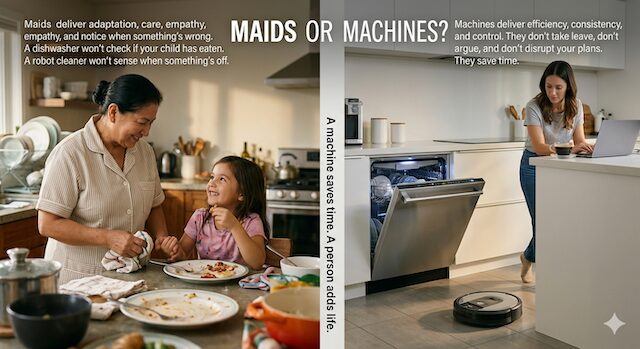
So… Maids or Machines?
Machines deliver efficiency, consistency, and control. They don’t take leave, don’t argue, and don’t disrupt your plans.
But a dishwasher won’t check if your child has eaten. A robot cleaner won’t sense when something’s off. They don’t notice. They don’t adapt. They don’t care.
A machine saves time. A person adds life.
Yes, people come with unpredictability—moods, leave, imperfections. But then… so do we.
Where I Stand
For now, I choose people. Not just because they support us—but because of what we build together.
Hands that serve become hands we lift—creating shared journeys and shared pride.
There is so much to learn from their resilience, their ability to endure hardship, and still show up with dignity. There is also a quiet, lasting joy in seeing their lives evolve—watching their children grow, study, succeed, and step into opportunities they once didn’t have.
When support flows both ways, something deeper takes root—something that stays. Maybe one day I will fully embrace automation. But not just yet.
Machines can run a house. Only people can make it feel like one.
What about you—who in your life quietly turned work into family?

Iti Mattoo, retired after 30 years in the IT industry, now enjoying her creative pursuits.