
For much of the period of British Raj, Shimla or Simla was the summer capital of India where the high and mighty of the subcontinent stayed for most of the year. Beautiful cottages and bungalows were built over the seven hills that constituted the salubrious hill station to house the officials – both civil and military. Later many of these elegant English style houses; many of whom had bombastic suffixes like ‘castle’ were acquired by Indian nobility for whom the door was opened though reluctantly. As the fate of millions of Indians was decided from Simla, it was the seat of many a monumental decision over some eight decades. Many notable people lived in these Simla houses and have left lasting legacies which are worth remembering and revoking. I would like to trace and pen down the beauty of these houses, personality of their owners and interesting incidents to which they were home. The icing on the cake is that the current occupants of these dwellings are themselves mostly very social and interesting personalities having been brought up in the company of men and women who guided the making of India.
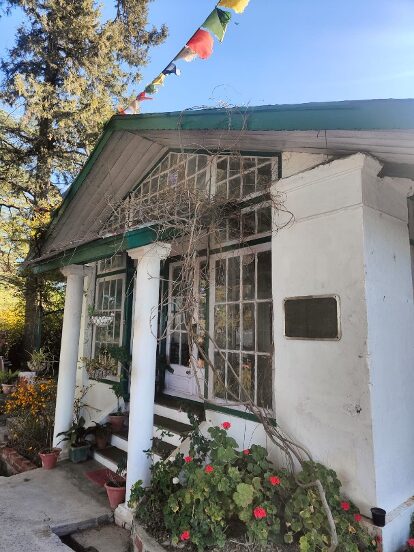
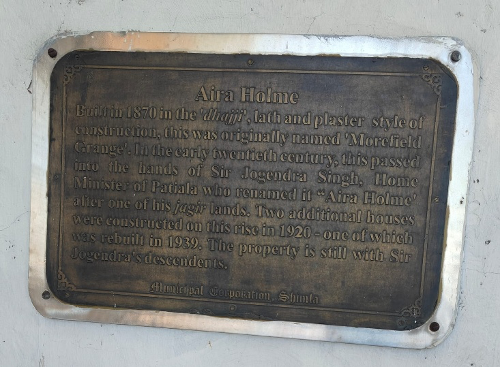
One fine morning, during my walk in Chhotta Shimla I decided to explore “Aira Holme’ the colonial era house on the spur. It being advertised as a home stay made my intrusion permissible. As I ascended the approach road beyond the old iron gate, I reached the entrance to the house which was covered by tall paned glass windows with flower pots adorning the stairs.It was a typical ‘Dhajji’ structure and the walls were made of braced timbrer frame filled with stone masonry and mud mortar to create lightweight, earthquake resistant walls. An original antique brass letterbox was embedded in the wall reminding of a bygone era. A brass plaque of Municipal Council fixed on the wall announced that the house once belonged to Sir Jogendra Singh, KCSI. I had never heard of the gentleman (unknown to me then, he turned out to be such a towering personality that I was forced to write this blog to introduce him to you – my fellow Simlaites and compatriots.
As I proceeded further and turned the corner, I was suddenly in front of a senior lady with a tall cup of tea on a garden Jhoola! She looked like straight out of bed and with a hint of surprise, returned my Namaste. As I expressed my apologies for intrusion she relaxed and very kindly invited me to have a cup of tea with her. She was Mrs Maheep Kaur, owner of the house and wife of Late Mr Sangram Singh – Grandson of Sir Jogendra.
‘Sir Jogendra was a truly great man’ she said. ‘He was on the viceroy’s executive council- the highest governing body and chairman for Departments of education, health and land. For his far reaching contributions in various fields, he was knighted twice – first in 1929 and then in 1946 as ‘Knight Commander of the Star of India’. It was he who bought this property from an English man in 1911. That time, the house was called ‘Morefield Grange’. The house was rechristened ‘Aira Holmes’ after Aira estate he inherited in Lakhimpur Kheri. Aira was a huge estate of 12000 acres bestowed by the British as jagir upon Panjab Singh, grandfather of Sir Jogendra for military assistance after annexation of Punjab and especially during the 1857 mutiny. Panjab was a cavalry commander in Maharaja Ranjit Singh’s Army. He belonged to same Sukerchakia misl as the Maharaja’.
I sipped the refreshing tea and tried to absorb the torrent of information.
‘ The Aira family has a huge ‘Aira estate’ in England and till recently we were in touch with them’.
I looked around and was surprised to see the unhindered view of Taradevi and the ranges towards south of Shimla.
‘Its a 360 degree view thats rare in Shimla’ said Maheep. ‘Sir Jogendra had an option to buy one of three properties – Oak over, Starling Castle and Morefield Grange. He stayed in the Viceregal estate complex then. On his horse he would visit all 3 for six months to analyse the direction and duration of sun in all weathers. Then he decided in favour of this property. The house is comfortable in all seasons, has a great view, is surrounded by Deodars and has enough flat area around – see how well these colonial houses were sited. We are so lucky. Second wife of Sir Jogendra was Lady Winifred May Singh who was Irish – thats why ‘L’ in ‘Holme’.
I confessed I had never heard of the great man.
‘ He was amongst the top people of his time. His contributions are lasting and in myriad fields. He as in-charge of Agriculture, brought about vast improvements in Punjab. Being a big landlord helped. He planned expansion of irrigation.You would be surprised – first tractor in India came to Aira estate! It was a Ferguson’!
I took another sip.
‘ The IITs you see – he was involved in their conceptualisation’
‘ Sorry ma’am but IITs were Nehru’s brainchild. And they came up post independence’.
‘That’s part true. IITs; rather Kharagpur IIT was conceptualised and finalised before independence by a committee of experts under Sir Jogendra’.
‘He had been Home Minister and later Prime Minister of Patiala state. he was also involved in administration of Mandi state and it was then that he planned the hydroelectric unit in Joginder Nagar’. This early power plant led to development of irrigation facilities in Punjab and also provided power for establishment of hosiery industry in Ludhiana’.
‘You mean the ‘Shanan Project’.
‘Yes! and I hope you now know why the place is called Joginder Nagar’.
‘That can’t be true! I thought its in honour of some Mandi Raja.’.
‘Oh no! trust me. You can research it. The township was developed to house the engineers and workers of the power plant’ said Ms Maheep.
‘Sir Jogendra had no formal education but he was a self taught expert of English, Punjabi, and Persian. He wrote a number of books. Notable among them are – ‘Sikh Ceremonies’, ‘Thus Spake Guru Nanak and ‘Persian Mystics (forward by Mahatma Gandhi). He also wrote fiction. He was the founder of ‘Khalsa National Party’ thus contributing immensely to early Sikh politics in pre independence era’.
‘I was lucky to get married in this family. I got the house with a mali, a cook, a darzi, a khidmatgar. Simla then was refuge of the elites during summers. There are bungalows owned by many noble families around us. There used to be great bon homie. We used to have parties and picnics. At times whole extended family used to land up from plains. We even acted in a movie by name ‘Staying On’ starring Trevor Howard and Celia Johnson. Its based on a booker winning novel of same title by Paul Scott. It was shot in a friend’s villa in Mashobra in late 1970s. I like meeting people and what better way than hosting them? So I run this home stay with 5 rooms. I have maintained the house in its original English manner. European travellers especially like it and spend a month or so with us. I restored all furniture that was part of the house – my mother-in-law nick named me ‘Nek Chand’ due to my penchant for restoration’ she laughed.
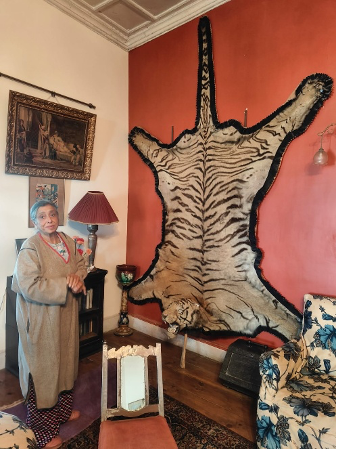
Later Ms Maheep gave me a tour of the beautiful house furnished with original colonial furniture maintained scrupulously. The house is adorned with portraits and photographs of Sir Jogendra’s family and is a veritable treasure house of history. The walls are decorated with original watercolours of pheasants. A corner of the sitting room wall is taken over by a life size huge tigress skin – the blood shot eyes staring ferociously at you.
‘It was a notorious man eater in Aira Estate. Sir Jogendra shot her after tracking her assiduously over a week to much relief to the villagers’ Maheep told me. ‘ The trophy was processed by the celebrated taxidermists – ‘Van Ingens’ of Mysore – they were most sought after for doing these trophies during the Raj. Our family boasted of great shots. Hunting was permitted then and was well managed. At one time we held 40 firearms’!
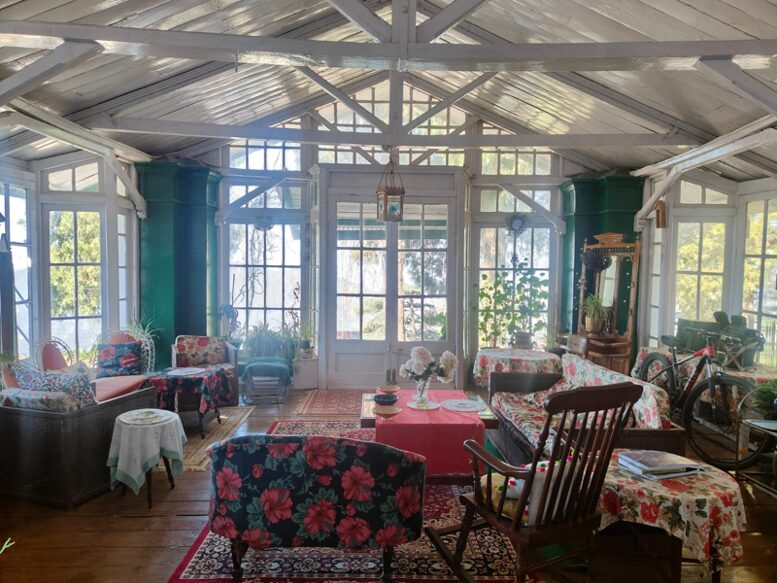
Whole bungalow exudes warmth and nostalgia. Maheep has maintained the bungalow in its original glory with colonial era furniture and retro upholstery and linen. The functional fireplace in the sitting room must be such a delight in winters – I thought. And there I saw something that I never new existed – ‘A Coal Scuttle’ – a brass box inside sitting room to hold coal for the fireplace! The entrance to the bungalow is a glass paned hall adorned with colonial furniture – originally it was meant to be a sun room to maintain the potted plants during harsh Simla winters. All colonial houses have these. Up under the high CGI sheet roof is hidden a spacious attic that holds 4 bedrooms and a hall which are let out.
‘You know among the interesting people who have lived here is Priety Zinta. It was when some 10 girls of St Bedes College were put up here with me as guardian. I tell you I had a tough time guarding the beauty from local boys who would follow. She was such a pretty girl’!
Hmm. Preity has surely made us Shimla people proud. A rare beauty with brains as well as Brawn she is !! Many hill lasses have followed her footsteps since to hog the limelight.
Amidst the mad hustle and bustle of the ‘bursting at its seams’ – Shimla, there still exists the sylvan Simla – if one explores. Behind a wild Bamboo hedge; or a CGI sheet boundary wall; in scattered bungalows and cottages ensconced under the whistling canopy of Deodars. Waiting to be discovered – to transport you to a forgotten, exotic era. And there, more often than not, you will come across some forgotten ‘Star of Simla’ like Sir Jogendra!
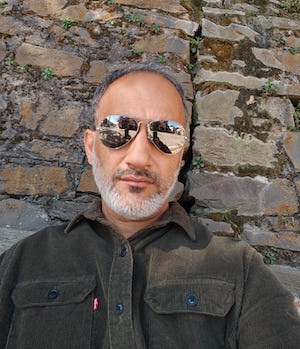
Dr Vikas Thakur is a Veterinary Pathologist who has worked extensively all over India, especially in the Himalayan region. A keen observer and thinker, he is much interested in local history, societal issues , nature and anything that arouses curiosity. After spending 4 years in Kashmir, he came out with his experiences and understandings of this most interesting region in the form of a critically acclaimed book -‘Pax Kashmir’ this year. A native of Shimla, he is currently based in Chandigarh. Besides reading and writing, he likes to spend his time Riding and Golfing.
He is currently – Executive Committee Member, Equine Welfare and Medication Control, Equestrian Federation of India.

Fit enough to be a chapter of a history book in the State Board. Col Vikas has a knack for researching historical facts where ever he is posted, I am a witness to this.
Great reading indeed. We know so little about our own heros.
Truly, you took a very good initiative.
Thank you Vikas for introducing such people and architecture, especially to Shimalites including me, who’re unaware of all these entities.
It is both well researched and wonderfully interesting. You already displayed penchant for penning similar historical and heritage related essays. This is, certainly, one of your best.
Keep up the excellent work, Vikas. Your fans including me have absorbing interest in your articles.
Excellent narrative about a star of Shimla and his abode. Memories are ment to be cherished but credit goes to the author who takes the initiative and bring out the memorable and interesting facts for educating people of present generation.
My compliments to you dear Col Vikas.Keep your pen flowing for many more prodful personalities.
Maj Gen BS Panwar
It never surprises me that with every article written and with time and travel Col Thakur is fast learning and developing amazing writing skills. This particular story gives glimpses into a Simla we tourists dnt know or rather don’t explore. Good work Thakur Shaib.
Well written Col Vikas…Congratulations…every time it is great to read your material…we all really appreciate…Kudos…
Kissaagoi aur sajeev chitran ki kalaa koi Col.Vikas Thakur se seekheiy.
Everything makes you feel as if you are also walking along with him .
So beautifully presented.
Very interesting story. Keep it up sir