
Indian television still asks viewers for only one thing — complete surrender of logic.
Heroes die and return after plastic surgery, yet nobody recognizes the same voice or mannerisms. Villains openly confess evil plans while entire families remain magnificently clueless. Women sleep in full make-up, heavy jewellery and perfectly ironed chiffon sarees, only to wake up looking fresher than bridal models.
And somehow, snake women still have stable employment on Indian television.
At this point, most people under sixty do not actively “watch” daily soaps anymore — they merely walk past the television while their mothers or grandmothers remain emotionally invested in episode number 4,327.
A fantasy concept in a two-hour movie can be entertaining. But when one misunderstanding survives longer than most marriages, patience becomes a spiritual exercise.
Relationships too became exhausting. Saas-bahu dynamics were constantly shown as toxic battlefields filled with manipulation, suspicion and emotional politics. Younger viewers, growing up with healthier expectations of relationships, found it difficult to connect with this endless negativity.
One person says, “I need to tell you something important.”
Three hundred episodes later, the conversation is still pending.
So audiences quietly started looking elsewhere for stories that felt more honest.
When Indian Television Actually Brought Families Together
Which is ironic, because Indian television was not always like this.
Shows like Hum Log, Buniyaad, Yeh Jo Hai Zindagi and Nukkad were simple, warm and deeply relatable. They reflected middle-class struggles, humour, relationships and moral values without preaching.
And then there were Ramayan and Mahabharat. Sunday mornings during those broadcasts felt almost like curfews. Roads became empty, families gathered together and television became a shared cultural experience.
The stories had emotion, values and sincerity. Somewhere along the way, however, storytelling became louder than feelings.
Disappointed with what television had become, many viewers quietly started looking elsewhere for better stories.
Hollywood Was Smart… But Emotionally Cold
Western shows offered realism, fast pacing and strong writing. But for many Indian viewers, they still lacked emotional warmth.
Sometimes the relationships felt too detached.
Sometimes the humour felt too cynical.
Sometimes the stories felt impressive but emotionally distant.
You admired them. But you did not necessarily feel comforted by them. And somewhere between exaggerated melodrama and emotional detachment, Korea found the perfect balance.
K-dramas also arrived at the perfect streaming moment. Episodes were shorter, stories were finite and viewers no longer needed to emotionally commit to 1,200 episodes and three reincarnations.
Enter K-Dramas: “Annyeong” to Emotional Addiction
“Annyeong” — the Korean word for “hello” — quietly entered our vocabulary, followed by “Saranghae” (I love you), “Gomawo” (thank you) and “Aigoo!” (oh no/oh dear).
Before long, many of us were slightly bowing while saying thank you and discussing kimchi like lifelong experts. I still remember watching Crash Landing on You for the first time. What started as “one episode before sleeping” became emotional dependence. This is the dangerous thing about K-dramas: they do not merely entertain you — they emotionally adopt you.
Hyun Bin smiling politely became enough to restore global faith in humanity. Then came the inevitable phase of searching for interviews, behind-the-scenes clips and every drama featuring him.
The same happened with Lee Min-ho. One series later and suddenly Seoul starts looking less like a country and more like an emotional destination.
But beautiful cinematography alone is not what made audiences stay.
The Revolutionary Discovery: Men Who Are Actually Nice
Perhaps the biggest shock K-dramas gave audiences was this: the hero was kind. Not aggressive or emotionally unavailable or shouting every three minutes.
K-drama heroes cook meals, remember tiny details, apologize sincerely and stand quietly beside people during difficult moments.
Apparently, basic emotional maturity is now peak romance. No helicopters. No dramatic shirt-tearing fights. No backup dancers appearing from forests. Just ramen, rain and emotional support.
And perhaps that emotional sincerity is why the romance feels so different.
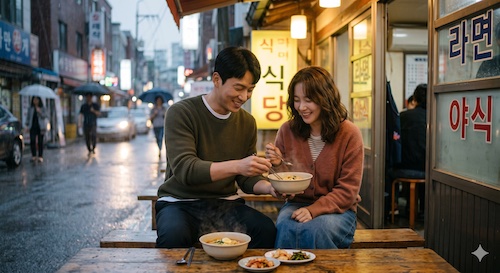
Romance Without Vulgarity
One of the most surprising things about K-dramas is how romantic they feel without relying heavily on explicit content.
A simple hand-holding scene creates more excitement than entire Bollywood rain songs. A shared umbrella becomes cinematic. One emotional stare across a room becomes unforgettable.
Korean dramas understand something modern entertainment often forgets: emotional intimacy is far more powerful than shock value.
Yet romance alone cannot explain the deep emotional connection audiences feel.
Family Values Without the Lecture
Another reason K-dramas connect deeply with Indian audiences is their emotional sincerity toward family.
Parents matter. Friendships matter. Loyalty matters.
But unlike many serials, these values are shown quietly and naturally.
Take When Life Gives You Tangerines for example. It portrays ordinary life, relationships and struggles with such heartbreaking honesty that both my daughter and I — watching separately — later admitted to shamelessly sobbing multiple times.
The acting feels so natural and real that the emotions stay with you long after the episode ends.
That is the power of these dramas. They create emotional connection without manipulation.And somehow, this emotional honesty survives whether the story is romance, fantasy or suspense.
Every Genre, Somehow Brilliant
What is even more impressive is that Korean dramas seem to succeed in every genre.
Romance? Crash Landing on You.
Mystery and suspense? Signal.
Historical drama? Mr. Sunshine.
Fantasy? Goblin.
Medical drama? Hospital Playlist.
Slice-of-life comfort? Reply 1988 feels like a warm hug from another era.
No matter the genre, the emotional sincerity remains constant.
Once audiences discovered this storytelling style, the Korean wave became impossible to ignore.
The Only Problem With K-Dramas…
Maybe the secret behind K-dramas is actually very simple: they make people feel. In a world of exaggerated plots and endless drama, they brought back sincerity, emotional warmth and characters people genuinely care about.
The only issue?
They have completely ruined romantic expectations. Now everyone wants someone who looks like Hyun Bin, communicates like a therapist, stays loyal for life and waits emotionally in the rain with ramen.
Real people never stood a chance against writers who gave fictional characters emotional intelligence, good hair and perfectly timed umbrellas.
P.S. If you have never watched a K-drama before, this is your sign. Just remember: “one episode” is a scientifically proven lie.

Iti Mattoo, retired after 30 years in the IT industry, now enjoying her creative pursuits.

So relatable as my family is into K entertainment. Great sense of humour.
You are awesome my dear!!
Proud of you💕💕
yet to watch one