
The status of widows in Spiti Valley, rooted in Tibetan Buddhist traditions, sharply contrasts with historically patriarchal lowland practices.
Mohan Bropta, a resident of the valley says that rather than facing severe restrictions, widows in Spiti are generally treated with respect and provided social safety nets.
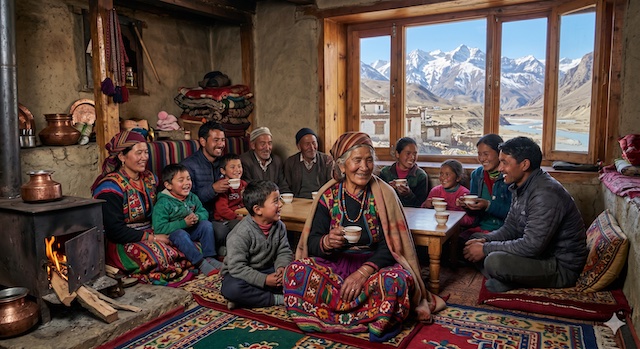
“Unlike many traditional Hindu communities where widows are barred from auspicious events or expected to wear only white, Spiti widows continue to wear colorful clothing and jewelry, actively participating in all community, religious, and social functions,” said Borpta.
He added that in extended families once the eldest son marries and takes over the household, elderly parents (including a widowed mother) often move into a smaller attached house known as the Khang-chung. This transition ensures the younger generation has full authority to manage the main household, while the widow retains an independent, respected living space supported by family yields.
Bropta said that according to Hindu tradition, a widow cannot remarry. She has to hide in the house, remove her jewellery and wear the color of mourning. She becomes a source of shame for her family, loses the right to participate in religious life and becomes socially isolated.
Many widows are either thrown out by or escape from their in-laws – with whom they usually lived – and head for the big cities, where they often disappear.
Kamleh Bodh, a resident of Lahaul says that widows or unmarried women in the region traditionally have the option of joining nunneries (such as the prominent Sherab Choeling Nunnery). Bodh further said that this provides them with a structured, respected role within the community where they can dedicate their lives to Buddhist philosophy and meditation.
He said that while Spiti’s widow culture allows for deep social inclusion, its strict customary inheritance laws have historically been patriarchal.
Under traditional Wajib-ul-Arz (or Riwaz-e-Aam) laws, ancestral land is passed down strictly to male heirs to prevent tribal lands from being transferred outside the community,” said Bodh.
He added that for decades, women’s rights groups in the Lahaul-Spiti and Kinnaur districts have actively campaigned for the right to inherit ancestral property equally under the Hindu Succession Act of 1956, which generally exempts Scheduled Tribes. The legal landscape has seen fluctuating verdicts, with recent judicial rulings reaffirming the primacy of traditional customary inheritance over the national act.

Sanjay Dutta, an engineer by qualification but is a journalist by choice.
He has worked for the premier new agency Press Trust of India and leading English daily Indian Express.
With more than a decade of experience, he has been highlighting issues related to environment, tourism and other aspects affecting mountain ecology.
Sanjay Dutta lives in a village close to Manali in Kullu valley of Himachal.