
A rare sighting of a Bengal Tiger was caught on a camera trap in a forested area of Paonta Sahib in Sirmaur region of Himachal Pradesh.
Wild life lovers and forest department wardens are excited about the Tiger sighting, holding it as healthy sign of wild life and forest conservation in the region. The trap camera clicked the tiger in its natural environs on the evening of 15th June, 2026.
Following the sighting, the wild life wardens conducted a survey of the forest and found fresh tiger claw markings on several trees in the area.
Paonta Sahib wildlife warden Aditya Sharma has advised migratory Gujjar and Gaddi tribesmen to avoid their seasonal visit to these forests as it disturbs the animals. “Tigers are solitary creatures and generally avoid humans,” said Sharma. “They prefer undisturbed habitats,” he added.
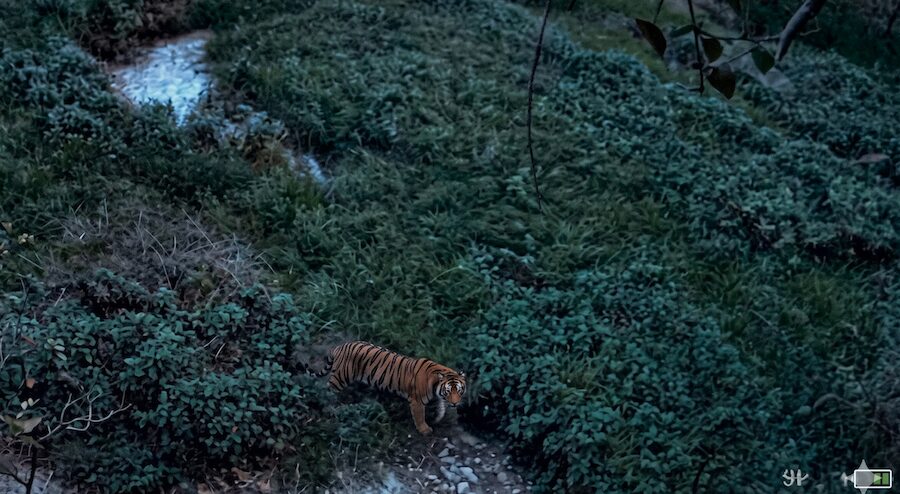
Where the camera trap picture has confirmed the presence of a tiger, locals have been claiming to seeing the tiger over the past year.
As this forested area is in near proximity to the Rajaji National Park of Uttarakhand which has a healthy population of tigers, elephants and other animals, it is being felt that this tiger has frayed out into the Sirmaur forests.
It’s not the first time that a tiger has been sighted in Sirmaur forests. In February 2023 a tiger was photographed in Simbalbara Wild Sanctuary, which is about 7 Km for the site of the this sighting.
In the neighbouring Himalayan state of Uttarakhand, the protected sanctuaries of Jim Corbet National Park and Rajaji National Park have rich wildlife with a healthy population of tigers. However there are no forest reserves in Himachal Pradesh with a resident tiger population.
Sirmaur being in the Shivalik range of the Himalayas has however, thrown up evidence of the extinct sabre tooth tiger in the rich fossil remains that have been discovered in the belt.
Bengal tigers are apex predators that primarily hunt large herbivores such as sambar and blue bull. They require dense vegetation for stalking prey and dependable water sources, making their presence a strong indicator of suitable habitat conditions.
The Bengal tiger is listed as Endangered on the International Union for Conservation of Nature (IUCN) Red List. It also receives the highest level of legal protection in India under Schedule I of the Wildlife (Protection) Act, 1972.

As Editor, Ravinder Makhaik leads the team of media professionals at Hill Post.
In a career spanning over two decades through all formats of journalism in Electronic, Print and Online Media, he brings with him enough experience to steer this platform. He lives in Shimla.