
Introduction
With some apple growers continuing to plant apple trees on seedling stock, this article argues the case for planting all apples on dwarf rootstocks: The basic thesis is that apple trees on seedling stock are inherently unproductive, and take about twice the time, about 10+ years, to produce harvestable apples; trees on dwarf rootstock produce marketable apples in five years or less. This article is based on the experience and data from a major, 2007-2025 rejuvenation effort at Harmony Hall Orchards, in which 25-50-year-old apple trees were cut from about 20 ha (50 acres, 250 bighas) of apple orchard on seedling stock, and replaced by new varieties on dwarf rootstocks – spur Red Delicious on EMLA-111 virus-free clonal rootstock, four sports of Gala (as pollinizers) and two sports of Fuji on M-9, EMLA-7 and M-9/EMLA-111 interstem rootstocks, and Honeycrisp, Jonagold, Golden Delicious, McIntosh, and Hyslop on different dwarf rootstocks.
At that time, because they were known to have shallow roots, there was great reluctance to plant high-density orchards on M-9 rootstock: To evaluate their viability, about 175 trees of several sports of Gala and Fuji on M-9 and Bud-9 rootstocks were planted in 2008. Experience over 17 years has shown that, in clayey soils, these high-density plantations have been productive without any irrigation.
The Case for Dwarf Rootstocks
The narrative in this section is based on data from a 3.2-ha (8-acre, 40-bigha), west-facing orchard at an elevation of about 2,135 m (7,000 feet), in which the trees are accurately aligned on a north-south axis, allowing for solar exposure on both sides of the trees. The high-density plants on M-9 and Bud-9 rootstock are spaced at 1.5 m (5 feet); the spacing between the rows is 3.4 m (11 feet). The plant-to-plant distance in the medium density plants on EMLA-111, EMLA-7, and M-9/EMLA-111 rootstocks is 3 m (10 feet); the spacing between the rows is 2.4 m (18 feet). All the trees in this orchard were planted in 2010.
Figures 1-10 show the fruit loading and colour on a variety of apples on different clonal rootstocks: Figure 1, Buckeye Gala on M-9 (about three weeks before harvest); Figures 2 and 3, Fulford Gala on Bud-9 and M-9/EMLA-111 interstem (interstock) rootstocks, respectively (about two weeks before harvest); Figure 4, Gale Gala on M-9/EMLA-111 interstem (about three weeks before harvest); Figures 5 and 6, Crimson Gala on M-9 and EMLA-7 rootstocks, respectively (about three weeks before harvest); Figure 7, Honeycrisp on M-9 (about two weeks before harvest); Figure 8, Jonagold on M-9, (about two weeks before harvest); Figure 9, Daybreak Fuji on M-9/EMLA-111 interstem (about four weeks before harvest); and Figure 10, SuperChief (Red Delicious) apples on EMLA-111 rootsock (about one month before harvest). Note: the fruits on all trees throughout the orchard were thinned, keeping only one apple of every five.
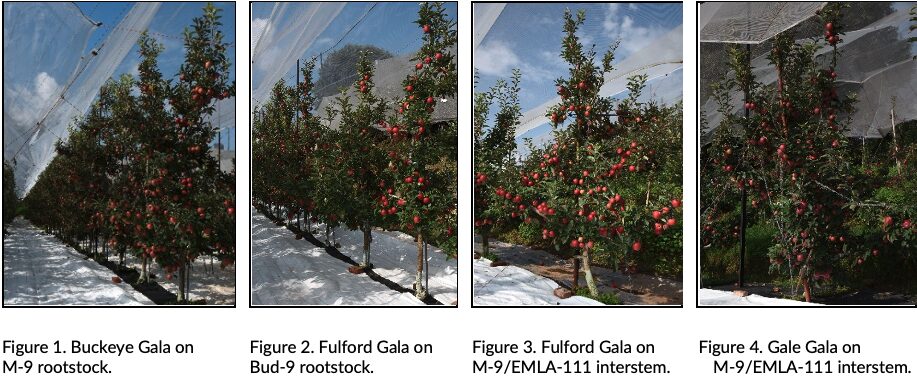
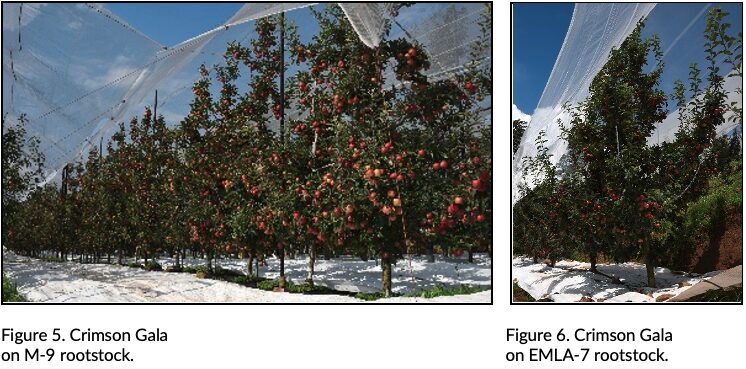
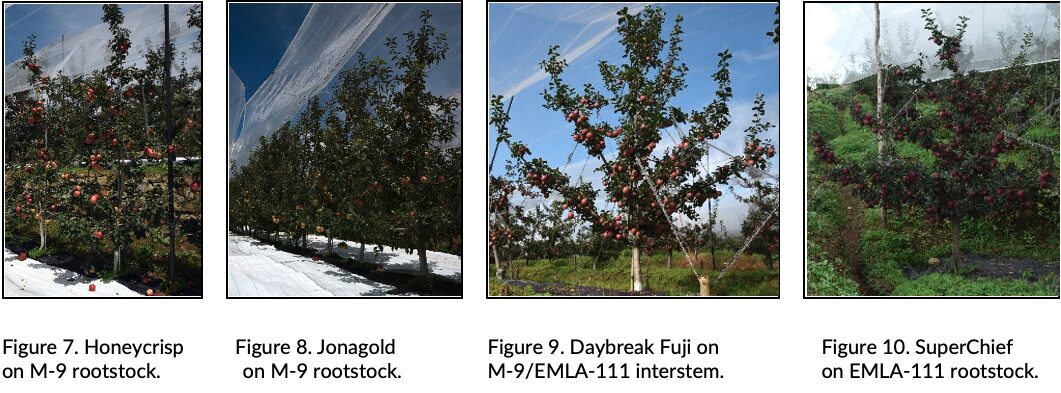
Clearly, these plants and the fruits on them are of very high quality. The same was true of this orchard last year during the 2024-25 apple season. This article was written to highlight the difference in these crop patterns from those in the surrounding old orchards with Royal Delicious apples that, both last year and this year, had almost no apples! Figures 11a,b,c,d,e show the lack of crops on Royal Delicious apple trees during the 2023-24 apple season; the crop during the current season is much worse.

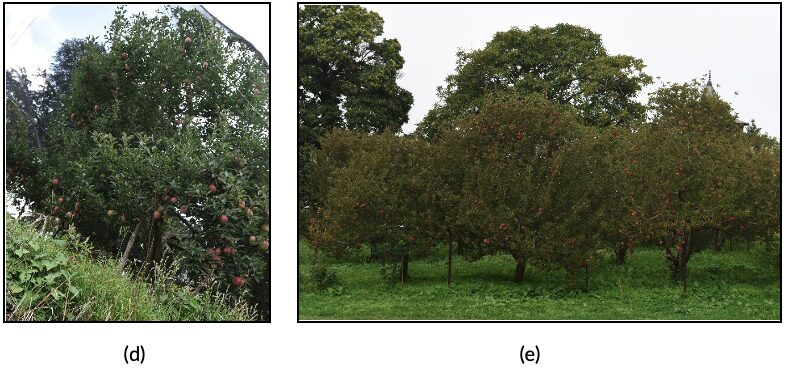
Figure 11. Extremely poor crop on 20+ year-old Royal Delicious trees on seedling rootstock.
There are two major differences between these two sets of orchards; (1) The use of dwarf rootstocks versus trees on seedling stock, and (2) modern varieties versus the 1916-based Royal Delicious strain of Red Delicious. Because SuperChief is a very recent strain of Red Delicious, the major difference in productivity is most likely due to the use of dwarf rootstocks. Also, note that all the cultivars and their sports – SuperChief (Red Delicious), four sports of Gala (Fulford, Crimson, Gale, and Buckeye), two sports of Fuji (Daybreak Fuji – an early strain, and Autumn Rose Fuji – a late strain), Honeycrisp, Jonagold, and Pink Lady on a variety of dwarf rootstocks – produced large quantities of high-quality fruit in both the 2024-25 and 2025-26 apple seasons.
Concluding Remarks
Based on the data presented for the quality and quantity of several apple cultivars – among others, Red Delicious. Gala, Fuji, Honeycrisp, Jonagold, and Pink Lady – there is a very strong case to suggest that growing apples on seedling stock has absolutely no future. Not only does it double the time to produce marketable quantities of apples, their productivity – the quantity of apples produced – is very low.
Hopefully, this article will start a healthy debate on this topic, and that apple growers will share their experiences with growing apples on dwarf rootstock versus seedling stock.

Vijay Kumar Stokes, PhD (Princeton, 1963), taught at IIT Kanpur (1964-1978), where he headed the Mechanical Engineering Department (1974-1977) and was the Convener of the Nuclear Engineering and Technology Program (1977-1978). He then worked at GE Corporate R&D (1978-2002). Besides setting up a world-class, science-based apple orchard at his ancestral home in Ilaqa Kotgarh, for over 25 years he has been documenting the local language, culture, and music and dance.

How did they perform sans irrigation?