
With the botanical name Prunus cerasoides D. Don, it is commonly known as the Wild Himalayan Cherry or Sour Cherry in English and ‘Padmakh’ in Hindi. Locally it is known by the vernacular name of Pajja in the hills of Shimla and nearby. It is popularly known as Padmakha – a Sanskrit word meaning “Similar to a lotus flower” due to the aroma from its wood. In Sanskrit it is also referred to as ‘Charu’, meaning beautiful– as the tree is very attractive to look at, especially in full bloom during late autumn when the landscape is otherwise drab.
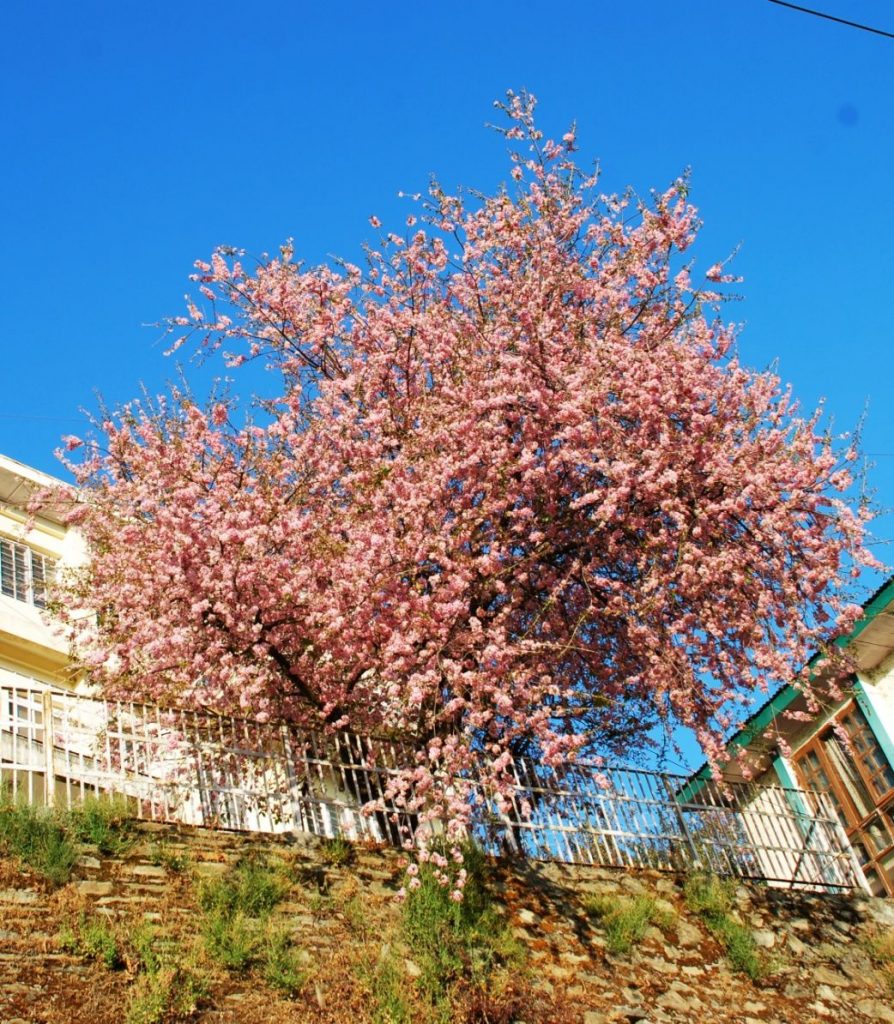
It is a welcome happening giving freshness to the otherwise dull landscape, flowering when other broadleaved trees are shedding their foliage and the evergreens are covered with city dust and pollution.
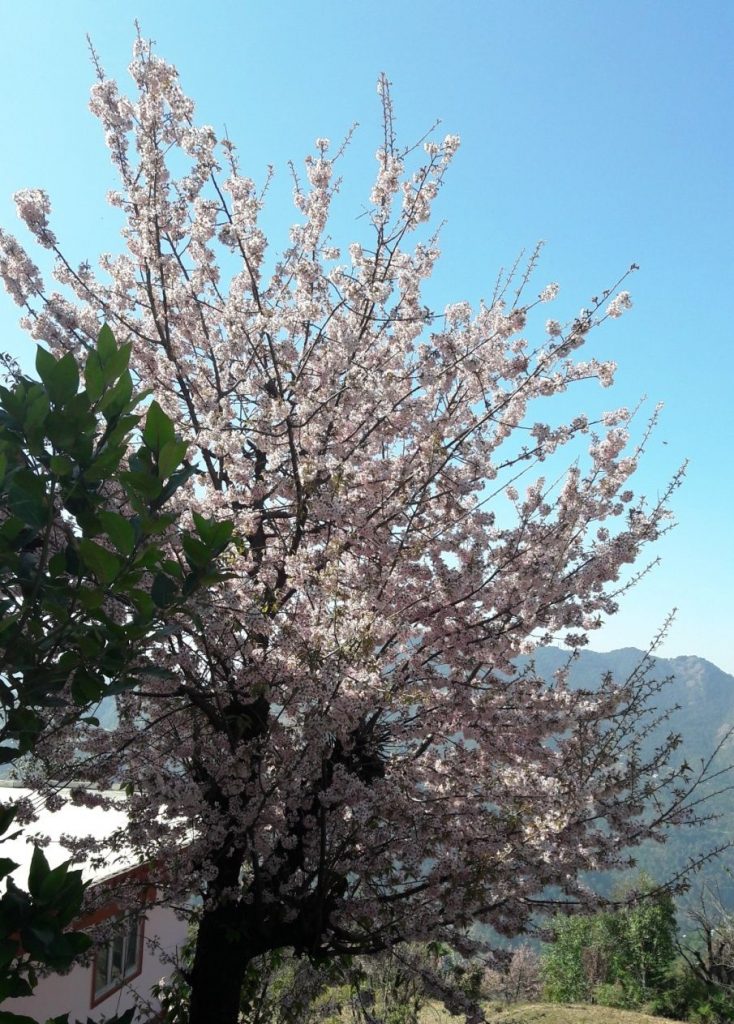 Pajja is a deciduous tree from the rose family (Rosaceae) with range extending in the Himalayas from Himachal Pradesh in north-west India to Nepal in Central Himalayas, to Southwest China, Burma and Thailand. It is commonly found growing in the sub-temperate and lower temperate forests from 1,000–2,500 metres elevation. The tree thrives in well-drained and moisture-retentive loamy soil, in any open, sunny locations and can be readily cultivated as an ornamental tree.
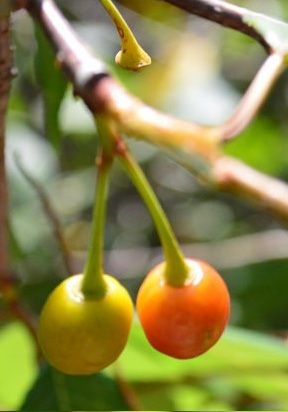
The tree grows up to 30 metres in height with the trunk being characterised by glossy, ringed bark and long, dentate stipules. The trunk is pale reddish with nodules and a smell similar to that of the lotus flower. The tree flowers generously in autumn and early winters, the entire tree covered with the beauty of light pink; flowers being hermaphroditic and are white or pinkish in colour. The fruit is ovoid glossy green, turning yellow and finally bright red as it ripens.
 The fruits and the leaves yeild a dark green dye. Earlier times, the seeds were used by rural womenfolk and children to prepare beaded necklaces. The wood is hard, strong, durable and aromatic, and mature branches are used as walking sticks and for preparation of handles for agricultural tools. The tree is also of utmost religious importance for hill culture, as it finds important use during the Shivratri festival. The leaves along with barley (Jau) and Kemtu (Citrus species) are worked together to prepare the chodoh, which is hung at the main alter of the sanctum podium at Shivratri in each home. The tree being a relative of the sweet cherry (Prunus avium), is often used as rootstock for propagating its good cultivars.
However, a large number of these trees are drying in the region; often the villagers I come across show lot of concern regarding this. Some studies need to focus on this aspect. I though mention here that the monkeys and langurs relish the fresh leaves on its branches and I personally have observed many a time, they removing the entire leaves of a branch in a backwardly direction and consuming them – thereby resulting in a bare branch.
Medicinally, the tree finds use in many formulations of Ayurveda and is often referred in the Charak, Shushruta and the Nighantus as Padmakh. The Ayurvedic uses include multiple indications like herpes, burning sensation, as in gastritis, neuropathy, burning sensation in eyes etc., boils, blisters, skin diseases, blood disorders such as abscess, skin disorders, bleeding disorders such as menorrhagia, nasal bleeding etc., toxic conditions, poisoning, excessive thirst, heavy periods, fever, vomiting, dizziness, delusion, protects pregnancy, etc., well that accounts for most ailments in us.
The message I give here is that we need to focus our attention to this native tree and many more like this — natives which we have sadly forgotten.
The recent plantations made in and around Shimla have been that of exotics like Grevillea robusta (Silver Oak from Australia), Robinia pseudoacacia (Black Locust from N. America), Ailanthus altissima (Tree of Heaven from Central China and Taiwan) and Jacaranda mimosifolia (Blue Jacaranda from South America).
We need to shed the love for exotics from other part of the globe; we need to encourage our natives.

Dr. Vaneet Jishtu, a field botanist specialising in high altitude himalayan flora, conducts a wide range of research at Himalayan Forest Research Institute (HFRI), where he works. At Shimla he has pioneered in setting up an arboretum, a botanical garden where a vast collection of Himalayan trees have been planted. He lives in Shimla

Which altitude is it found.
I think we use this in Shivratri festival in himachal.
Good one. You might have seen my poem on ‘Prunus cerrasoides’ in Hillpost a couple of years ago?