
Introduction
Most of Himachal Pradesh had a disastrous 2025 apple season: First, the apple crop was very small, and then, premature leaf fall in resulted in very poor fruit quality in over 95% of the orchards, causing a major loss of income to horticulturists. This article discusses whether this was inevitable, or, could it have been avoided.
For some time, apple growers have been aware of the warming effects from climate change causing a slow but steady increase in the altitudes at which apples grow from inadequate chilling, and reduced soil moisture affecting tree life. However, in contrast to this direct warming effect, with rare exceptions, continuing excessive rain during the 2025 apple season throughout Himachal’s apple growing belt, caused uncontrolled spread of Alternaria on apple leaves and other fungi on apples resulting in very early, premature leaf fall – mostly with apples still on trees. This not only affected fruit quality but also caused sooty-blotch like blemishes on fruit surfaces. And, of course, it prevented the trees from continuing to make and store food for augmenting nutrition when the small leaves emerging next season are not able to produce food, thereby affecting flowering, and fruit set and size.
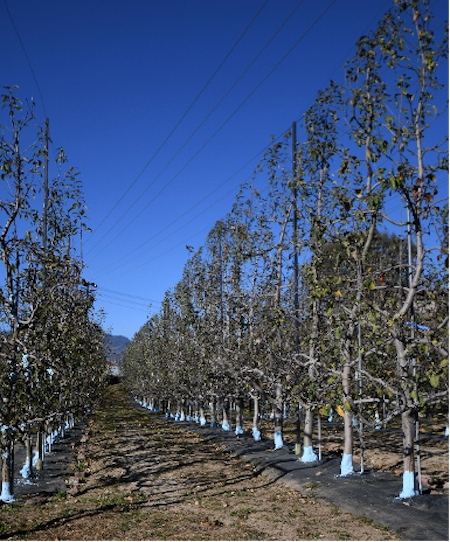
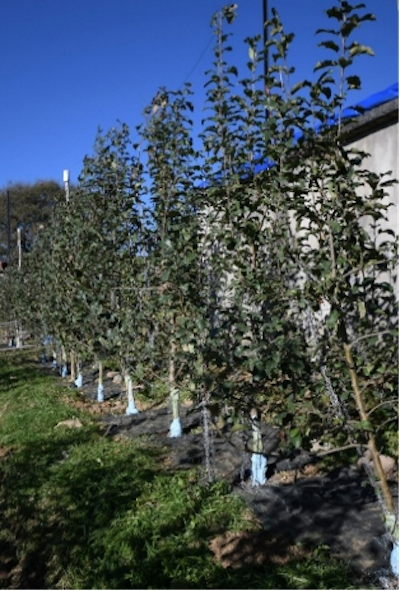
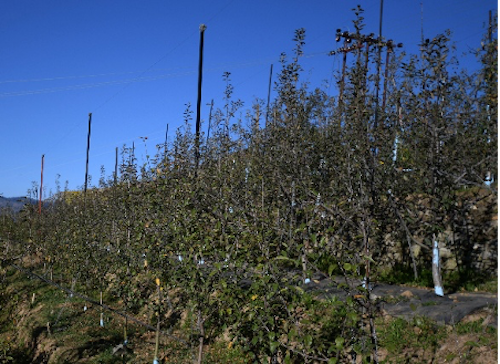
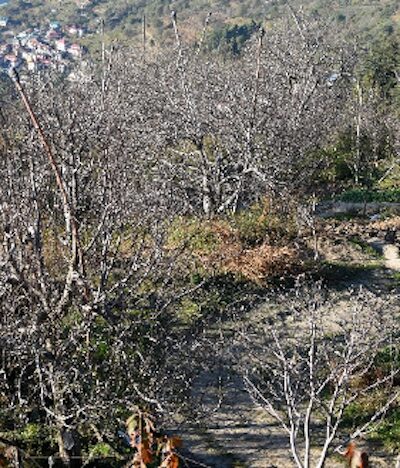
One such rare exception is that of Harmony Hall Orchards (HH) in Thanedhar, Ilaqa Kotgarh, in which, as shown in Figures 1-3, trees still had leaves on November 12. Figure 4 shows the absence of leaves on trees in a neighbouring orchard on seedlings stock (mainly Royal Delicious). Although some leaves were lost in HH, fungus did affect the quality of Autumn Rose, a late Fuji, harvested on October 14. Remarkably, plants of Pink Lady on M-26 rootstock still had most of their leaves at harvest on November 7.
Clearly, this example shows that, with proper fungicide sprays, the disastrous leaf fall in the State, and the consequent enormous losses could have been avoided.
Background
On initiating a major orchard rejuvenation effort in 2006, HH started a collaboration with Bayer CropScience (BCS) on plant protection, and later a plant nutrition collaboration with YARA; they advised HH on plant protection and plant nutrition, respectively. For many years, BCS provided very active support by assigning plant pathologists to train staff on recognizing mite and thrips infestations, Alternaria, Marssonina, and powdery mildew, and in proactively managing them through timely sprays. This was helpful to all the collaborators: Clearly, it helped HH apply up-to-date protocols for plant protection and nutrition. But, at the same time, it allowed BCS and YARA to try out their molecules on new cultivars on several dwarf rootstocks; this was important because the timing and requirements for them are different from those for legacy cultivars, such as Royal Delicious, on seedling stock, with which they had substantial experience.
HH was able to retain leaves by following an aggressive fungicide spray schedule recommended by Bayer CropScience, requiring 11 fungicide sprays between March 26 and August 9, 2025. Even that schedule was not adequate – on some late cultivars leaf fall was observed as early as late October. Some background on how this schedule was arrived at follows:
In the 2023 apple season – despite having followed an aggressive fungicide spray schedule, requiring eight fungicide sprays between April 23 and August 17 – HH lost a substantial portion of its apple crop from fungi on apples ruining the surfaces by ugly sooty-blotch-like texture, requiring manual scrubbing. On August 31, 2023, HH wrote to BCS, “This year we have had unprecedented rainfall, with very little sunlight for almost two months, increasing the chances of fungal attack by Alternaria and Marssonina. While this has been tough on farmers, it was an excellent opportunity for you to have worked with us to prevent such fungal attacks both on leaves AND on fruit. Unfortunately, no one from your organization has visited HH since about July 2. As such you missed this opportunity to assess the effectiveness of your fungicides in such trying circumstances”.
Recognizing that we were experiencing similar heavy rainfall this year (2025), after the July-19 visit by a new plant pathologist hired by BCS, on July 31 HH wrote, “The relevance of this email is that we again appear to be having the same type of weather – lots of rain, mist and fog, with very little sunshine – which could result in the disastrous situation we faced in 2023. With reference to our long-standing technical collaboration with you – which we value highly – through this email I am requesting you to provide us with continuing guidance to prevent a recurrence of the problem”. This plant pathologist attributed the small amount of leaf fall to the second?last of the 11 sprays – which had been recommended by BCS – to a wrong fungicide having been used! Some of the more recent inadequate communication can be attributed to staff cutbacks and realignment at BCS, resulting in qualified plant pathologists not being available at the right time to recommend appropriate spray protocols.
HP Government Support for Horticulturists
HP Government has two major resources for helping horticulturists: (1) The YS Parmar University of Horticulture and Forestry (UHF), Nauni, at which the Department of Plant Pathology (DPT) researches plant protection issues and posts recommended spray schedules on the UHF website. And it has an extension Centre in Mashobra charged with propagating recommended protocols to farmers; it also has several satellite extension centres at which UHF can try out its protocols. And (2), its Department of Horticulture, a large organization that has Horticulture Development Officers (HDOs) located throughout the state to liaise with farmers; while, hopefully, helping farmers, it provides a mechanism to get a first-hand feel for the problems of farmers that can be fed back to policy makers in Horticulture Department and to UHF. It too has the UHF spray schedule on its website. With these significant resources, why then did the disastrous early leaf fall in Himachal Pradesh Apple Orchards occur?
On the December 1, 2025 Foundation Day celebrations at Nauni, at a meeting with the faculty and post-graduate students, to a question as to whether HH had tried the YHF spray schedule the author answered no, and that instead, HH had relied on its collaboration with BCS for spray schedules. But he went on to say that the more important question was whether Himachali horticulturists were using the UHF recommended protocols: The fact that well over 95% of the apple orchards had drastic early leaf fall indicates either that, (1) if some horticulturists did use the UHF recommendation, it was ineffective, or, (2) these recommendations were not being used. This also applies to the recommendations made by the HP Horticulture Department; in both cases, these recommendations were of no help in preventing premature leaf fall.
From the disastrous early leaf fall in apple trees in the 2025 apple season, it should be clear that the expertise available in the YSP University of Horticulture and Forestry and the HP Horticulture Department was totally ineffective in preventing this tragic loss. If they do have an adequate understanding of plant protection, their protocols appear to have been designed for ‘normal’ weather patterns; the system just is not set up to react to the climate-change induced dynamic changes in weather patterns.
The extension mandate of UHF is very weak; the knowledge base being developed by it is not benefitting horticulturists. UHF needs to expand its outreach to farmers.
Shortcomings of the Government Support Systems
All Government Departments are run on a two-tier system: (1) The first comprises IAS and HAS officers whose competence essentially is in government administration, and who normally administer Departments for a few years before being assigned to other departments, thereby not allowing them sufficient time to develop an understanding of the core technical issues for the department. Members of this ‘Administrative System’, whose core competency essentially is administration, weald the real power over decision making in the departments they oversee. And (2), the second comprises ‘specialists’ in different areas such as, for example, language and culture, horticulture, and finance. They represent people with ‘domain knowledge’, and, in contrast to the administrators, they tend to remain in their departments – rising in the ranks – and hopefully, keeping up-to-date and providing the current scientific base for decision making.
This overly bureaucratic system, a carryover from the British Imperial days, was designed to tightly control the work of ‘locals’ (Indians) by keeping the main decision-making power in the hands of the elite, ICS – now IAS – officers. Persons with domain knowledge basically provided the ‘technical base’ for project development. As a result, such ‘specialists’, who were regarded as subordinates, were expected to do what they were asked to do. This resulted in demoralized cadres who looked up to the administrators for guidance; the will to innovate is wiped out early in the career. In the past this did not matter that much. But now, with changes occurring exponentially, persons with domain knowledge should be at the helm of affairs – else HP will be run by people with totally outdated ideas and thought processes. Just think of the relatively recent changes that affect almost everything we do: Google (1998), Wikipedia (2001), Google News (2002), Gmail (2004), Facebook (2004), Google Maps (2005), YouTube (2005), Twitter (2006), iPhone (2007), Google Chrome (2008), WhatsApp (2009), Instagram (2010), Snapchat (2011), and TikTok (2016) – the habits of our younger generation is driven and controlled mainly by what occurred just in the three years from 2004 (Facebook) to 2007 (iPhone). Our government departments are not designed and manned with people to cope with such fast changes. And this is nothing compared to the exponential changes that will be caused by Artificial Intelligence (AI) – for instance with the advent of ChatGPT (2022)!
Clearly, the Horticulture Department, as currently constituted does not have the nimbleness to react to this fast?changing world. Its main function appears to be to provide subsidies. Over the years it has not even driven the improvement of the quality of the Royal delicious apples, the main horticultural cash crop. Many of its initiatives cover developing infrastructure, such as setting up Cold Atmosphere Storage facilities. But, because it has not, and does not work on developing a long-term strategic vision for the future of the apple industry, many of its infrastructure ventures, such creating bigger mandis for auctioning apples, should not have been undertaken as the outmoded mandi system is on its way out.
An example of the inability of the current Government Systems undertaking the formulation and execution of major projects, is the gross mismanagement of the Rs. 1,100 crore World Bank Project, “Himachal Pradesh Horticulture Development Project (HPHDP)”. While the Project Development Objective (PDO, “… to support small farmers and agro-entrepreneurs in Himachal Pradesh, to increase the productivity, quality, and market access of selected horticulture commodities,”) was well-intentioned and laudable, its poor execution resulted from the wanting quality of the people who prepared the project report and those who executed it in a haphazard manner – essentially by persons lacking sufficient knowledge and experience to manage a project of this magnitude.
The plan implementation team was headed by an IAS officer, and manned by a motley group of inadequately trained specialists and retirees from different departments. It is instructive to peruse the Project Report which, evidently, had not been adequately studied by the World Bank before approving the loan, and in not subsequently having appropriately monitored its progress. The Project Implementation Plan (PIP) of the Himachal Pradesh Horticulture Development Project (HPHDP) is a very impressive, 701-page document. It appears to have been put together with teams of people who scoured the literature for everything relating to apple farming and lots of equipment, including all types of sophisticated diagnostic instrumentation, that they will not be able to hire the manpower to run: Something that looks very impressive on paper but with a poor chance of effective implementation. It was a laudable, comprehensive plan for the effective implementation which the HP Government just does not have the staff. The ‘face’ of the HP Horticulture Department as seen by farmers is people who dole out subsidies and subsidized agrochemicals.
This was a loan that the HP government will eventually have to pay off. Much could be learned from a professional ‘post mortem’ of this Project to determine what its execution actually delivered.
Climate Change and the Future
The disastrous effects of excessively wet weather patterns on apple productivity and quality, as during the 2023 and 2025 apple seasons, should be a warning to apple growers to prepare for such short-term climate change effects. While it is difficult to accurately predict weather patterns in advance, with current technology the Indian Meteorological Department should be in a position to futurecast likely weather patterns several months in advance. This information could then be used by UHF to prepare dynamic spray schedules that account for actual weather conditions to prevent premature leaf fall.
Rather than to work in their isolated mode as separate entities, this will require the YSP University of Horticulture & Forestry, and the HP Department of Horticulture to team up with the Indian Meteorological Department – which could prepare weather futurecasts of possible adverse weather conditions – to come up with dynamic, updated spray schedules to prevent premature leaf fall and direct fungus attacks on apples.
Economics of Plant Protections and Nutrition
The main reasons for the low income of apple growers are twofold. First, the reliance on the over 100-year-old Royal Delicious apples as the main cash crop, which in a good year fetches an orchard-averaged wholesale price of no more than about Rs. 45 per kilo. And second, the extremely low productivity of the older trees on seedling stock resulting from decades of faulty pruning practices. The low prices and poor productivity results in low profit margins, which causes growers to reduce the amount spent on plant protection and nutrition. This results in a classic catch-22 situation: spending more on plant protection and nutrition reduces the profit margin, but not spending enough can cause early leaf fall that can affect fruit size and quality, and adversely affect fruit productivity in the following season. Also, in a low-yield low-income year, many growers forgo necessary plant-protection sprays, resulting in more disease in the following season, which can also affect adjacent orchards.
Whatever the cultivar, fruit quality – on which the final price depends – should not be a casualty. This requires proper attention to plant-protection and nutrition protocols – no matter the cost. Of course, rather than using ‘brute-force’ extensive spray schedules, costs could be reduced by using intelligently configured less expensive spray protocols, something that the YS Parmar University of Horticulture & Forestry should be asked to come up with.
In contrast to this, not only are modern cultivars on dwarf rootstocks more productive and produce better quality fruit, they fetch much higher prices. As an example, the more modern imported cousins of Royal Delicious, such as Super Chief, collectively referred to as ‘Washington Apples’ wholesale for Rs. 125-150 per kilo. The resulting increased profit margins make it easier to improve both productivity and fruit quality.
All the input costs for growing apples will continue to increase. As such, there is a need for a careful analysis of the economics of growing apples in Himachal Pradesh, which can then be used to focus on the key factors for controlling cost, and for designing appropriate subsidy schemes for growers.
Only by using science and the up-to-date plant-protection and nutrition protocols can the Indian apple industry hope to compete with the ever-increasing amounts of imported apples. This will require focusing on and using up-to-date, science-based principles. The current misguided fad – yes, it’s a fad! – of using natural and/or organic farming to grow apples will not improve the lot of apple growers: not using science-based plant-protection and nutrition protocols will cause a fall in productivity, and, more importantly, the market for truly ‘organically grown’ apples – which have ugly surfaces with blemishes – will have a very limited market in India. Instead, the focus should be on using all available modern tools to improve fruit yield and quality.
Other Headwinds
While this article mainly has focussed on climate-related issues, the Indian apple growers will be facing increasing competition from international apple growers – India already imports far more apples than it grows – who will be using all available science tools to produce high-quality fruit at lower prices than are possible in the Indian mountainous terrain. And as the current geopolitical conditions change to allow Iran to export its apples, Indian farmers will have to compete with a formidable proximate apple producer. The current Indian focus on poor-quality, legacy Royal Delicious apples guarantees a looming disaster for the Indian apple industry.
For India to have a viable apple industry, at the very least, it must be capable of producing world-class fruit.
Concluding Remarks
It is only in the last decade that large numbers of apple growers started using anti-hail nets to counter the increasing scourge of hail. The example cited in this article has shown that, with more aggressive anti-fungal spray schedules, premature leaf fall can be prevented. Of course, this will increase the input cost, but in addition to producing better quality fruit – even at reduced margins – it will guarantee better fruit quality and production in the succeeding apple seasons. Government agencies could help by asking UHF to come up with less expensive plant-protection and nutrition protocols, and by making the appropriate fungicides available at subsidized rates.
To compete with lower prices from reduced tariffs of high-quality imported apples, farmers must embark on a scientific management of all aspects of the apple business, both to protect plants and to improve fruit quality.

Vijay Kumar Stokes, PhD (Princeton, 1963), taught at IIT Kanpur (1964-1978), where he headed the Mechanical Engineering Department (1974-1977) and was the Convener of the Nuclear Engineering and Technology Program (1977-1978). He then worked at GE Corporate R&D (1978-2002). Besides setting up a world-class, science-based apple orchard at his ancestral home in Ilaqa Kotgarh, for over 25 years he has been documenting the local language, culture, and music and dance.

Its a very valuable article. UHF and Department would do well to study it and act on suggestions of the author. I visited the author in november 2025 and he showed me his orchard and I vouch for whatever he claims about his trees.