
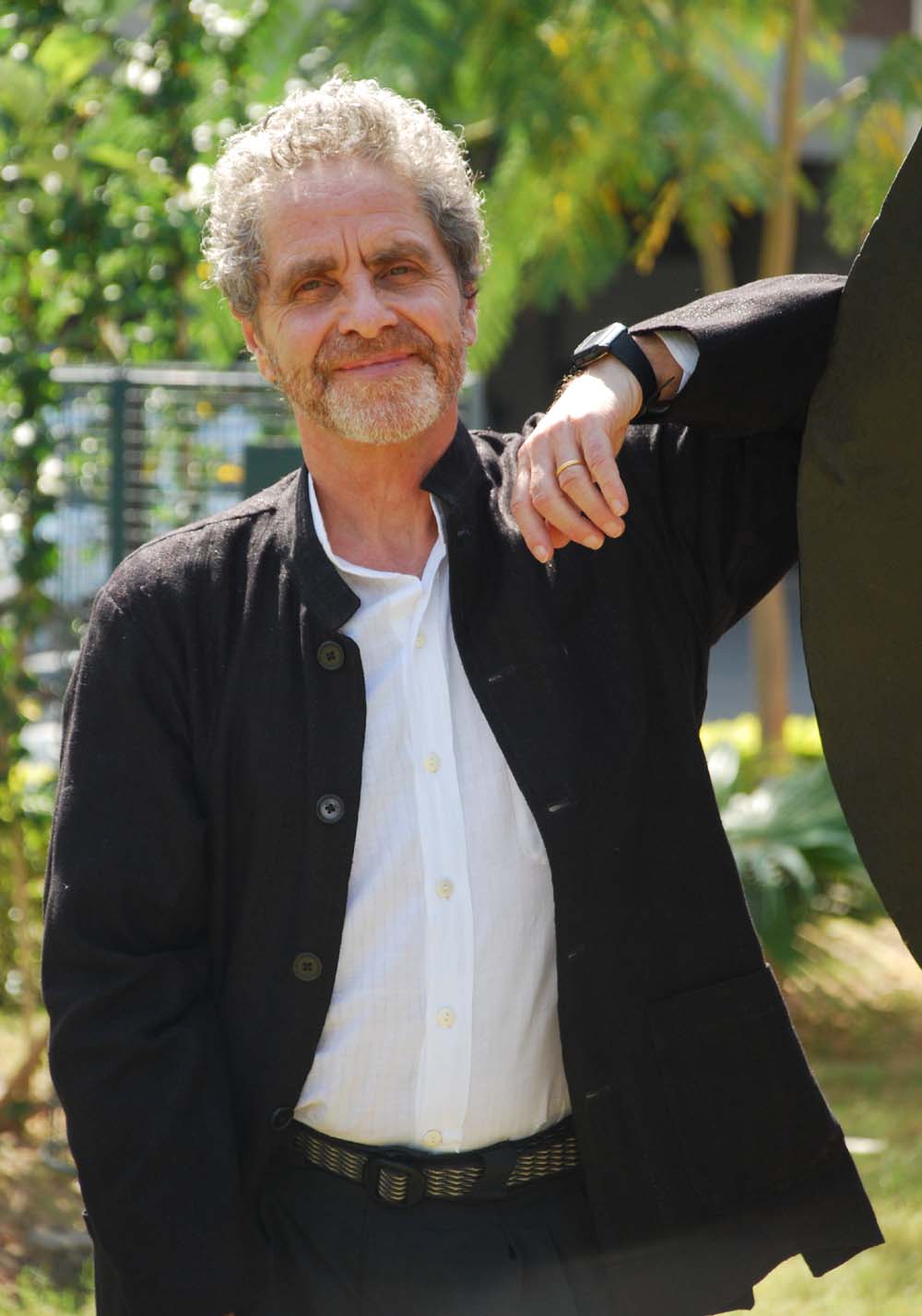
 Energy Flows, an exhibition of recent works by American earth scientist and artist, Payson R. Stevens, opened here today at the Government Museum and Art Gallery.
Neelam Man Singh Chowdhry, eminent theatre personality inaugurated the exhibition which showcases three different series, namely the stream suite depicting the energy of flowing water which is inspired from the Nature, while the Bardo series and Moksha series focus on interpretation of the soul as it moves through its numerous and mysterious energy states.
Payson who lives with his Indian wife, noted writer Kamla K. Kapur, for half the year in a remote area of Kullu valley in Himachal Pradesh describes his Energy Flow work as “a continuation of my preoccupation with energy flows going back over thirty years which epitomizes the larger spiritual dimensions of Nature that permeats our being”.
“The energy flows of the natural world”, he describes, “is depiction of the cycle of continual creation and destruction, death and rebirth, karma and reincarnation, which is very much part of the Indian philosophy”. This flow of s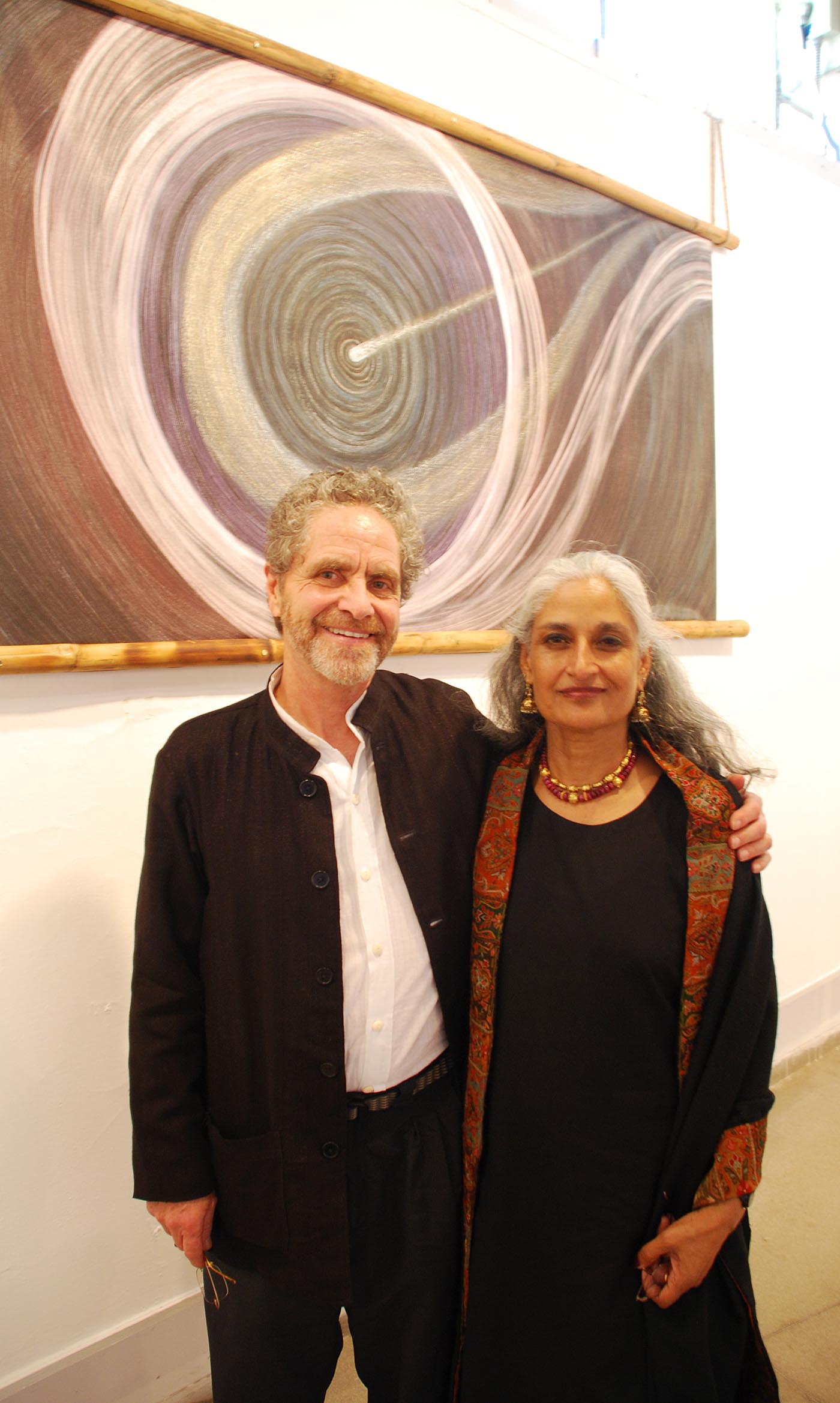 upernatural and supranatural energy finds expression in his latest additions to his repertoire, the Bardo and Moksha series.
Payson draws his inspiration from the variegated secrets of mother earth which he had been able to explore and enjoy the patterns of Nature, as an earth scientist having worked from Alaska to Antarctica, and now as an environmentalist and advisor to the Great Himalayan National Park since 2000, had an opportunity to trek to the most difficult snow-covered terrains in the glacial regions.
Payson is deeply concerned about environmental degradation and global warming, and is engaged with Sahara, an NGO in Himachal Pradesh, to help protect the ecosystem through community participation, besides vociferously generating awareness about the environmental damage that the untamed exploitation of the natural rivers is being caused by setting up hydel projects in the state.
As a part of his drive to engage youngsters and common man about the preserving and conserving Nature, a special presentation is scheduled at the Government Museum auditorium on 11th October along with the first director of Great Himalayan National Park, Dr. Sanjeeva Pandey.
Payson’s exhibition is open till 14th October.
Photos by CJ Singh

An IT professional for 17 years, based in the US since the last 12 years. Founded NGO My Himachal and then Himachal Media Pvt. Ltd.. A Himachali forever. Always trying to bring together people whose hearts beat for the state.

The Science of Art
American earth scientist on an artistic mission
Aditi Tandon
Tribune News Service
Chandigarh, October 9
It sometimes takes a guest to remind you of the beauty of your own house. So, when a renowned US-based earth scientist travels all the way to India and reminds its people the forgotten Himalayan splendours, one can only say – “Thank God for small merciesâ€.
For Payson R. Stevens, involved with global warming research across the planet – Alaska to Antarctica, the upper Banjar Valley in Kullu has become a sort of reference point for the energy flows within nature.
But a few years ago, when he made Kullu his home, he had no idea these flows would inspire a striking show of artworks, wherein the Indian concept of Shakti will find easy expression and meaning.
On the face of it, Payson’s ‘energy flows’, that went up for display at the Government Art Gallery, Sector 10, Chandigarh, today might seem like a routine exercise in art. But, in fact, it is a reflection of a scientist’s preoccupation with energy flows going back over 30 years.
“I have two lives- one as a scientist observing the earth in satellite images and researching the melting glaciers, the other as an artist smitten by nature and the vividness of its energy forms. This exhibition is a result of my Indian experience ,†Payson told TNS.
No surprise that his works celebrate the magnificence of the Himalayas and inspire people to love their surroundings. It begins with what Payson calls the ‘stream suite’ featuring the Himalayan wealth of streams that lend the area its unique edge. Unfortunately, the state’s fragile ecology is now battling for survival with its water resources facing overexploitation to meet India’s energy needs. This is just one of the challenges Payson helps the locals meet.
Second in line is the ‘bardo’ series featuring paintings inspired by Tibetan Buddhism. “These works were catalysed by the death of my close relative in 2007. As I watched his body go up in smoke, I was deeply affected by the fact that within the larger drama of nature, each one of us has our own round of death and rebirth,†says Payson, who seals the show with ‘moksha’ series.
Works in the final segment visualise energy flows from a spiritual perspective. They remind us of our earthly passage, says Payson, whose inspiration for the exhibition came from the 1,200-km trek in the Great Himalayan Park, where he visited all the four river sources.
Back in the USA, he has won the Presidential Design Award for Excellence from Bill Clinton for the CD-ROM science-journal prototype, Arctic Data InterActive. He was also lead author of ‘Embracing earth: New views of our changing planet’ and contributing author to the award winning college textbooks. In art, he trained from the School of Visual Arts, New York City.
But with his many laurels, Payson remains an observer at heart, trying to see reason in nature’s wondrous patterns that baffle scientists and artists alike.