
I grew up in Shimla, and winter holidays had their own rhythm. Outside, snowflakes settled softly on the roofs, the cold persuaded everyone to stay indoors, and the world became wonderfully quiet. For me, there could be no better companion than an Agatha Christie novel with a hot cup of tea and some snacks.
It was never only reading. It was a competition with the most brilliant minds.
I wasn’t simply following a mystery; I was trying to outthink Hercule Poirot. By the end, I would have confidently identified the murderer—almost always incorrectly. Christie, with quiet satisfaction, would reveal the truth in the final chapter and remind me that overconfidence is not a literary qualification.
Forget the superheroes in costumes. Sherlock Holmes and Hercule Poirot were already doing the real work. Sometimes Miss Marple and Tuppence joined in too. No capes. No gadgets. Just amazing observation—and a slightly alarming ability to dismantle everyone else’s theories without raising their voice.
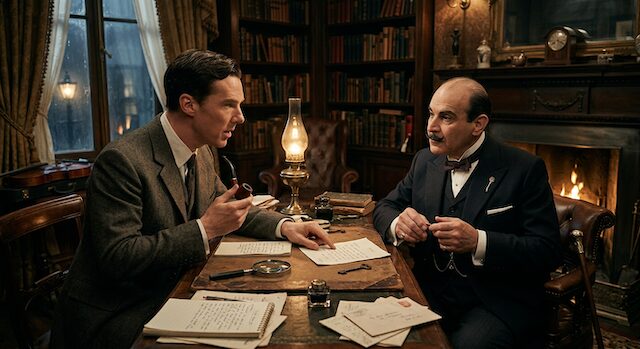
The Art of Seeing What Others Miss
Sherlock Holmes was gloriously unfair. Give him a stranger for a few seconds and he would calmly reconstruct an entire life, preferably while making everyone else feel mildly incompetent.
A mud-stained boot, a frayed cuff, a scratched watch—suddenly it became a biography. The rest of us saw shoes. Holmes saw where a man had been, how he lived, and possibly what he had eaten for breakfast.
“How did you know I had travelled recently?” an astonished visitor would ask.
“My dear fellow,” Holmes would reply, “your boots have been gossiping.”
Watson, standing right there, would look at the same boots and conclude… nothing at all. So did I.
Poirot, meanwhile, had little interest in ash or footprints or other earthy distractions. He watched people.
A smile a fraction too quick. A reply slightly too polished. A sentence corrected mid-thought—always suspicious.
“But Poirot, there is no evidence!” Hastings would protest.
Poirot would smile gently.
“My friend, people are full of evidence. They are simply very bad at hiding it.”
Holmes made observation feel like science. Poirot made human nature feel like a guilty secret.
A Holiday Without Leaving the Room
Those Shimla winters disappeared one chapter at a time.
While others went skiing or visiting cousins, I travelled without moving. One day, I was in a quiet English village where everyone was polite and at least one person was guilty. The following day, I was aboard the Orient Express, confidently accusing someone every twenty-odd pages like it was a group assignment.
By the middle of the book, I always knew the answer. Or at least I thought I did—which, in hindsight, amounts to the same thing.
“The doctor,” I would announce.
Later: “Actually… the niece.”
Then came the final revelation.
“Ladies and gentlemen…”
Three words capable of resetting all intellectual confidence.
By the last page, I had usually accused half of England and somehow missed the murderer sitting politely in Chapter Three, drinking tea and minding his own business.
Agatha Christie wasn’t just writing mysteries. She was inviting readers into a game of deduction—and quietly proving that she played it better than any of us.
When Science Took Over the Mystery
Somewhere between those winters and today’s headlines, detective work changed its personality.
Modern crime investigation has become relentlessly scientific and technical. It sounds less like deduction and more like data recovery. Today’s investigations speak the language of DNA profiling, CCTV networks, mobile tower logs, GPS trails, digital payments, and cyber forensics.
In short, nobody is disappearing gracefully anymore. Every action leaves a trail, and every trail eventually finds its way into a database.
One can imagine Sherlock Holmes stepping into a modern police station.
“I should like to examine the footprints,” he says.
“They’ve already been scanned, sir.”
“The cigar ash?”
“Digitally catalogued.”
“The suspect’s movements?”
“We have his mobile location, UPI transactions, and CCTV timestamps.”
Holmes pauses.
“Watson,” he says quietly, “we appear to have arrived after the upgrade.”
Poirot would fare no better.
“My dear Inspector,” he would begin, “I shall observe the household for two days.”
The Inspector nods. “The DNA report will be ready this evening, and cyber forensics already has his entire timeline.”
Poirot adjusts his tie.
“Then I shall observe… the tea. Very carefully.”
The Romance I Miss
Modern detective work is brilliant. It is precise, efficient – almost inescapable. It solves crimes faster and more reliably than any gentleman with a pipe ever could.
But I miss the detective who could read a journey from a muddy boot. I miss the one who could detect guilt in a pause and innocence in an over-explanation. I miss Holmes turning fragments into logic, and Poirot turning people into puzzles.
They didn’t just solve crimes. They made intelligence feel like mischief.
The Return of the Game
These days, I have one problem. I have reread almost every Sherlock Holmes and Hercule Poirot mystery. The moment a suspicious colonel enters a room, the ending begins arranging itself in my mind.
Fortunately, Poirot refuses to retire. With the blessing of Agatha Christie’s estate, new mysteries continue to appear. Which means I can once again enjoy my favourite pastime: confidently accusing the wrong person.
And once again, Poirot can smile politely. And once again, I can reach the final page wondering how I missed something that was, in retrospect, entirely obvious.
Some mysteries end. The game never does.
And that is the romance of deduction.

Iti Mattoo, retired after 30 years in the IT industry, now enjoying her creative pursuits.