
The Sweet Simplicity
The smell of ghee and cardamom still takes me back to my childhood Diwalis in Pamposh Colony, Delhi. Back then, gifts were simple — a plate of sweet puris made at home, golden and fragrant, passed from one Kashmiri household to another.
The fun lay in the friendly competition — whose puris turned out best this year? Everyone knew the usual winners — first, second, and third — and it became a small, cherished ritual. Ours was almost always among the top three, and that little victory brought immense joy every year. At most, a diya or a couple of sweets were added to the plate — usually “recycled” from what we received. It was all so simple, sustainable, and full of warmth.
From Homemade to High-End
Fast-forward a few decades when we moved to Bangalore and built a good circle of friends, the gifting culture changed completely. The early years were filled with enthusiasm — crystal bowls, Fab India crockery, elegant jars, table runners, and scented candles — you name it. We took pride in picking tasteful, thoughtful things.
But soon enough, reality hit. By the sixth year, we’d run out of ideas. What do you gift people who already have everything — and shop at the same stores as you?
Recycling — once a proud family tradition — suddenly became risky. In a close-knit circle, a “familiar” gift could easily circle back to its original giver! Imagine the embarrassment if your candle stand made a full round trip.
The Age of Eco and Aesthetic Gifting
And then came the “eco-friendly” wave — seed crackers, plants, handmade soaps, bamboo baskets, and jute bags. All charming, all thoughtful. But after a few seasons, even our homes started overflowing with ‘green’ goodness. Who knew being sustainable could take so much shelf space?
Even the wrapping became an art — ribbons, lace, and boxes that often cost more than the gift, only to be torn apart in seconds.
The Diet Diaries
As if the gifting dilemma wasn’t enough, there’s now the health angle. Everyone seems to be on a diet. Some are counting calories, others are on keto, and quite a few hover around the pre-diabetic scale. Sweets are now a strict no-no.
Traditional sweets—kaju katli, soan papdi, ladoos—which had once been the stars of the Diwali plate, now earned polite refusals and suspicious glances.
Over the years, we’ve adapted by adding some healthier treats — flax seeds, pumpkin seeds, dates, things that can be enjoyed without guilt. But this year, with so many people choosing these options, I ended up with three packets of flax seeds alone!
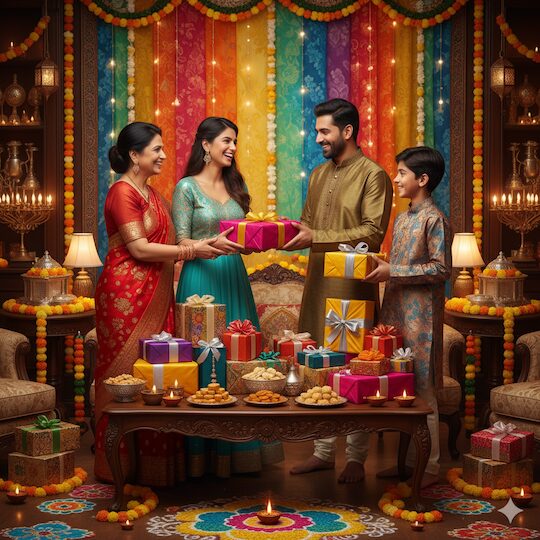
Cupboards Groaning, Creativity Waning
After more than twenty years in the same society, my cupboards are full of “good gifting material” — decorative trays, candle stands, coasters, serving bowls, and runners — all beautiful, all unused, waiting for the “right occasion” that never comes.
And yet, it’s not that one doesn’t want to part with these things. I would love to give them to those who might use them — our house helps, security staff, or others in the neighbourhood. But would they really want a table runner or a piece of crystal ware? Sweets can always be shared easily, but such gifts are tricky. You need the right takers — people who would truly appreciate them. Otherwise, they just move from one cupboard to another.
Gifting as a Social Ritual
Gifting isn’t just about the presents — it’s also about the occasions they create. For friends and relatives living far apart in the city, Diwali gifts were a reason to travel, meet, reconnect, and catch up. Those visits were as much about gossip, laughter, and shared moments as about the gifts themselves.
For my only relative in Bangalore, I had the gift delivered through Porter, which was convenient but inevitably felt a bit impersonal — a reminder that distance can change the way we experience traditions.
For those of us who meet at least twice a week, however, the Diwali gift drop often feels more like a ritual than a true get-together. It makes you wonder: should we rethink gifting? What was meaningful yesterday, or for others, may not hold the same value for us anymore.
The Meaning of a Gift
Back then, gifts were personal — handmade, heartfelt, and received with joy. It’s not as if today’s gifts lack thought — everyone still gives with love and care. The difference is, earlier we were content with the same homemade treats every year; now, we crave something new and different. With endless choices, the search never really ends.
Maybe “old is gold” still holds true. Perhaps gifts that are practical, usable, or edible make the most sense. They don’t add clutter — they bring back warmth and togetherness, which is what Diwali is really about.
I even once floated a no-gift idea, hoping to lighten things, but it didn’t quite catch on — some traditions, after all, are hard to let go of.
So, this Diwali, my gifts came full circle — back to where they began, in a plate of homemade puris and a handful of love. For now, I’m done — but before the next Diwali, I’ll need a few ideas on how to make it all easier.
That’s my little insight for now… what’s yours?

Iti Mattoo, retired after 30 years in the IT industry, now enjoying her creative pursuits.

I vote for a no gift policy or just exchanging some homemade delicacies among family and friends and something really helpful and practical for our staff.
Anecdotes would have been fun. I have this Parsi neighbour who is amazingly glam in her gifts. Beautifully wrapped rice sheet covered sweets tastefully placed on a long glass plate and covered in a colourful shawl / napkin. I spent more time photographing it than eating those sugary dreams. The awe slowly turned to nervousness when it was time to gift something back. We had my mums Konkani style dish, which we tried wrapping 10 different ways and finally gave up and just plonked it on a plate and offered it. The delight and wow on her face more than made up for the sorry presentation. Content rocks!
No gift
Thank you, Iti, for this post. It invites thoughtful reflection on the deeper significance of celebrating festivals!