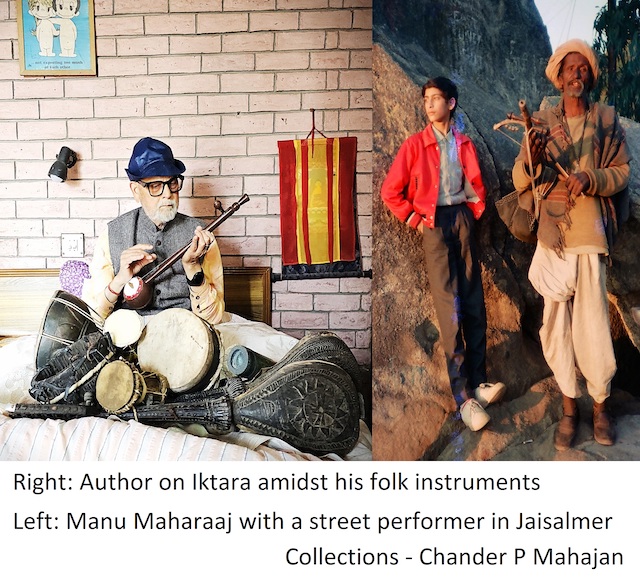
 To my pleasant surprise, Manu gifted me an iktara, a stringed drone lute. We have fond memories of our brief sojourn in Jaisalmer in his boyhood. A street performer sang a folk song over a handheld lute- the so-called Rawanahatha. It was a unique desert experience, blending ancient history with modern comfort.
Plucked, bowed, or struck to produce sound; Chordophones are the string instruments in musicology.
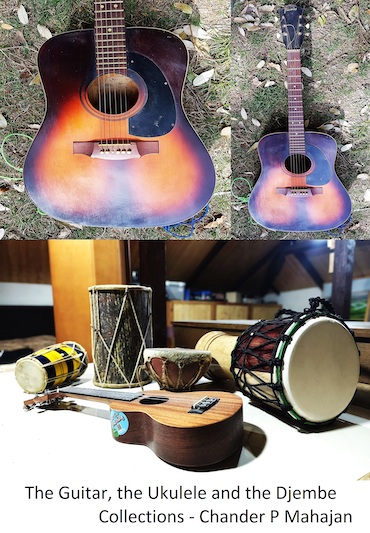
- I have been toying with my German guitar, a 14K Framus, for years. Of late, I have been practicing ukulele, a smaller version of the guitar, typically with four strings.
Though never played, I have known that:-
- The mandolin, a smaller, pear-shaped instrument with eight strings, is usually played with a pick.
- Sitar -an Indian classical instrument played by plucking and striking strings with a plectrum.
- The violin, in the string family, is perhaps the smallest and highest-pitched instrument.
- The Indian santoor is more rectangular and can have more strings than its Persian counterpart, which generally has 72 strings. The instrument is generally made of walnut.
I have also known a little about ‘Rawanahatha’, said to be an ancient bowed, stringed instrument, typical of Rajasthan.
- A peep, out of curiosity, into the literature has brought forth so many different compositions.
Bandurria, for instance, the harp with 14 strings & 16 frets is used in many Philippine folkloric songs.
Beganna, with a 10-string (like the ancient Greek kithara), is a large, heavy, rectangular instrument that is considered by the Christian Ethiopians to be a God-given instrument.
- Several traditional stringed instruments of Himachal Pradesh are the legends.
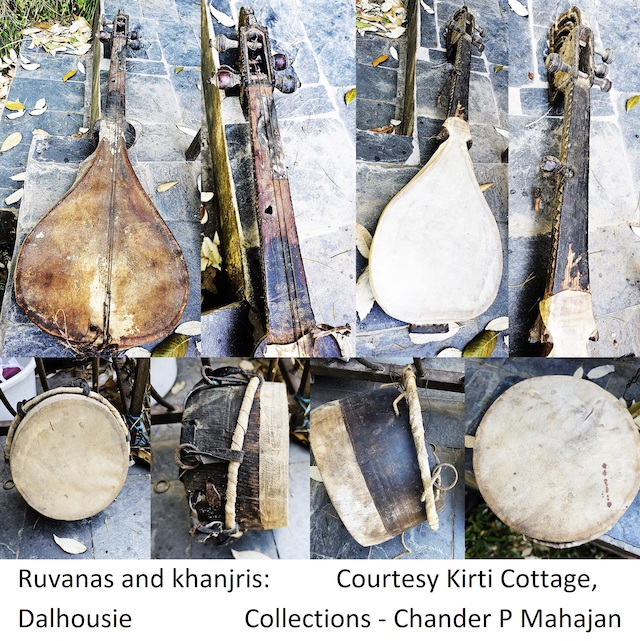
Ruvana (a small fretless lute) is quite prominent in the musical rejoicings. The primary stringed instrument is associated with the Bharmour and Chamba region. Traditionally, Ruvana is made up of chir (locally called khumani) wood. The strings were earlier made up of goat’s intestines, but now they are made up of nylon. It is a fascinating guitar-like instrument.
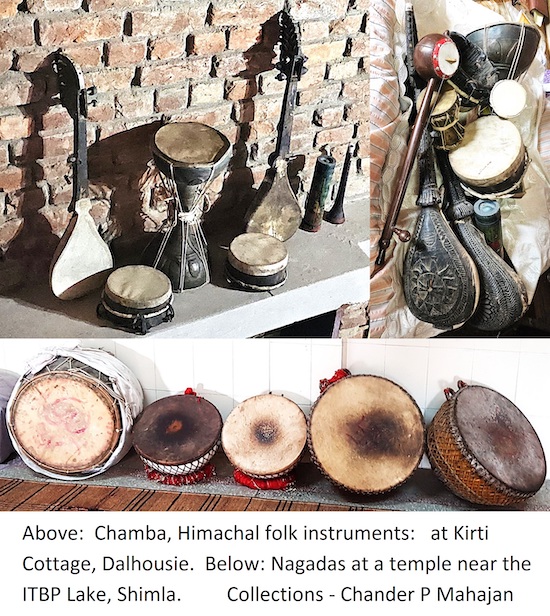
The Ruvana is often played together with the Khanjari small percussion (dafli-like) instrument. Made up of walnut wood, the circular frame of Khanjari is covered with plastic or skin, with metal discs around the edge. Similar to a tambourine. To play it, you hit it or shake it with your hand. The combo is often used to play melodies and accompany singing, especially in traditional music and storytelling by Gaddis.
Once, while in Khajjiar, I saw a musician surrounded by a few people performing in the open. He is Saran Dass from Bharmour; I had the privilege to meet him later. The musician now lives in Mangla and is well known for playing the Ruvana-Khanjari combo. ‘The duo, in conjunction, provides rhythmic accompaniment,’ he says.
Culturally rich, an avid devotee of Lord Shiva; he sings with his heart and soul.‘His brother Roshan Lal also plays an old Ruvana handcrafted from Chir wood, tells Gauri Shankar of Khajjiar.
These days, people hardly like listening to or learning about folk music. While getting into Western music and discos, and other things, mixing folk with different pieces of music has become a craze. The Emulsion of the various tunes, tones and tenors comes out as a strange concoction. The amalgamation pops up as ‘pop music’, and that is the trend of the day.
*Anahad Foundation.
https://hillpost.in/2024/02/chander-guddus-my-heart/123788/ https://hillpost.in/2025/05/himachals-drums-resound-japan/166538/

Prof. (Er.) Chander P Mahajan is an art critic & a free lance journalist. The Environmentalist stays in Shimla and Dalhousie, Himachal Pradesh, India.