
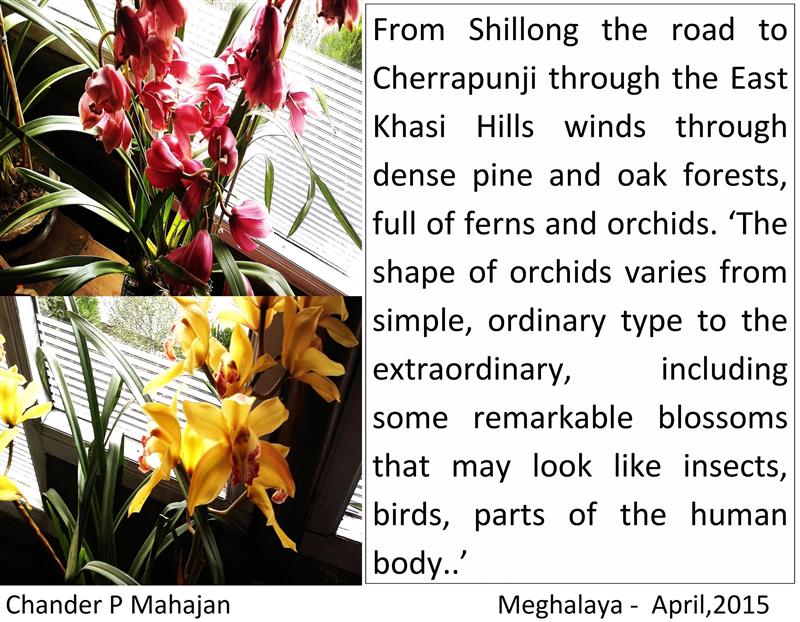
 Orchids have been around from time immemorial. Whimsical growths are found globally, except on glaciers. A majority grows anchored to trees and shrubs. This is a unique group of plants with colourful and fragrant blooms; the flowers are irregular, and extremely variable in size and shape with sparkling texture. The perennial leaves look ornamental.
- “Beauty lies in the eyes of the beholder.” Many have stunningly beautiful flowers. The ‘Jewel orchid’ is grown more for its colourful leaves than its white flowers.
With stripes and spots, while others may look different with hairs and even warty growth. Umpteen patterns show up, as if tints from the rainbow have popped up. Some show sparkling silver and gold veining on a light green background, others are light brownish-green with maroon-pink markings-and so on. The attractive mottle is caused by an uneven distribution of chlorophyll, created by flower pigments.
- “What’s in a name?” It comes from the Shakespeare’s Romeo and Juliet.
In the Indian Vedic scriptures, there is a mention of an orchid under the name ‘Vanda’.

Botanical names may sound Greek to the “florist” who may know them by local popular names, and orchid hobbyists wishing to describe the unusual species they grow.
A system of abbreviations for the nomenclature such as V for Vanda and Cleis for Cleisostoma is maintained by the Royal Horticultural Society.
Furthermore, naturally occurring orchid species vary from horticulturally created hybrids, some are vegetatively diverse.
New orchids are registered with the International Orchid Register, maintained by the Royal Horticultural Society. Several thousand new hybrids of orchids are registered each year.

- The orchid symbolizes love and beauty. In Chinese cultures, they are symbols of scholarly pursuit, nobility, integrity, and friendship. Green orchids are often seen as symbols of good luck, harmony, good health and good fortune. Blue orchids are rare and often seen as symbols of rarity and uniqueness.
The City Flower of Shaoxing, China, is the orchid. The national flower of Singapore is ‘Vanda Miss Joaquin’; Panama’s national flower is the ‘Holy Ghost orchid’.
‘Foxtail orchid’ is the state flower of the Indian state of Assam where it is known as ‘Kopou Phul’.
- Orchids can smell like a variety of scents, including spices, chocolate, citrus, and floral blends. The scent can vary depending on the type of orchid and the time of day.
They find favour in flavouring in baking, perfume manufacturing and aromatherapy; the scent is analyzed by perfumers.
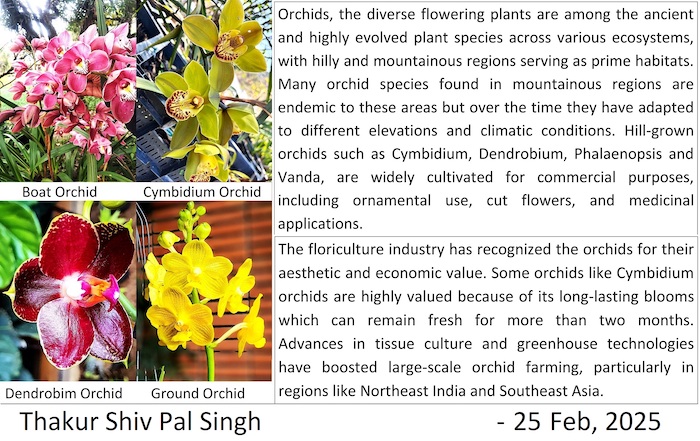
‘Jumellea fragrant’ is used to flavour rum on Reunion Island of France. The botanical wonders were initially employed for medicinal purposes; as a source of herbal remedies in China. Orchids have been used since the Vedic period some orchids have been used by Indians for their curative and aphrodisiac properties.
- Orchids, both species and hybrids, are collectors’ delight. Way back in 2015, here in Aseem Cottage, Shimla; I tried multiplying my orchids, I had carried from Meghalaya. To my surprise, they grow on their fads and fancies. It was a futile effort, despite homemade fertilizers made from milk, tea, eggshells, and even boiled rice water. Perhaps, the colder climate was not conducive.
Orchids are cultivated for the enjoyment of the flowers. Species like ‘bee orchid’, ‘fragrant orchid’, ‘pyramidal orchid’ and ‘common spotted orchid’ are available at nurseries. They are sustained in hot and humid summers and mild to cold winters.
Many orchids are pollinated by the male bees hovering over the flowers. In some specialized orchids, the petal is adapted that attract male insects via mimicry of a receptive female. Pollination happens as the insect attempts to mate with flowers. Some orchids rely on self-pollination, especially in colder regions where pollinators are rare. The ‘slipper orchid’ reproduces by self-fertilization.
In India, growing the orchids commercially is not organized and is still in the hands of hobbyists and a few dealers who mainly depend on wild collections from the forest to meet a large part of their foreign and local demands.
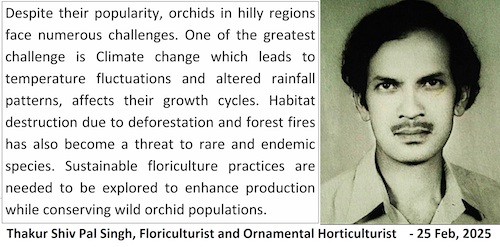
“Orchidomania,” of the Victorian era- a craze for collecting and discovering orchids had reached extraordinary levels.
The ‘flower madness’ is surfacing back in modern times. There are umpteen societies and clubs worldwide to encourage the cultivation and collection of orchids. There are others engaged in conservation or research.
Almost all orchids are included in the Convention on International Trade in Endangered Species (CITES), restricting their international trade.
International Orchid Day takes place annually on the first Thursday of September.
http://hillpost.in/2017/12/akaash-ka-chhoona-pan/109864/

Prof. (Er.) Chander P Mahajan is an art critic & a free lance journalist. The Environmentalist stays in Shimla and Dalhousie, Himachal Pradesh, India.