
For the Jaintias, rituals were more than ceremonies-they were expressions of faith, gratitude, and the enduring relationship between human beings, the Creator, the ancestors, and the nature. Whether preparing for the sowing of seeds, embarking on a hunt, or cleansing the village of evil, every important undertaking began with prayer and symbolic acts that sought harmony, protection, and divine guidance. These sacred traditions, passed down through generations, reflect the spiritual richness of Jaintia culture and the values that sustained community life.
Thoh Langdoh: Preparing the Earth for Life
Among the sacred rituals of the Jaintias, Thoh Langdoh holds a special place because it marks the ceremonial beginning of the agricultural season during the observance of Behdieñkhlam. While Behdieñkhlam is widely recognised as a festival to drive away plague, disease, and evil, it is equally a celebration deeply rooted in the agricultural life of the Pnar people.
Before anyone could plant cucumbers, pumpkins, beans, or other vegetables, the ritual of Thoh Langdoh had to be performed. The ceremony sought the blessings of the Creator for fertile soil, favourable weather, and a season of abundance. Only after this sacred rite were villagers permitted to begin planting their vegetable crops, signifying that cultivation should commence only after divine approval had been sought.
Beh Ser Soopen: The Sacred Hunt
Before the hunters entered the forest, the village assembled at the sacred altar. Hunting was never regarded as a mere pursuit of food but as an undertaking that required divine guidance and respect for the natural world.
The priest offered prayers and carefully cracked an egg, reading its signs to seek the blessings of the Creator and the ancestors. From the sacred omen, he determined the direction in which the hunters should travel, believing that the spirits of the forest would reveal the safest and most fruitful path.
With spears in hand and blessings upon them, the hunters entered the forest. When the hunt was successful, the animal was brought back with reverence to the altar. There, prayers of thanksgiving were offered before its meat was shared among the entire community, reminding everyone that nature’s gifts were never for one person alone but for all.
Cher Iung Blai: Driving Away Evil
When the time came to cleanse the village of misfortune and evil influences, the men gathered to perform the ancient rite known as Cher Yung Blai.
Together they built a small hut from bamboo and fresh grass on the outskirts of the village. The humble structure symbolically became the dwelling place into which all harmful spirits, sickness, and ill fortune were drawn.
Armed with spears, the men circled the hut while prayers were offered. At the appointed moment, they rushed forward and thrust their spears into the structure, symbolically destroying the forces of evil and driving them away from the community.
As the ceremony ended, the villagers believed that peace had been restored, the village purified, and harmony renewed. The ritual served as a powerful reminder that the well-being of the community depended not only on physical strength but also on unity, faith, and the collective resolve to overcome darkness with courage.
Ka Siang ka Pha: Honouring the Ancestors
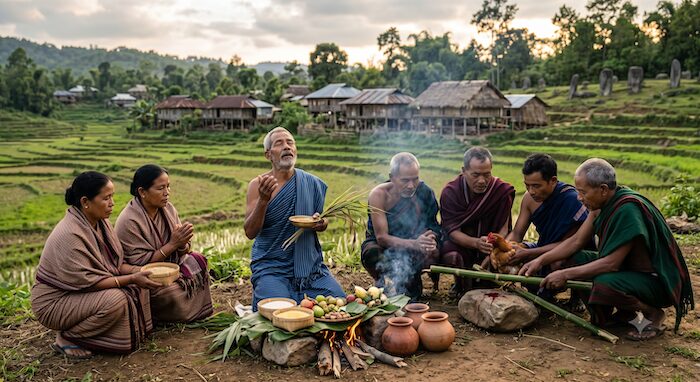
Among the most revered sacred traditions of the Jaintias is Ka Siang ka Pha, a ritual of ancestor veneration that marks the beginning of the annual Behdieñkhlam festival in Jowai. Celebrated on Ka Pynsiñ, the sixth day of the traditional eight-day Pnar week, the ceremony officially inaugurates the three-day and four-night festival.
The ritual begins with families and clans preparing offerings of food for their departed ancestors. More than a ceremonial feast, it is an expression of gratitude, respect, and remembrance for the forebears who laid the foundations of the clan and preserved its traditions. Through this act, the living reaffirm their bond with those who came before them.
According to the Jaintia belief in the afterlife, the souls of the departed dwell with the Creator, where they partake of betel nut in the courtyard of His abode. Once each year, during Behdieñkhlam, these ancestral spirits known as Ki Syngngia Ki Saret are believed to return briefly to the earthly realm to receive the offerings lovingly prepared by their descendants. The ritual serves to honour and propitiate the departed, while seeking their blessings for the well-being and prosperity of the family.
Ka Siang ka Pha is traditionally observed by every clan. However, families that have recently experienced a bereavement or are affected by serious illness do not perform the ceremony, as the offering to the deceased would already have been made during the funeral rites. This observance reflects the continuity of Jaintia beliefs concerning life, death, and the enduring relationship between the living, their ancestors, and the Creator.
More than a ritual of remembrance, Ka Siang ka Pha affirms one of the central tenets of Jaintia spirituality: that death does not sever the bond between generations. Instead, it strengthens the sacred continuity of family, tradition, and faith, reminding each generation that the ancestors remain an integral part of the community’s spiritual life.
Ka Siang Ka Pha — offerings of food and fruits prepared with reverence for the ancestors during Behdieñkhlam.
Source: Wyrta
Ka Sngi Kylliang Ka Nongkylliang: The Sacred Duty of Neighbourly Compassion
Beyond its sacred rituals, Jaintia spirituality has long been expressed through the ethical values that governed daily life. Among the noblest of these is the principle of Ka Sngi Kylliang Ka Nongkylliang, a cherished teaching of Niamtre that calls upon neighbours to stand by one another in times of need, sharing not only labour and food but also comfort, compassion, and encouragement. It embodies the belief that the well-being of every individual is inseparable from the well-being of the community.
The spirit of this principle is beautifully illustrated in the cultural tradition known as E Ja Khonbo.
According to tradition, a woman of the Ryngkhlem clan migrated from Tuber to Jowai with her two daughters, Ka Talanglato and Ka Piahrah. Following the death of their mother, the sisters came under the care of the priest U Langdoh at Loomiongkjam. In due course, both married and established families of their own.
During this period, U Langdoh’s sister died in childbirth, leaving behind an infant. He entrusted the care of the child to the two sisters. Since Ka Piahrah had recently given birth herself, she nursed both infants. The physical demands of caring for the two children soon weakened her, and she became frail.
Moved by compassion, the neighbours began bringing food each evening to support the two sisters during their difficult circumstances. Witnessing this spontaneous expression of kindness and solidarity, U Langdoh declared that such acts of mutual care should become an enduring social custom, thereafter known as E Ja Khonbo.
This tradition is more than a touching story; it reflects the moral foundation of Jaintia society. Compassion, mutual assistance, and communal responsibility were regarded not merely as admirable virtues but as sacred obligations. The practice reminds us that the customs of the Jaintias emerged from deeply rooted principles of empathy, generosity, and collective care.
Today, these values continue to inspire reflection on the importance of community life and neighbourly responsibility. The tradition of Ka Sngi Kylliang Ka Nongkylliang reminds us that caring for one another is a timeless ideal that finds expression during occasions such as Linam, when families, friends, and neighbours gather to offer prayers, comfort, and support to the bereaved. More than a custom observed at times of loss, this principle encourages mutual care in every season of life, calling upon each generation to strengthen the bonds of compassion, generosity, and shared responsibility that have long been cherished in Jaintia society.
Modernity, individualism, and the pressures of contemporary life have gradually weakened the close bonds that once defined village society. The willingness to care for one’s neighbours once regarded as a sacred duty is too often replaced by distance, indifference, and isolation.
Yet the principle of Ka Sngi Kylliang Ka Nongkylliang was never intended to be observed only during bereavement. It is a philosophy of everyday living. It calls upon individuals to stand beside one another in times of illness, hardship, loneliness, and the many quiet struggles that often remain unseen. It teaches that faith is demonstrated not only through ritual observance but also through acts of kindness, generosity, and shared responsibility.
In this sense, the values of Niamtre remain profoundly relevant today. They remind us that a meaningful life is measured not solely by personal achievement but by our willingness to serve others, strengthen our communities, and uphold the bonds that unite us. By reviving the spirit embodied in Ka Sngi Kylliang Ka Nongkylliang and E Ja Khonbo, the Jaintia community preserves not only an ancient indigenous faith but also a timeless philosophy of humanity, service, and social harmony.
Conclusion
The sacred rituals and moral traditions discussed in this chapter-Thoh Langdoh, Beh Ser Soopen, Cher Iung Blai, Ka Siang ka Pha, and the enduring principle of Ka Sngi Kylliang Ka Nongkylliang-represent only a small part of the rich spiritual and cultural heritage of the Jaintia people. Together, they reveal a worldview in which faith is not confined to places of worship or ceremonial occasions but permeates every aspect of life, shaping humanity’s relationship with the Creator, the natural world, the ancestors, and the wider community.
Each tradition embodies a distinct yet complementary dimension of Jaintia spirituality. Thoh Langdoh teaches that the blessings of the earth must be sought with humility before cultivation begins. Beh Ser Soopen reminds us that nature is not to be exploited but approached with reverence, gratitude, and divine guidance. Cher Iung Blai symbolises the collective responsibility to safeguard the community by restoring harmony and overcoming the forces of misfortune. Ka Siang ka Pha affirms that the bond between the living and the departed endures beyond death, preserving the continuity of family, memory, and faith. Ka Sngi Kylliang Ka Nongkylliang, expressed through the tradition of E Ja Khonbo, extends these sacred values into everyday life, teaching that genuine faith is demonstrated through compassion, mutual service, and neighbourly responsibility.
Taken together, these traditions present a holistic philosophy of life founded upon gratitude, humility, respect, and shared responsibility. They teach that human flourishing depends upon living in harmony with the Creator above, the earth that sustains us, the ancestors who guide us, and the community with whom we share our lives. In this understanding, spirituality is inseparable from ethical conduct, and religious devotion finds its fullest expression in service to others.
Although many of these practices have evolved in response to changing times, the values they embody remain timeless. In an age marked by rapid social change, individualism, and cultural transformation, the wisdom preserved within Jaintia traditions offers enduring lessons on environmental stewardship, communal solidarity, reverence for life, and the dignity of human relationships. Preserving these sacred rituals and moral teachings is therefore not merely an act of cultural conservation but a reaffirmation of a living philosophy that continues to inspire succeeding generations.
To understand the sacred traditions of the Jaintias is to appreciate more than a collection of ancient ceremonies. It is to encounter a civilisation whose religious life, social ethics, and cultural identity have long been united by a profound belief that faith is most meaningful when it nurtures harmony with God, with nature, with our ancestors, and with one another.
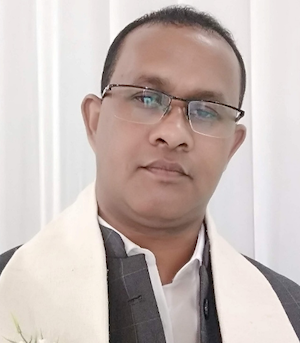
Dr Omarlin Kyndiah is an Associate Professor in the Department of Biochemistry at St. Edmund’s College, Shillong, India, where he has been teaching since 1997. Beyond academia, he served as General Secretary of Sein Raij Niamtre Shillong (Meghalaya) from 2008 to 2024, a congregation representing the indigenous Niamtre faith