Life, many a time, does not happen in bold letters. It unfolds quietly, in the margins, between the sentences we think define our days. We plan for the big moments—decisions, achievements, milestones—but what stays with us often belongs to the spaces in between: a pause in conversation, an unplanned walk, a half-remembered tune drifting through the afternoon. These moments are easy to overlook because they do not announce themselves. They arrive without urgency and leave without documentation. No reminders, no notifications. And yet, they shape the texture of our lives far more gently and persistently than the grand events we prepare for.
A day actually passes not as it appears on a schedule, but as it is lived. Between meetings, there is the walk to the window. Between tasks, there is the moment of staring at nothing in particular, just infinity. Between responsibilities, there is the quiet satisfaction of finishing a cup of tea while it is still warm. These moments are not productive, but they are deeply human. We are taught to value outcomes. Results, conclusions, summaries. The lines themselves. The moments between the lines are where we catch our breath, where we remember ourselves, where we quietly make sense of what has just happened.
Travel reveals this beautifully. We remember destinations, but what lingers are the in-between spaces: the view from a train window, a conversation with a stranger, the feeling of waiting for transport in an unfamiliar town. These moments do not advance the journey, yet they become the journey. The same is true of relationships. We remember anniversaries and significant conversations, but intimacy grows in smaller moments. In shared silences, inside jokes, routine phone calls that say very little and mean quite a lot. The strength of a relationship is often measured by how comfortable the quiet moments become.
Reading, too, lives between the lines: not merely in what the writer has written, but in how the reader relates to the page, to the words on the page, emotionally and experientially. A sentence reminds us of something unrelated. We pause, wander into memory, then return. That pause is part of the reading experience. It is where the text meets life. Without those pauses, reading becomes mechanical. Even creativity depends on these in-between moments. Ideas rarely appear when we demand them. They arrive while doing something else, walking aimlessly, staring at the ceiling. The mind needs empty spaces to rearrange itself. The moments between the lines are not gaps; they are incubators.
Modern life, however, has grown impatient with these spaces. We fill pauses with screens, silence with sound, waiting with scrolling. Every gap is treated as wasted time. But in filling these spaces, we lose something subtle. We lose the ability to be gently bored, to daydream, to notice what is quietly unfolding around us. Boredom, after all, is not always the enemy. Sometimes it is simply the doorway to noticing. When we stop rushing to fill every moment, our attention sharpens. We begin to observe details we would otherwise miss: the rhythm of footsteps, the way light shifts across a room, the comfort of familiar sounds.
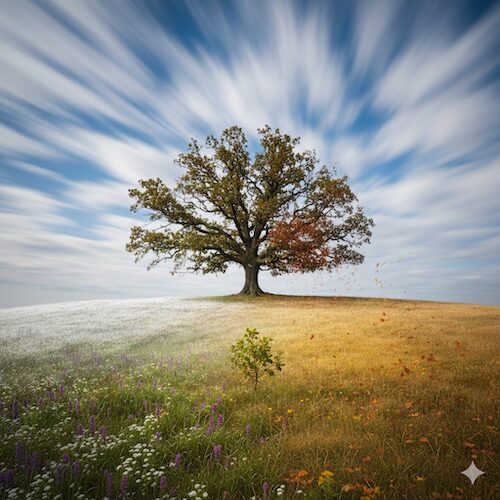
Nature exists almost entirely between the lines. The growth of a tree, the movement of clouds, the change of seasons—none of these are dramatic if you watch them moment by moment. Their power lies in accumulation. They remind us that life does not need constant punctuation to be meaningful. There is something deeply reassuring about routines for this reason. Morning walks, evening tea, habitual radio programmes, familiar routes. These routines create spaces where nothing much happens, and that is precisely their gift. They hold life steady while everything else shifts.
In conversations, the moments between the lines are often the most revealing. A hesitation before an answer. A smile that lingers. A shared laugh over something insignificant. These are not recorded in transcripts, but they carry emotional truth. They tell us how someone really feels, beyond what is said. Even learning happens here. Understanding rarely arrives the moment something is explained. It settles slowly, through repetition, confusion, and sudden clarity while thinking about something else entirely. The older we grow, the more we begin to recognise the value of these quiet intervals. We realise that life is not only about what we achieved, but about how it felt to live through it. The remembered warmth of an afternoon, the comfort of routine, the calm after finishing something small. Such moments remind us that it is acceptable to slow down, to not always be progressing visibly. Life is not a performance that requires constant proof. Some moments exist simply to be lived.
Even silence has a role to play. Silence between words allows meaning to settle. Silence between people allows connection to deepen. Silence between thoughts allows clarity to emerge. Without these pauses, life becomes noisy but shallow. Choosing to notice moments between the lines is a quiet act of attention. It is the decision to stop rushing toward the next highlight and instead inhabit the present more fully. It does not require major lifestyle changes, only a slight shift in awareness.
Perhaps this is why certain memories feel so vivid. They belong not to dramatic events, but to ordinary days that unfolded gently. A slow afternoon, a familiar voice, a walk taken without purpose. These moments do not compete for importance, yet they endure. Life is lived in fragments, pauses and passing moments. The lines may tell the story, but the spaces between them give it depth. And when we learn to pay attention there, we often discover that those quiet, unnoticed moments were never empty at all— they were simply waiting to be felt, to make us feel alive, to awaken us to life.

Rachna Vinod is a multilingual poet, writer, blogger and broadcaster, proficient in Hindi, Urdu, English, and Dogri. Her works have been broadcast through multiple media platforms, including All India Radio. In addition to her books, her articles and creative pieces are regularly published in both print and online literary magazines. She has made significant contributions to literature with over 20 individual publications and participation in more than 25 collaborative anthologies.
A Few Published Works:
Urdu: Yasmeen-e-Sughandh, Mere Humsafar
English: Eternal Heritage, Shahada Aisha, I Am Here Only, Bridging The Gap, Lotus Lore, Kashmir Konnectivity: A Biosketch
Hindi: Ankahi Sargam, Pighalte Himkhand (poetry collection), Madhyaratrik Kshan, Parvaton Ke Dayare (short story collection)
Dogri: Adaya Madaya Geeten Bharya, Hirkhi Phuhar, Aakhi Lai Dile Di Gall