
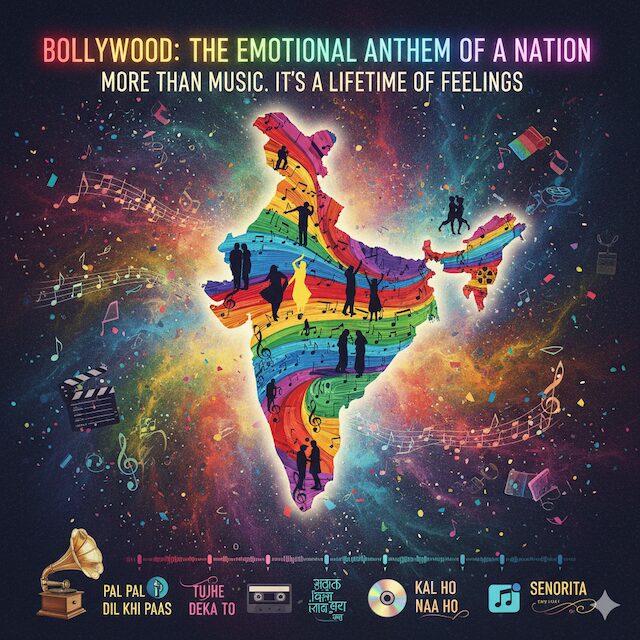
Bollywood songs are more than just a part of cinema—they are part of the emotional vocabulary of an entire nation. For more than a hundred years, Hindi film music has shaped how millions of people feel, remember, celebrate, mourn, and dream. A Bollywood film becomes truly memorable when its music lingers long after the credits. Songs arrive before the film itself, creating curiosity and feeling even before the story unfolds. People hum lyrics without knowing the plot, attach personal meaning to melodies originally written for fictional characters, and carry those emotions into their own lives. From weddings to heartbreaks, from festivals to quiet nights of longing, Bollywood songs accompany us like private companions.
The story of Bollywood music is essentially the story of how India listened to itself evolving. In the 1950s and 60s, composers created melodies that were soaked in classical ragas, folk tunes, and poetic lyricism. These songs were shared experiences—people didn’t merely consume them, they lived inside them. Families sat around radio sets during programs like Binaca Geetmala, waiting to hear the nation’s current favorite song. The voices became immortal: Lata Mangeshkar with her crystal purity, Mohammad Rafi with his emotional range, Kishore Kumar with his playful, unpredictable spontaneity, and Asha Bhosle with her bold, sensuous versatility. Their voices were not just recordings but presences. They shaped the romantic imagination of generations who believed that to love meant to sing.
The 1970s and 80s brought a new flavor. Bollywood songs adopted Western influence—guitars, synthesizers, disco beats—yet never abandoned emotion. Composers opened musical windows to the world, mixing jazz, Latin rhythms, rock elements, and Indian classical in a way no one else could.The era reflected urbanisation, changing lifestyles, and a youth becoming aware of its identity. The music could be mischievous, philosophical, romantic, or rebellious—all in one album. Songs like “Chura Liya Hai Tumne,” “Roop Tera Mastana,” or “Dum Maro Dum” did not just entertain; they altered the musical DNA of Bollywood forever.
With the 1990s came the golden wave of melody married to mass appeal. The era reimagined Bollywood music not just as entertainment but as sonic architecture. Compositions were not just tunes; they were atmospheres. Each layer of the arrangement carried emotional weight—soft flutes, subtle electronic textures, harmonies inspired by global cultures. Films like Roja, Bombay, and Dil Se proved that a song could be political, spiritual, romantic, and contemporary all at once. Simultaneously, composers championed simplicity in melody. Their songs revived the idea of romance as something gentle, respectful, almost worshipful. The lyrical era of “Pehla Nasha” and “Tum Dil Ki Dhadkan Mein” made every teenager believe love was not just possible, but cinematic.
Lyrics have always been the soul of Bollywood songs. In the early decades, lyricists were poets first and screenwriters second. Sahir Ludhianvi questioned society; Shailendra wrote from the heart’s inner softness; Gulzar infused abstraction, memory, and fragrance into language; Javed Akhtar balanced philosophical clarity with emotional warmth. A single line from a Bollywood song could hold universal truth: “Tere bina zindagi se koi shikwa toh nahi,” or “Main pal do pal ka shayar hoon.” Lyrics turned personal emotions into shared experiences. Even today, when someone falls in love or faces loss, the language they reach for is often a Bollywood lyric.
The 2000s witnessed a transformation in technology and taste. Music production became digital, films became global, and so did their soundtracks. Composers introduced fusion with a new boldness. They blended folk with rock, electronic with classical, Sufi with pop. A new generation of singers arrived with unmatched vocal finesse, classical tenderness, energy and power and emotional vulnerability. Bollywood music no longer came from the radio—it came from mp3 players, USB sticks, and eventually from streaming platforms that turned personal playlists into private universes.
Bollywood songs also reflect cultural diversity. They carry Punjabi beats, Rajasthani folk, Bengali angst, Kashmiri softness, and Tamil rhythmic structure. Bollywood songs create a sense of belonging among the Indian diaspora. The moment a dhol beat begins, differences melt. Everyone knows the steps, or at least pretends to. As emotional passports—they transport Indian identity across borders.
Yet, the journey has not been without criticism. As remix culture became dominant, some feared originality was dying. The re-creation of classics, often with heavier beats and reduced lyrical depth, raised debates. Was Bollywood losing its poetic soul? But even within commercialization, moments of brilliance kept appearing. In between item numbers and dance hits, there remained space for quiet confession, for music that touches the pulse.
What makes Bollywood songs eternal is their emotional utility. They do not merely exist; they function. They help someone confess love, muster courage, heal a broken heart, or celebrate a personal victory. A young person in a hostel room plays an old romantic song and suddenly feels less alone. A family on a road trip turns into a choir, singing lyrics from three different generations. Bollywood music tells people that emotions are not weaknesses; they are evidence of being alive.
The role of Bollywood songs in shaping memory is profound. People remember entire phases of their lives through a song. A tune can bring back the smell of a monsoon afternoon, the taste of roadside tea, the trembling nervousness of a first proposal, or the bittersweet ache of saying goodbye. Songs act like personal archives. When someone says “This song is my life,” they mean it literally. A three-minute composition becomes a diary page.
Bollywood songs have adapted to every technological evolution—from vinyl to cassettes, CDs to digital downloads, and now streaming algorithms that recommend tracks based on mood. But no matter how the medium shifts, the emotional need remains unchanged. India needs music to feel alive. Bollywood continues to supply that emotional oxygen. Whether in the hushed poignancy of a ghazal, the pounding rhythm of a dance track, the soulful gaze of a romantic ballad, or the passionate plea of a Sufi song, Bollywood music understands the heart’s restlessness.
Even in the age of AI and short-form content, a song still holds the power to stop someone mid-scroll, to make them close their eyes for just three seconds and feel something true. The power of Bollywood songs lies in the fact that they make every listener believe—they are the hero of their own story. In the end, that is Bollywood’s gift: the ability to transform ordinary lives into cinematic moments.

Rachna Vinod is a multilingual poet, writer, blogger and broadcaster, proficient in Hindi, Urdu, English, and Dogri. Her works have been broadcast through multiple media platforms, including All India Radio. In addition to her books, her articles and creative pieces are regularly published in both print and online literary magazines. She has made significant contributions to literature with over 20 individual publications and participation in more than 25 collaborative anthologies.
A Few Published Works:
Urdu: Yasmeen-e-Sughandh, Mere Humsafar
English: Eternal Heritage, Shahada Aisha, I Am Here Only, Bridging The Gap, Lotus Lore, Kashmir Konnectivity: A Biosketch
Hindi: Ankahi Sargam, Pighalte Himkhand (poetry collection), Madhyaratrik Kshan, Parvaton Ke Dayare (short story collection)
Dogri: Adaya Madaya Geeten Bharya, Hirkhi Phuhar, Aakhi Lai Dile Di Gall