
My hookah is a magnificent work of craftsmanship. Cornered gracefully in my cottage, it looks peevishly at me, as if it could be rewarmed ever. I wonder if it is a leftover artefact.

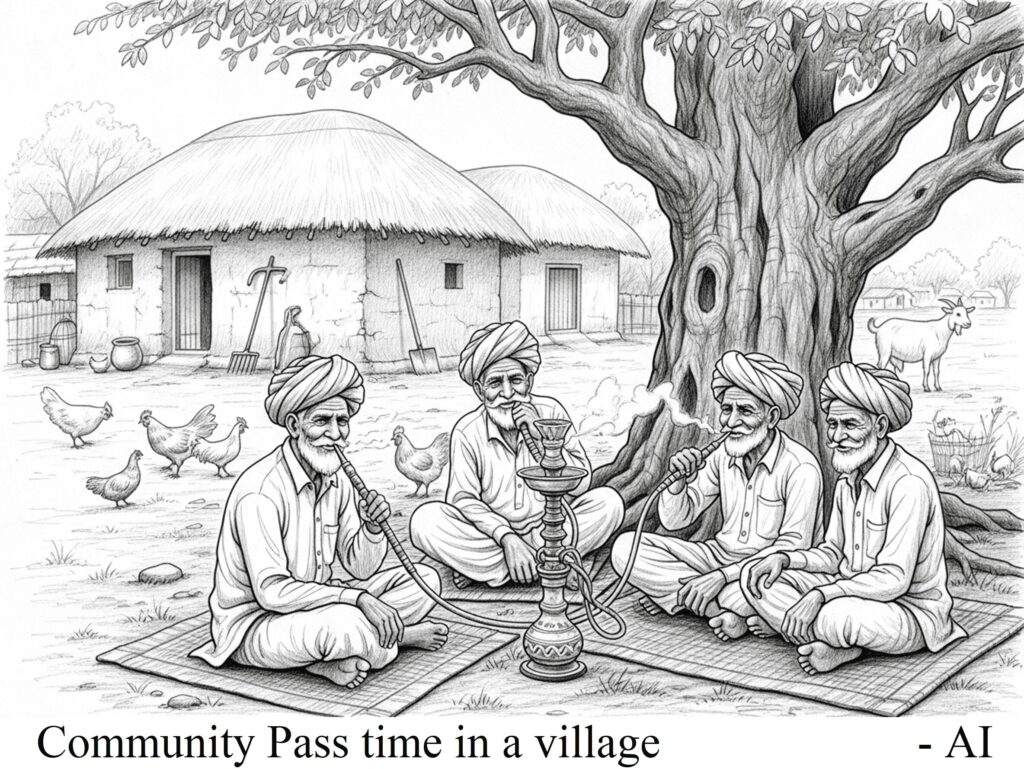
I have fond memories of the hookah hose being passed around the congregation, partaking to one’s choice.
Once it was an object of recreation in the Chamba Club, gaining popularity in the mid-seventies. Blowing smoke rings, an artful portrayal, is fun and frolic.
Elsewhere, it may be smoked as a social pastime.
- A physician in the Mughal court envisoned a system that allowed smoke to be passed through water to be ‘purified’ when puffed, cooled and filtered before inhalation.
That excited the great Mughal emperor Akbar to take up smoking, and the smoking of hookah and hubble-bubble started in India.
Hookah had become a status symbol for the Indian nobility and high society.
My Nana ji, Rambheja Shah, smoked hookah till he was, perhaps, ninety-eight.
- The ‘arrangement’ is known by different names. “Lula” In Albania, “chillim” in Afghanistan, “Jajeer” In Kashmir, “Guduguda” in Maldives, and so on.
Locally known, in South Africa, as a hubbly bubbly – an okka pipe, is also popular among the Indian populations.

In the Arab world and the Middle East, people smoke water pipes as part of their culture and traditions.
- Small hookahs were sculpted from coconut shells. Most hookahs are still produced with older technologies.
Placed below is the AI description: –
The Indian hookah (also called hukka or hubble-bubble) has a simple but clever mechanism that uses water filtration and suction to cool and smooth the smoke before inhalation. Its mechanism is quite traditional and has been used in villages and towns for centuries.
Here’s how it works:
Main Parts of an Indian Hookah-
o Chillum– the clay or brass bowl at the top where tobacco (often mixed with molasses and flavours) is placed, covered with burning charcoal.
o Jali / Net– a small perforated plate that keeps charcoal separated from the tobacco.
o Stem / Pipe– the vertical pipe that connects the chillum to the water base.
o Base– usually made of brass, copper, or clay, partially filled with water.
o Hose / Tube– a flexible pipe made of leather, cloth, or plastic through which the smoker inhales.
o Mouthpiece– the tip of the hose used for inhaling.
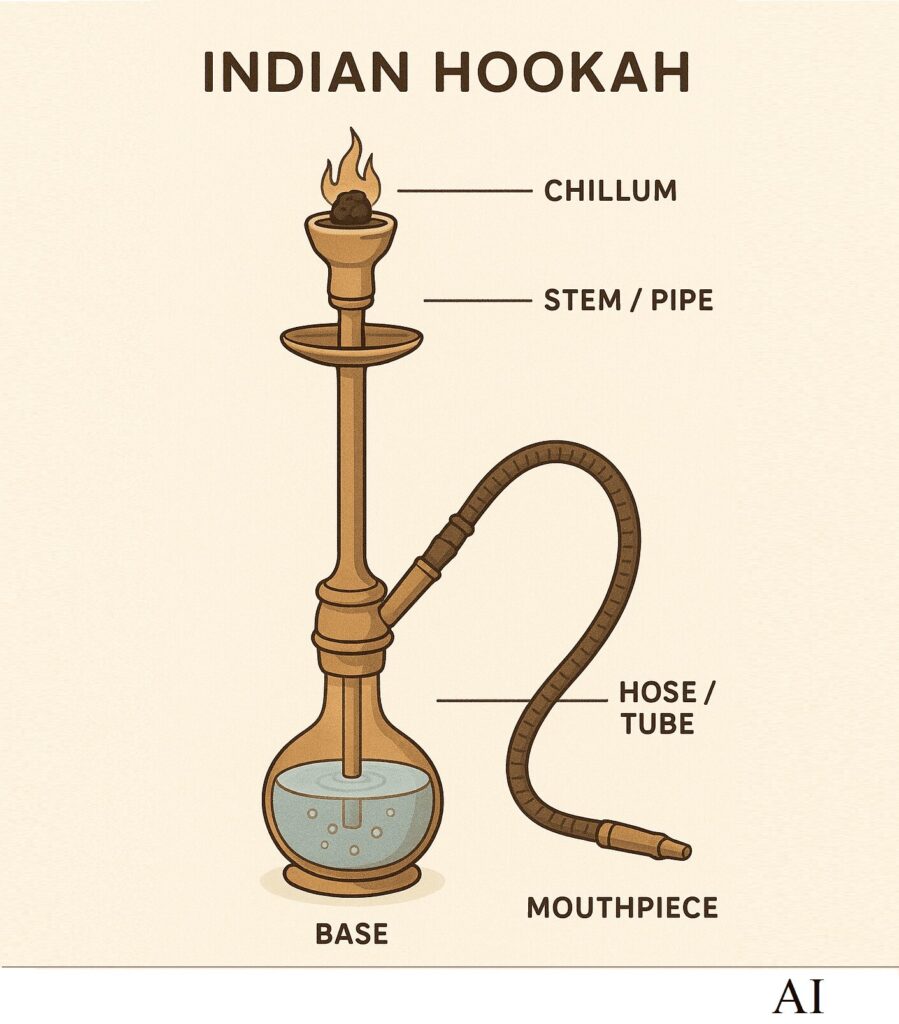
Mechanism of Working-
o Ignition – Tobacco and other herbal mixtures are placed in the chillum, topped with live charcoal.
o Suction – When a person inhales through the hose, it creates negative pressure inside the base.
o Air Flow – This suction pulls hot air through the burning charcoal, which heats and vaporises the tobacco mixture, producing smoke.
o Water Filtration – The smoke then travels down the stem into the base filled with water. The smoke bubbles through the water, which cools it down, removes some ash/impurities, and moistens the smoke.
o Inhalation – The cooled and filtered smoke rises into the hose and is inhaled by the smoker.
In earlier days, smoking was often associated with high society and glamour. In cinema, Smoking was frequently used to frame characters. In the Hindi film
Aaram (1951), Durga Khote has nostalgia for her face being puffed over with pipe smoke by her late husband.
Some particulate matter is removed before the smoke is inhaled by the user. While the water can cool and humidify the smoke, it does not filter out all harmful chemicals and heavy metals, making its use a public health concern.
While once seen as sophisticated, it is now largely viewed negatively due to the well-known health risks.

Prof. (Er.) Chander P Mahajan is an art critic & a free lance journalist. The Environmentalist stays in Shimla and Dalhousie, Himachal Pradesh, India.