One of the most beautiful high altitude passes in Himachal, Chandrakhani pass is the traditional gateway to the state’s most famous and mysterious village, Malana. Along with its twin, the Rasol pass, it also connects the valleys of the Beas and Parbati rivers.
The trek begins from the tiny hamlet of Rumsu (1800 meters), about six kms. above the historical village of Naggar on the left bank of the Beas, 20 kms below Manali. It is well worth spending a few hours in Naggar and visiting its two landmarks: Naggar castle, a well preserved building from where the Kings of Kullu ruled before they shifted to Kullu town; it then became the residence of the British Resident, and today is a hotel. The second landmark is the Roerich museum, dedicated to the paintings of this legendary Russian artist with a passion for the Himalayan landscape.
One climbs gradually from Rumsu in a SE direction through dense forests of deodar, fir, and horse chestnut, crossing two big “thatches”- Stelling thatch and Dhankarari thatch. From the latter one gets a panoramic view of the entire Pir Panjal range to the north and can clearly see Friendship, Patalsu, Hanuman Tibba, and Shittidhar peaks and make a guess at the location of the Kalihani pass behind which lies the forbidding Bara Bhangal valley. At Dhankarari the track abruptly swerves eastwards, following the ridge line, and after another two hours one reaches the first day’s camping site, Chaklani ( 3300 m.), a huge thatch surrounded by dwarf rhododendron which were in full bloom when we arrived there, ringing the pasture in a haze of pink and mauve. Chandrakhani pass is visble now, about 2 kms away, its massive but gently inclining flanks completely carpeted with spruce, birch, and betula (bhojpatra) till about 200 meters below the saddle from where the snow took over. It was a lovely sight, made magical by the rays of the setting sun.

It snowed that night and in the morning crispness we could see that the pass had a two to three feet thick mantle of snow. Covering the two kms to the pass was no problem, but once on the saddle we had to be extremely careful for it slopes sharply to the left and ends in a precipice. Half a kilometre on the saddle and we arrived at the narrow aperture on the ridge line which is the Chandrakhani pass itself (3700 m). Legend has it that Jamlu devta (or Jamadagni rishi), the presiding deity of Malana who had kept all the other minor gods in his closed fist, once came to the pass and flung them all to the winds. They were wafted to all parts of Kullu, which is why every village and valley of Kullu has its own devta. They all collect even now in Kullu town during the Dussehra, but Jamlu devta does not join in the festivities because he considers them all inferior to him; instead, he watches the proceedings from the heights of Bijli Mahadev, another lofty peak nearby.
From the pass the track drops sharply to the south-east, a precipitous 5000 feet or so to the Malana gorge and the village which takes its name from it. It’s a knee crushing descent, made slightly bearable by the magnificent vistas to the east-the soaring peaks of Indrasen and Deo Tibba and the Malana glacier below which is spread out the Nagroni pasture, a full day’s trek away.
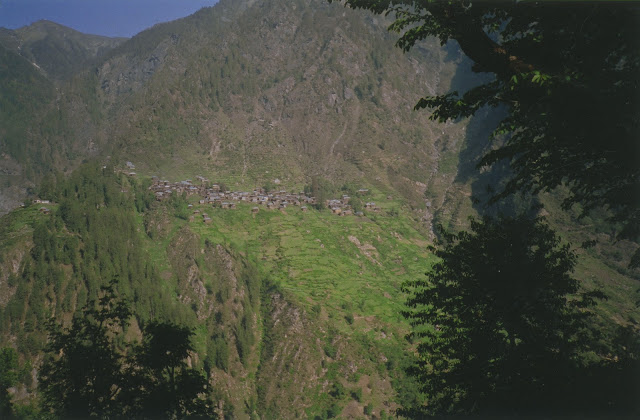
The unfortunately (and undeservedly) infamous Malana village is attained in four hours; it’s large by mountain standards, about 150 well constructed wooden houses, situated 200 meters above the gorge. Its residents are believed to be descended from AWOL soldiers of Alexander’s army who deserted the Greek general when he reached the Indus, fed up of the continuous fighting. Malana is thought to be the oldest democracy in the world and still has its own “Parliament” which makes laws and passes decrees. It resolves all disputes and people are forbidden to go to the police. It is ruled with an iron hand by Jamlu devta: till a couple of decades ago even the Deputy Commissioner or the Police Superintendent could not enter the village without the devta’s approval! But things are now changing and the splendid isolation which enabled Malana to preserve its unique culture for hundreds of years is now being nibbled away. The prime culprits are two hydel projects on the Malana stream, a few hours away. Their roads have made access easier, hundreds of outside labour have brought their own influences, Malana’s own youth are now going out, finding jobs, and coming back with modern ideas and habits. The govt’s relentless drive to “civilise” this oldest of civilisations means that the hey days of this unique culture are all but over.
What will prevail, however, for a longer time is the famous Malana Cream, the best cannabis in the world. Cultivated by Malanians as their prime cash crop, it is smuggled out in huge quantities and has many exotically named variants: AK47, Russian Mist, Space Ball etc. The police wage a losing battle to eradicate this crop even though destroy hundreds of acres every year. The villagers simply shift deeper and higher into the forested terrain they grew up in, which the out-of-condition cops can barely negotiate. My sympathies are with the hardy folks of Malana- this is their only economic activity, practised for generations untold, and the govt. has failed to provide them any alternative livelihood. The state govt. is now making efforts to legalize the growing of cannabis for non-narcotic purposes.
Because of the cannabis connection, the Malanians do not welcome outsiders and we were advised not to stay in the village but to camp outside. We spent the night in a “dogri”, a rough hut in the forest with the not unpleasant aroma of hash all around! The next day brings another 1000 meter strenuous climb to Rasol pass (3200 meters), beyond which is the Parbati valley. The descent from here is as precipitous as the previous day’s, through a dirty little village called Rasol. It is another eight kms. to Kasol, a tourist hub on the banks of the Parbati with its dozens of guest houses, pizza parlours, billiard halls and ATMs. I, however, much preferred the spartan isolation of Malana and the unparalleled beauty of Chandrakhani.

| The author retired from the IAS in December 2010. A keen environmentalist and trekker he has published a book on high altitude trekking in the Himachal Himalayas: THE TRAILS LESS TRAVELLED.
His second book- SPECTRE OF CHOOR DHAR is a collection of short stories based in Himachal that was published in July 2019. His third book was released in August 2020: POLYTICKS, DEMOCKRAZY AND MUMBO JUMBO is a compilation of satirical and humorous articles on the state of our nation. His fourth book was published in July 2021. INDIA: THE WASTED YEARS – chronicles all the missed opportunities in the last nine years. His fifth book – THE DEPUTY COMMISSIONER’S DOG AND OTHER COLLEAGUES – released in September 2023, portrays the lighter side of life in the IAS and in Himachal. He published his sixth book, DISAPPEARING DEMOCRACY-DISMANTLING OF A NATION in March 2024; it is a commentary on events from 2021 to the present, a sequel to THE WASTED YEARS. Shukla writes for various publications and websites on the environment, governance and social issues. He divides his time between Delhi and his cottage in a small village above Shimla. He blogs at avayshukla.blogspot.com |