
1. Introduction
The rich, centuries-old cultures of the hills of Himachal Pradesh are vanishing at an alarming rate. While much of this heritage has already been lost, there is still time to study and document the unique language, music and dance, and social fabric of these societies. These cultures have been neglected mainly because their richness and diversity have not been recognised: they were considered shallow and not worthy of serious study.
This article is about the rapidly disappearing western Pahari languages of the hills – using the form used in Ilaqa Kotgarh, about 80 km north of Shimla as an example – that, remarkably, have systematically and significantly more vowels and consonants than Sanskrit: The common phonetic systems of Sanskrit and Hindi are now written in the Devanagari script that, depending on which distinct sounds are considered, requires 49 characters – 16 for the vowels and 33 for the consonants (excluded in this count are ligatures, or ‘combined’ consonant sounds such as ksha, gya, and tra ). A remarkable feature of the Pahari language, the subject of this article, is that it has 29 additional sounds – 6 extra vowels and 23 additional constants. So, using Devanagari with 29 diacritical marks to represent these additional sounds is not a practical option.
These local languages have all the elements of a modern language to describe the fabric of society: such as a well-structured grammar, rich vocabulary, aphorisms, idioms, metaphors, “poetry” and storytelling. Since dialects can vary greatly over short distances, describing them as “Western Pahari” or “Sadochi” indicates how poorly these language structures have been mapped. The local cultures also have several well-developed genres of folk music, with strong traditions of dance. And the unique cooperative societal structure of the upper hills – dominated by a Hinduism-based devta culture – reflects how difficult surviving without help was.
In a series of articles, of which this is the first, this culture loss will be discussed through changes over the past 75 years in Ilaqa Kotgarh. The main purpose of this article is to create an awareness of the richness of this cultural heritage, thereby generating support for its sustenance and documentation.
The longer story about the major changes taking place in the language, social structure, music, dance, and religious practices of this region is not written by an anthropologist or a linguist or a musician. Rather, the author is a research engineer who, till 1990, had taken little interest in the local culture. As such, the author must be excused for the many errors that professional anthropologists, linguists, and musicians might find – their critiques would help in correcting such errors. He became interested in the local language while trying to understand why outsiders from the Indian plains could not properly pronounce Pahari words; and in the local folk dance because he observed that the strong rhythm for the dance was synthesised by orchestrating three percussion instruments, in contrast to the Indian classical music tradition which does not have orchestration.
The initial effort to separately understand the language – which introduced him to various aspects of linguistics – and the music-dance tradition gradually evolved into a fascinating, holistic look at all aspects of the local culture, which showed that language, societal structure, devta culture, and music and dance are inseparably intertwined. In this sense, language is more than just a means of communication, explaining why it is very difficult to translate nuances of feelings from one language to another. Hopefully, critiques of this story will get professionals interested in documenting and “saving” the very diverse cultural heritage of Himachal Pradesh.
The search for a framework in which to embed the nascent Pahari sounds fortunately led the author to Sanskrit, which he had not studied as a student. Fortunate, because Sanskrit has the most highly developed phonetic system – in which the articulation of sounds is arranged in a very scientific manner – of any language. Of course, this phonetic articulation system – the Varnmala – is the same as in Hindi, which every student of Hindi learns. Unfortunately, almost all students of Hindi and Sanskrit are not aware of the scientific basis of this Varnmala – one of the true gems of our ancient heritage! Because it helps in classifying the phonetics of the Pahari language, this scientific basis of articulation in Sanskrit/Hindi is first explained in detail in the sequel.
This article on the local language, is an updated version of a longer study on the Language, Social Structure and Devta Culture, and Music and Dance, documented in “Vanishing Cultures of Himachal: The Example of Ilaqa Kotgarh,” which appeared in the June, 2012 issue (Vol. VI. No. I) of Vidhanmala, a magazine published by the Himachal Pradesh Vidhan Sabha. Other aspects, such as culture, and music and dance, will be addressed in subsequent articles.
The discussion of the language is preceded by a brief introduction to Ilaqa Kotgarh.
2. Ilaqa Kotgarh
Ilaqa Kotgarh is a small area located 80 km north of Shimla, 18 km beyond Narkanda on the old Hindustan-Tibet mule trade route to Tibet through the Shipki pass. After the Gorkha War (1814-1816), in 1815 this small enclave became a part of Punjab province under British administration until independence in 1947. It was surrounded by small princely states, the largest of which was Rampur Bushahr.
In 1843 British missionaries opened a school, later called the Gorton Mission School, in Kotgarh, the administrative hub of the Ilaqa. St Mary’s Church in Kotgarh was consecrated in 1873.
The Arya Samaj started the Himalaya Anglo-Sanskrit Middle School in village Dhada (now Virgarh) in 1920. Samuel Evan Stokes, who later became Satyanand Stokes, started a primary school near his home in Barobagh in 1923. This progressive school evolved into the Tara High School, students of which passed the Punjab Matriculation Board Examinations as private candidates in 1930, 1931 and 1932. In comparison to the surrounding autocratic princely states, this easy access to education resulted in the Ilaqa accepting more progressive ideas.
The original people of this Ilaqa, mostly disaffected migrants from the surrounding states, were very independent, very proud and confident of themselves, with few interactions with the surrounding areas; they did not venture beyond the Ilaqa until motorable roads were built in the late 1940s. This isolation resulted in a homogeneous culture with a common language, music and dance tradition, and societal mores forming a cultural base that proved resistant to change, most likely changing very slowly over hundreds of years.
In contrast to the surrounding princely states, Ilaqa Kotgarh was dry from 1815 until well after independence, and alcohol – the use of which was frowned upon – could only be purchased at the boundaries with the princely states. A policy change by Chief Minister Ram Lal Thakur in the 1980s, combined with increased income from apples, resulted in wide-spread alcohol abuse, and a belief in the younger generation that dance or socialising are not possible without drinking alcohol.
Urdu, which became the court language of the British Raj (East India Company) in 1837, was also the primary language of instruction in the schools until 1947, so that Urdu words (Ilaqa as an example), modified to suit the phonological structure of the local language, began to be absorbed into the local vocabulary. English had a much smaller influence. Hindi started to have an impact well after Independence when Sanskritised Hindi began to replace the mixed Hindi-Urdu vocabulary of Hindustani. Ideas from outside the Ilaqa, through books and newspapers, had very little influence on the local culture because of the isolation and very low literacy rates.
Although radio broadcasts were available in India since the 1930s, well before motorable roads in the Ilaqa in the 1940s, they again had little effect as very few people could afford radios. The author remembers hearing an All India Radio broadcast of Mahatma Gandhiji’s funeral in Delhi on January 31, 1948 on a radio run by a storage battery charged by a small wind mill. Radio broadcasts from Shimla started on June 16, 1955.
Increasing contact with the burgeoning post-independence Indian bureaucracy shattered the self-confidence of the local people: For the first time, they were intimidated by the better educated and better dressed outsiders who looked down on them as uneducated country bumpkins, resulting in people wanting to emulate the cultural values of these outsiders. Although the commercial success of apples in the late 1950s brought unheard of riches to the local people, some of whom were then able to educate their children in sophisticated schools, the lack of confidence continued. Having acquired a thin veneer of western cultural values, these better educated people tended to look down even more on the local culture, which they associated with being backward.
3. Language
The languages spoken in the mountains are generically referred to as Pahari, and those of Shimla District fall under “Western Pahari”. Two older subdivisions of Shimla were Seraj that included Kotkhai, and Sadoch (Sandoch), of which Ilaqa Kotgarh was a part. As such the language spoken in this Ilaqa can be considered as a dialect of “Sadochi”, which has also been referred to as Kotgarhi. While it does not have a script, as will be shown, it has a very rich phonology.
In the early 1990s the author was intrigued by the inability of English- and Hindi-speaking people to correctly pronounce local Pahari words. This awareness resulted from his having studied in the local school system until the age of nine, when the phonological structure of the local language was imprinted on his mind at the age at which such “hard wiring” of the brain occurs. The quest to understand this “phonological blindness” led the author on a very fruitful, fulfilling journey, which resulted in a much deeper understanding of the local language, the subject of the sequel.
At this stage it suffices to point out that, in addition to almost all the consonants and vowels of Sanskrit, the local language has additional aspirated nasals not present in Sanskrit and Hindi, but used in Marathi, Urdu, and Sindhi, and additional vowels and consonants used in Marathi. This local dialect also has a much richer vowel set than Sanskrit and Hindi, and includes a rich use of diphthongs and nasalized vowels. It is for this reason that outsiders cannot pronounce Pahari words that contain sounds that they have not been programmed to recognize.
3.1 Language and Phonology
While a script – which does not exist for Pahari – is important for documenting and communicating thoughts and ideas, it is the phonology, or sound system, of the language that characterises its speech. As shown in Section 3.2, in these days of computers a script can easily be developed to describe a sound system. Such a script can then be used for capturing the vocabulary of the language and to then record history, stories, aphorisms, and lyrics of songs.
In languages such as English, in which letters of the alphabet do not represent unique sounds, much time is wasted in learning to spell words. Indians are blessed with their languages being phonetic: each script symbol, with very few exceptions, corresponds to a unique sound.
Sanskrit provides the best, systematic classification of the sounds used to articulate languages, which is used in most Indian languages. The Devanagari script, common for writing both Sanskrit and Hindi, is easily the most recognized script in India. However, the phonological structures of Sanskrit and Hindi do not cover all possible sounds of all languages. For example, because Sanskrit and Hindi do not have the English “Z” sound, a person only knowing Sanskrit and Hindi will pronounce ‘zed’ as ‘jade’ and “zebra” as ‘jibra’. Similarly, because these two languages do not have the English ‘F’ sound, they cannot pronounce ‘fish’ which would be articulated as ‘phish’. While one might consider such pronunciations amusing, they represent speakers using their ‘internally wired’ phonetic maps to articulate the closest sounds perceived by their internal sound repertoire.
More importantly, Sanskrit and Hindi do not even include all the sounds of existing Indian languages. As examples, Urdu does have the “F” (fay) and “Z” (zay) sounds to accommodate which the Devanagari script is modified by placing dots below the symbols for ‘ph’ and ‘J’ sounds to represent the ‘F’ and ‘Z’ sounds, respectively. A dot under the letter for the hard “D” (as in donkey) is used to represent the retroflex “r” sound in the Urdu-derived word “larki” (“kanya” in Hindi). And a dot under the aspirated “D” for the aspirated retroflex “rh” sound in the Urdu-derived word “parho” read).
Such changes in script are not uncommon: For example, consider the script for Urdu, the genesis for which is Arabic (a Semitic language) that has 28 characters. With the advent of Islam in Persia, 4 letters – ‘pay’, ‘zhay, ‘gaaf’, and ‘chay’ – were added to this script to accommodate the four existing sounds in Farsi (an Indo-European language) which has 32 characters. Then, with the Afghan/Persian conquest of India, Urdu, which literally means the language of the camp, or soldier, evolved as an Indian language with Arabic, Farsi, and “Hindi” root words and the grammar of Khari Boli, the form of Hindi spoken in Delhi at that time. But, because Arabic and Farsi do not have aspirated sounds, the Arabic-Farsi script had to be extended to accommodate the many aspirated sounds that Indian languages have – such as the ‘kh’ sound that follows the ‘k’ sound. In Urdu script, this was achieved by using the “do chashmi hay” (two-eyed ‘hay’): adding this symbol to one representing a consonant converts it into the aspirated equivalent of the sound, such as, for example ‘ k + h = kh ’ , ‘ g + h = gh ’ , ‘ p + h = ph ’ , and ‘ b + h = bh ’ . In all, Urdu has 14 such aspirated sounds, called ‘heavy letters’ (‘bhari haroof ’) – of which ten ( kh, gh, ch, jh, Th, Dh, th, dh, ph, and bh ) exist in Sanskrit/Hindi, while the remaining four ( lh, mh, nh, and Rh ) are used in Pahari – had to be added to complete the 46 characters used in Urdu.
Since Pahari has more sounds than Sanskrit, the Devanagari script would have to be modified to accommodate the new set of sounds, requiring an even more complex typing scheme than for the already burdensome scheme for Hindi. One alternative would be to use the International Phonetic Alphabet (IPA), used in linguistics to spell words of all languages. However, this would impose the additional burden of having to learn a non-intuitive script.
Recognizing that scripts for Indian languages do not have upper- and lower-case letters, the use of the 26 lower-case and 26 upper-case letters of the Latin (Roman) alphabet provides 52 symbols for representing each sound by a unique symbol. The main disadvantage of this scheme is aesthetics: words will be made up of lower- and upper-case symbols. Also, sorting words would follow the ordering of the Latin alphabet.
Another issue is the display order of the symbols – to follow the International Phonetic Alphabet (IPA) or the Sanskrit scheme? The latter one is adopted because of the familiarity with this scientific system used in Indian languages.
3.2 Transliteration Scheme for Sanskrit and Hindi
Sanskrit sounds in Devanagari script are arranged systematically into vowels, consonants, semivowels, Sibilants and Glottal Stop. Many of the vowels are arranged in short and long versions. The scheme adopted for the transliteration of vowels is shown below in Table 3.1: The first row has the Devanagari letters, the second row shows the transliterated symbols (Latin letters), and the third row shows the IPA symbols.
Table 3.1 Latin alphabet transliteration scheme for Sanskrit/Hindi vowels.

In this transliteration scheme, the apostrophe “ ’ ” represents the nasal “ang”; it nasalises any letter preceded by it. And the colon “ : ” represents “ah”. Of the four Sanskrit vowels ri, rii, li, and lii only the first is used in Hindi; the last two are rarely used in Sanskrit. Note that in an earlier version of this transliteration scheme an underscore “ _ ” was used to represent the nasal “ang”; this has been replaced by an apostrophe to facilitate typing. For example, the Pahari word bhu’gu (owl) was earlier transliterated as bhugu.
Several comments on the vowels of Sanskrit/Hindi are in order: First, although for articulating (pronouncing) the long and short vowels in a two-vowel set, such as i and ii for example, the lips form the same external shape – as shown in Figure 1 – the internal position of the tongue may be different; the “longer” vowel is not just of longer duration, but is also qualitatively different. Second, only four pairs of vowels – i, ii; u, uu; ri, rii; and li, lii – have long and short versions. The external positioning of the lips for the vowels u and uu are shown in Figure 2. For pronouncing the not so often used vowels, rii, li, and lii the tongue has to be in in a retroflex position. Of them, only ri is used in Hindi, like in the words riShi, riN, ritu, kripa, wriksh, kriShAk, and Amrit (The sounds represented by sh and Sh are indicated in Table 2.3). While rii and li, are used in Sanskrit, lii is very rarely used. Almost all students, and even teachers of Hindi, do not know how to articulate these vowels.
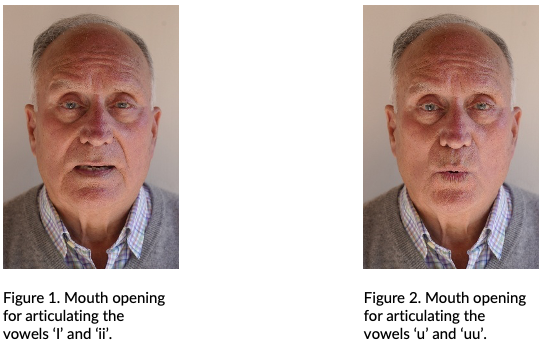
The ‘ee’ and ‘oo’ vowels only come in the long form. Interestingly, the short versions, ‘e’ and ‘o’, of these two long vowels are present in Kanada and Telegu.
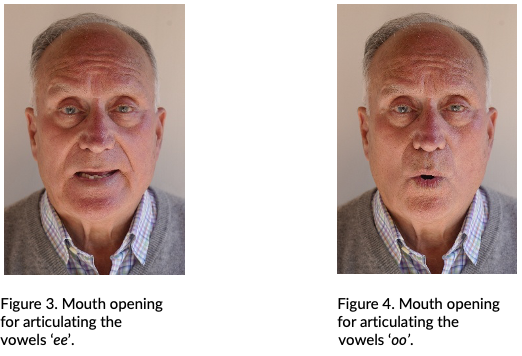
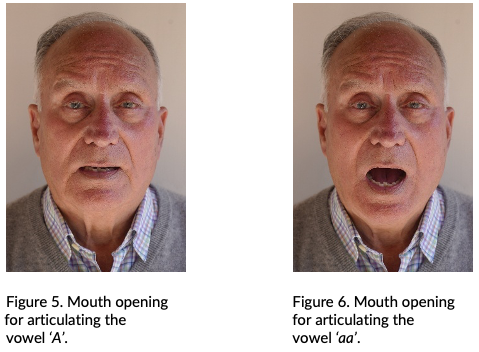
A common impression most people have is that the first two vowels in Sanskrit and Hindi ‘A’ and ‘aa’, are the short and long versions of the same vowel. That this is not so can be seen by observing the external shape made by the mouth and jaw for articulating the “short” and “long” vowels: The lips are only slightly open for the short vowel ‘A’ (schwa) but have to be separated more by opening the jaw for the long vowel aa, as indicated in Figures 5 and 6. The author became aware of this difference only after he found that Pahari has the short form ‘a’ of the long vowel ‘aa’, and that it does not have the first vowel ‘A’ of Sanskrit/Hindi (Section 2.3).
The consonants of Sanskrit/Hindi are shown in Table 3.2. They are first grouped in rows according to how the vocal tract and the tongue are arranged (Velar, or back of mouth; Palatal, or mid-point of mouth; Retroflex, or tongue curled back against palate; Bilabial, or mouth exit shaped by both lips; Dental, or tongue touches teeth). The significance of the letters U, UA, V, VA (M), and N in the heading row are explained in the text following Table 3.2.
Table 3.2 Sanskrit/Hindi consonants in Devanagari script.

Note that in the Devanagari script, the letter for each consonant represents the base consonant sound together with a default vowel ‘A’, so that, for instance, ‘k’ represents the consonant ‘k’ together with the vowel ‘A’ , that is, ‘kA = k + A’.
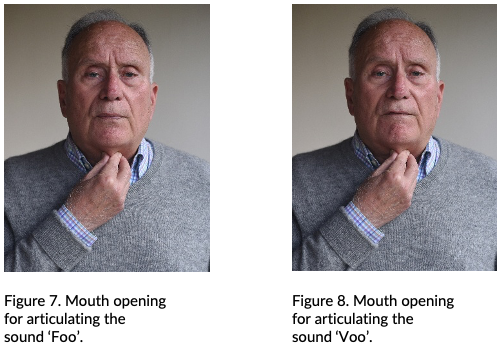
To appreciate the wonderful, scientific basis for how the sounds of the Sanskrit/Hindi letters are arranged, the three ways of producing sounds – other than the positioning of the lips and tongue alluded to above – must be understood: First, sounds can be produced with or without vibrating the vocal fold (‘vocal cords’). To get a feel for this, press the thumb and first two fingers against the Adam’s apple, as shown in Figure 7. Then, in this position, continue to articulate (pronounce) the sound of ‘Foo’ – notice that the thumb and fingers do not feel any vibration. Next, with the thumb and first two fingers still touching the Adam’s apple (Figure 8), continue to articulate (pronounce) the sound of ‘Voo …’ – notice that in this case the thumb and fingers sense vibration. So, sounds can be produced without vibrating the vocal fold (vocal cords) – such sounds are said to be unvoiced, and are represented by the letter U on the top of Table 3.2. Sounds that are produced by vibrating the vocal fold are said to be voiced, and are represented by the letter V.
The articulation of any sound can be accompanied by the expulsion of air, as in the articulation of the ‘kh’ sound. To get a feel for this sound producing mechanism, hold the open palm of a hand close to the lips, as shown in Figures 9a,b. With the palm in this position pronounce the letters (sounds) ‘k’ and ‘kh’ in succession – notice that the articulation of ? will be accompanied by expulsion of air that can be felt on the palm; sounds accompanied by the expulsion additional air are said to be aspirated and are represented by the letter A.

With this superb classification, the sounds of Sanskrit/Hindi in Table 3.2 are then grouped into columns according how the sound is produced: (1) unvoiced sounds (vocal fold not vibrating) represented by the letter U; (2) voiced sounds (vocal fold vibrating) represented by the letter V; and (3) aspirated sounds accompanied by the expulsion additional air represented by the letter A; (4) a voiced sound accompanied by a “weak” aspiration called a murmured sound represented by the letter M; and (5) a nasal sound produced by shutting the passage to the mouth by lowering the uvula and forcing air through the nose, represented by the letter N. In this elementary introduction, the murmured sound, M, may be assumed to be the same as an aspirated sound.
For this classification of sound production, the transliteration scheme shown in Table 3.3 will be used for representing the sounds of Sanskrit/Hindi by letters of the Latin (Roman) alphabet: Each consonant will be represented first by the Latin letter having the same sound. The aspirated or murmured sound for a letter will be represented by that letter followed by a lower-case h. Thus, in this scheme, the most guttural consonants – those in the first row – will be written as k, kh, g, gh, ?. Below each letter, within brackets, is the corresponding IPA symbol.
Table 3.3 Latin alphabet transliteration scheme for Sanskrit/Hindi consonants with [IPA transliteration].


Note that each consonant (sound) of Sanskrit/Hindi, represented in Devanagari script by a single symbol, is enunciated and written with an attached, default ‘A’ sound. For instance, the symbol kA, consist of the consonant sound ‘k’ together with the vowel sound ‘A’, i.e., k + A = kA. Although Sanskrit and Hindi use the same Devanagari symbols for the same sounds, there is a slight difference in how the same written word is pronounced: As an example, consider the word “ kamal ” for the lotus flower that in both Sanskrit and Hindi is written as ‘kAmAlA’. While in Sanskrit it will be pronounced as kAmAlA, in Hindi it is pronounced as kAmAl. In Hindi the ‘A’ sound in the last consonant is dropped. It can also be dropped in the middle of a word, such as for example in sArAknaa (‘A’ missing between ‘k’ and ‘n’ ) and nAmkiin (‘A’ missing between ‘m’ and ‘k’ ). Thus, while Sanskrit written in Devanagari script is fully phonetic, Hindi is not because the ‘default’ “A’ sound attached to all letters can also be dropped in the middle of a word.
3.3. Phonological Structure of Pahari (Kotgarhi)
As pointed out above, Pahari does not have the ‘A’ sound, so the consonants cannot be articulated with a default A sound as in Sanskrit and Hindi. As such, the transliteration scheme for Pahari will encode the basic consonant sounds without any attached vowel. And to make it easier to differentiate them from non-Pahari words, Pahari words will be set in a larger italic font.
While Pahari does not have the ‘A’ sound, it has many more vowels not present in Sanskrit/Hindi, the transliteration scheme for which is shown below in Table 3.4.
Table 3.4 Latin alphabet transliteration scheme for Pahari (Kotgarhi) vowels.
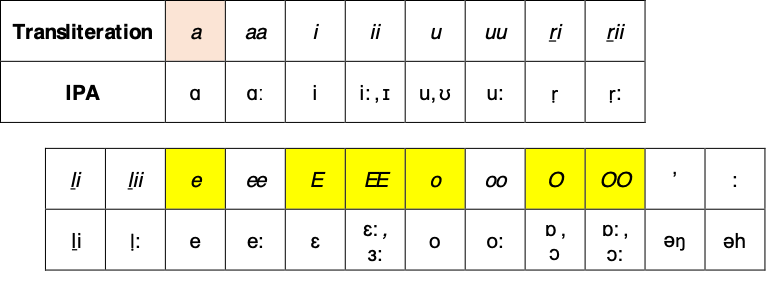
Noteworthy in this vowel set are the following differences from the Sanskrit/Hindi vowels: (1) Pahari does not have ‘A’, instead it has the short vowel ‘a’, the long form of which, ‘aa’, is present in Sanskrit/Hindi; so, this change (indicated by the light orange box) does not affect the number of vowels in Pahari. (2) Pahari has the short forms ‘e’ and ‘o’ of the long forms ‘ee’ and ‘oo’. While these short vowels do not exist in Sanskrit/Hindi, they are used in Kanada and Telegu. (3) Other non-Sanskrit/Hindi Pahari vowels are E , EE , O , and OO : The short vowel E sounds like the short vowel ‘e’ in the English word “bed”, and the long vowel EE sounds like the long vowel ‘a’ in the English word “man”. The short vowel O sounds like the short vowel ‘o’ in the English word “lot”, and the long vowel OO sounds like the long vowel ‘o’ in the English word “born” or like the English vowel sound ‘ou’ in the word “mourn”. The six extra vowels are placed in yellow boxes.
The Sanskrit vowel ri, is certainly used in Pahari – as in the name riShi , where the sound Sh of is defined later – but, as in Hindi, rii; li and lii are likely not used in Pahari. They are, however, included for comparison with the sound system of Sanskrit.
The transliteration scheme for Pahari consonants, without any attached default vowel sound, is shown below in Table 3.5, in which the extra consonants in Pahari beyond Sanskrit are in yellow boxes.
Table 3.5 Latin alphabet transliteration scheme for Pahari (Kotgarhi) consonants.

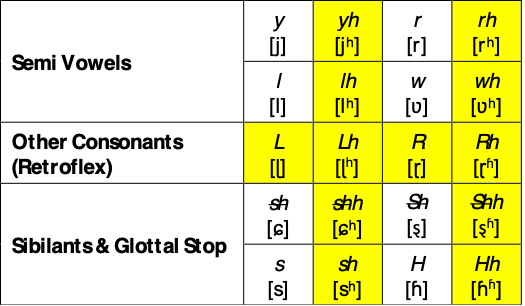
In addition to all the consonants of Sanskrit/Hindi, Pahari has a sixth column of aspirated nasals, some of which also exist in Marathi, Urdu, and Sindhi.
Another noteworthy difference is a complete row of Alveolar consonants C , Ch , Z , Zh , Ñ , and Ñh . The articulation scheme for producing these sounds is the same as that for producing the “Z” sound in English. The first four of these exist in both Marathi and Pahari; for the present the last two sounds, whose use in Pahari have yet to be established, are postulated for completeness. Interestingly, while Marathi also has the Sanskrit Palatal consonants c , ch , j and jh , the same symbol is used for both rows. For example, c and C are represented by the same symbol. As a result, the Marathi script is not fully phonetic and the sound value of the common symbol for both rows has to be known in advance!
Although the existence of many sounds in Pahari (Kotgarhi) have been postulated, at this stage the use of all of them has not been established. For example, words using the aspirated sounds yh, shh, Shh, sh, ñh, and Ñh have yet to be found.
Pahari has “aspirated vowels”, i.e., the ‘h’ sound can be used after a vowel. For example, the Pahari word for house is gOOhr, not ghOOr, and that for clarified butter (ghii) is gihu, not ghiu.
The use of this transliteration scheme will be illustrated in the next section through Pahari words.
The absence of ‘A’ in Pahari results in a major change in how Pahari-speaking persons recite the Varnmala (Devanagari Alphabet); the default ‘A’ sound is replaced by the ‘O’ sound. As a result, the vowels A , aa are articulated (pronounced) as OO, aa, and the first row of consonants is articulated as kOO, khOO, gOO, ghOO. By asking a person to recite the Hindi Varnmala, this variant pronunciation can be used to identify persons who learned Hindi in Shimla District schools, where, remarkably, many Hindi teachers continue to teach this Pahari pronunciation! The absence of the A sound in Pahari causes changes in how Hindi words are pronounced by Pahari speaking people. Some examples: Ashok, Neeraj, Priyanka, and Sutlej are pronounced as shook, niirj, prE’ka, and stluj, respectively.
This is not unusual: When persons with a ‘wired’ phonetic ‘vocabulary’ of sounds, such as those of Devanagari, hear sounds outside this ‘vocabulary’, they replace them with the closest sounds they are used to. As an example, because Devanagari does not have the OO sound, Hindi speakers will pronounce the English word door as ‘Door’, while its correct pronunciation should be DOOr, the Pahari word for fear.
3.4 Some Pahari Words
In keeping with its mountain-based agriculturally driven culture, Pahari has a rich vocabulary for different kinds of snow, soils, weeds, flour from different grains, animals, and everyday living.
First, a look at numbers from one to twenty in Pahari : eek, dui, cOOn, Caar, pa’Z, ChOO, sat, aTh, nO’O’, dOsh, gEEra, baara, Teera, COuda, pO’dra, sooRa, sOtra, Thaara, Ni’i’, bii. Clearly, the Pahari words for the first twenty numbers use the three additional sounds C, Ch and Z from the Alveolar row, and R.
Pahari counts in twenties: Beyond 20, the count proceeds as ek biE eek, ek biE dui, ek biE cOOn, …. Thirty would be ek biE dOsh, but is now called tii. Similarly, 40, 50, … ( ek biE caar, ek biE pa’Z … ) are now referred to, respectively, as CaRi, pZaa, shaT, sOtr, Oshi, nObE, shOO.
The use of the aspirated (murmured) voiced Alveolar sound Zh is illustrated by the Pahari phrase bOld ZhuZia, in which the first word stands for the English word bull and the second refers to the “horse play” between two bulls trying to push each other by butting their heads. Notice the use of both Z and Zh in the same word. Also, ZhukRi for wood.
Next consider the use of the aspirated nasals Nh, nh and mh. The first is used in Nhi’mku (jumping hard on a wooden floor during an indoor dance) and in NhE’NO’ (also hNE’NO’) – notice the simultaneous use of both Nh and N – the name of a village, which in Hindi is now called HAlyaanaa!
The use of mh, lh and wh are illustrated by the words mhakO (fly), lhOsN (garlic) and whari (offering of wheat or barley to the deo during puuZa).
Relatives: ii (mother), baab (father), na’a’n (maternal and paternal grandfather), sENi’ (maternal and paternal grandmother), bORObaab and HOknbaab (elder and younger brothers of father, respectively) – both now also referred to as kaak, bODi ii and HOkni ii (wives of elder and younger brothers of father, respectively), bui (father’s sister), ma’a’m (mother’s brother), ma’mi’ (mother’s brother’s wife), daad (brother), dai (sister), ra’Du, or gOhraRO (husband), ThOldi, or bOOThi, or gOhraRi (wife), shOOrO (father-in-law), shashu (mother-in-law), Za’O’i’ (husband’s elder sister), nORn (husband’s younger sister), saRO (wife’s brother), saRi (wife’s sister), Zwa’i’ (son-in-law), bOu (daughter-in-law), bha’NZO, bha’NZi (sister’s son, daughter), bhau (generic word for young boy), Cei (generic word for young girl).
Animals, Birds & Insects: bOld, gaO (bull, cow), baChTu, baChTi (calf, young cow), riTh, bheeR (ram, ewe), gaphTu (young ram), bakrO, bakri (goat, doe), Chelu (young goat), su’gr, su’gri (pig, sow), kukr, kukri (dog, bitch), Chaotu (puppy), brERO, brERi (tomcat, queen cat); ci’u’khu (bird), TelO (bird chick), kukhRO, kukhRi (cock, hen), pooRu (chick), kaO (crow), bhu’gu or uuR (owl), u’mbRkao (bat), TuThlO (woodpecker), shuu (parrot), bhriuRi (sparrow), shEri (mynah), Cakur (partridge), krEETO (Himalayan Magpie), bnaaR (Himalayan Monal), ChEpO (hawk), CkrEE (eagle), gOlD (vulture), diuRi (firefly), totO (ladybird), phimpRi (butterfly), mhakO (fly), mhaCr (mosquito), geohl (beetle), ghrE’shO (spider), Ci’i’T (ant), jhimRi (wasp), RgooR (bumble bee).
Days and Years: While Hindi uses one word, kAl, for both yesterday and tomorrow, Pahari has different words for today ( aaZ ), yesterday ( HiZ ), day-before-yesterday ( phOrZ ) and the day before that ( thnOrZ ); it also has different words for tomorrow ( kalE ), day-after-tomorrow ( pOrshi ), and the day after that ( COOthE ).
HOptO (week), bOrsh (year), ashu (this year), pOOr (last year), praar (two years back), ntraar (three years back), agli bOrshE (next year).
Days of the week: twaar, swaar, mu’gR, budh, brest, shukr, shnicr. Days of the lunar month: CEtr, bshEE, ZeTh, shaR, shaON, bhOdr, shOOj, kati, mE’gshr, pOsh, magh, phaguN. The first day of each lunar month is called saZO.
Colours: The main colours in Pahari are shuklO (white), kaRO (black), ChiCO (beige), ratO (red), and pi’u’RO (yellow). Pahari does not distinguish between blue and green; both are called OhrO. CitbRilO refers to a ‘salt and pepper’ mixture of black and white.
Size, Directions and Taste: bODO, bODlO (large, larger), mhaTO, mhaTlO (small, smaller), bakRO (thick), patRO and mhiin (thin), bilDO (wide), sa’gRO (narrow), jE’drE (in the middle), ZeThO (elder), kOnO’ (younger), ubi (up), Hu’di (down), gaashE (above), tooshE (below), lu’Nw’O’ (salty), khaTO (tart), miiThO (sweet), kODuO (bitter), tatO (hot), sheRO and ThaDO (cold).
Linear, Volumetric and Weight Measures: The smallest linear measure, the width of a finger, is the O’gR. bi’i’t is the distance between the tip of the thumb and the little finger of an extended hand. shO’O’ is the length from the elbow to the tip of the middle finger. These nonstandard measures were even used by tailors. The basic measure for volume is a taTh, a metallic cylindrical vessel having a diameter of about 180 mm and a height of about 75 mm (7 and 3 inches) with a volume of about 2 litres (115 cubic inches). Then, 1 seer = 0.5 taTh, 16 taTh = 1 bhaar, and 20 bhaar = 1 khaar. moRi could be distributed by the fistful ( mu’Dhkru ) or by the amount in two palms-up, hands held together ( O’dR, O’dR gidi ). The Hindi names for the basic Indian standard measures for weight were: 16 Cta’a’k = 1 seer, 40 seer = 1 mO’N. Two seer was also called a baTi.
Wool was weighed by an instrument called a tuuR. In terms of the standard cta’a’k, the local Pahari weights used with this instrument were: 1 seer = 6 Cta’a’k and 1 baTi = 2.5 seer, so that 1 baTi = 15 Cta’a’k.
Food Grains, Pulses, Vegetables, Cooked Food, Spices & Fruit: gi’i’u’ (wheat), jOO (barley), kodrO (finger millet, ragi), ogR (common buckwheat), phaprO (bitter buckwheat), dha’a’n (unhusked rice), CaOR (husked rice), ka’O’Ni’ (foxtail millet), bithu (bAthua), Chali (maize), mash (blackgram, uRAd ), CO’NE’ (chAnE’), balRi (dried beans), mOsr (lentil, mAsur), kolth (horsegram, kulthi ), pyaaZ (onion), lhOsN (garlic), TmaTr (tomatoes), mithO (fenugreek), bhi’Di (ladies finger, okra), shgotri (brinjal, egg plant), kha’a’N (food), daaR (daal, lentils), baaht (cooked rice), roti (rotii), btuuru (thick rotii made of leavened wheat flour), pkEEn (pAkaawAn), deep fried, stuffed “rotii” made of leavened wheat flour), sigRi (thick, steamed, stuffed “rotii” made of leavened wheat flour), ZroRi (barley flour “rotii”), kdroRi (finger millet flour “rotii”), ChloRi (maize flour “rotii”), lhapi (salty gruel of boiled maize or wheat), lOOTE, CilRE (crepes made of wheat flour), pTa’DE (thin CilRE), sO’NsE (crepes made of rice flour), baRi (thick porridge of wheat flour and turmeric), gNa’Ni’ (jaggery boiled in water), Cini (sugar), guuR (jaggery), mOO (honey), chOShNO (butter), Chaa (buttermilk), lu’u’N (salt), pipRi (chilies), HOlj or bsaar (turmeric), ZiirO (cumin), buhgRO (coriander), pdinO (mint), lEECi (cardamom), lO’O’g (cloves), Hi’i’g (asafoetida), du’u’Nu’ (scallion), seo (apples), nashpOti (pears), COri (cherries), khmani (apricot), arTu (peach), and luCE (plums).
Meals: People ate four meals: nwhari (at about 7:00 am) consisting of leftover ChloRi or ZroRi from previous evening, kOli (at about 9:00 am) for which the main food was lhapi, dpaari (in the afternoon) consisting of food leftover from the kOli and bturu, and bERi a full night meal which could include rice. Food was never wasted and the word basi was used to connote food cooked for a previous meal, e.g., basi ChloRi.
3.5. Some Phonological Characteristics of Pahari
Besides the absence of the A (schwa) sound – consequences of which are discussed in the second-last paragraph of Section 2.3 – a striking feature is the very limited number of words that start with the ‘v’ or ‘w’ sounds and their aspirated versions: The only words that a search has so far found are warnO (showering or throwing fruit, nuts, and moRi over a devta), whari (offering the first harvest grains to the devta), wanchThi (chanting shlokas in Pahari), and was (the place where birds roost at night).
In Hindi words starting with w (v), the ‘w’ changes to a ‘b’. Some examples: Vinod or Winod changes to bnood, Veena becomes biina – note change from N to n, and Varsha becomes bOrsha.
Another interesting shift is in the change in words adopted from Hindi that start with the VA sound gh : ghAr becomes gOOhr , ghoRa becomes gOhRO , and ghii becomes giuh . Essentially, gh is replaced by g, the schwa, A, is replaced by an aspirated Pahari vowel, such as Oh or OOh ; in the third case the vowel ii is replaced by the Pahari aspirated diphthong iuh.
In going from Hindi to Pahari, the use of the long short and long vowels is reversed. As examples, the Pahari names of the villages bhuti and bhreRi – which have the short i at the ends – in Hindi are converted, respectively, into ‘buttii’ and ‘bhAreRii’. Because of this vowel reversal, Pahari speaking people pronounce the Hindi words ‘uupar’, ‘niiche’, and ‘piiChee’ as ‘upar’, ‘niche’, and ‘piChe’.
3.6. Origin of Words
On being exposed to the structure of Pahari, people tend to ask about the origin of its words. In the past, the author maintained that he will explore their origins only after developing a proper understanding of Pahari. This section provides an elementary, introduction to this topic.
Clearly, for the longest time, the regions surrounding Ilaqa Kotgarh were essentially isolated from the influence of the ‘more educated’ hill states closer to the plains. So, the local language evolved without much outside influence. Most of interactions influencing the language would have been with Tibetan traders and with people from Kinnaur – both groups speak languages belonging to different language groups. Much later, with the British East India Company having taken over the Ilaqa in 1815, and with it having imposed Urdu as the court language in 1837, the locals would have become familiar with Urdu words relating to revenue records. And, after the first school opened in Kotgarh in 1845, in which the medium of instruction was Urdu, students became familiar with Urdu as a second language; it continued as the medium of instruction until independence in 1947. Although, under the auspices of the Nagari Pracharini Sabha, an effort to introduce Hindi using the Devanagari script was initiated in the late 1920s to the early 1930s, it had little effect on the general public. Hindi became the medium of instruction in schools after independence in 1947. So, the inclusion of loan words may be expected to be mostly from Urdu, English, and Hindi in that order.
To assess the influence of ‘surrounding’ languages on Pahari, Table 2.6 shows the equivalence of several words in Sanskrit, Urdu, Hindi, and Punjabi. The following colour coding is used to characterize the ‘origins’ of words: (1) In the Pahari word column, a light green shade is used to indicate ‘truly Pahari’ words – those that do not have any relation to equivalent words in Sanskrit, Urdu, Hindi, and Punjabi. (2) In the Sanskrit column, a light blue shade is used to indicate that the corresponding Pahari word appears to have Sanskrit roots. And (3), a light beige colour is used to indicate that the word appears to have been borrowed from another language, mainly Urdu.
Clearly, Pahari has ‘original’ words that do not appear to have roots in any of the languages considered here. As an example, the Pahari word for rainbow, phnEri , is unrelated to indrdhAnuSh: , AndArAdAkhAsh , and sAtArA’gi pi’i’ghA , respectively, the words for it in Sanskrit, Urdu, and Punjabi. Also, Pahari appears to have many words that come directly from Sanskrit. As an example, the Pahari word for ‘chaff’, tuSh , for which the Sanskrit word is tuShA , is very different from the Urdu, Hindi, and Punjabi words cokar, bhusaa (cokar), and tuuRi , respectively.
The influence of Urdu can be seen by the adoption of the words ‘paRh’ and ‘likh’ for read and write – for which, because of the absence of education prior to 1837, Pahari had no words – that in Pahari became pOR and liikh, respectively. And gradually, some Pahari words were replaced by Urdu ones. Examples; The old Pahari word sOrp for snake, has now been replaced by saap and even sa’a’p. And the Pahari word soTNO’ (to think) has been replaced by soCNO’ , the equivalent of the Urdu word ‘socna ‘.
Of the 32 (non-scientifically) chosen Pahari words, the numbers representing ‘pure Pahari’, Sanskrit, and the other three languages are 14, 8, and 10, respectively. Notice that words borrowed from Urdu tend also to have similar meanings in Hindi and Punjabi – most likely because of the common borrowings among these evolving languages. Of course, a much larger sample of Pahari words would have to be examined to determine the core of old Pahari words and those borrowed from other languages.
Table 3.6 Equivalents of Pahari words in Sanskrit, Urdu, Hindi, and Punjabi.

3.7 Some Aphorisms ( bkhna’NE’ )
Pahari has a rich set of aphorisms. As an example, while much is lost in translation, one aphorism, “ sE’NiO bool a’O’NE’O’ swaad ”, compares the “advice” of elders to the taste of aamlaa (Emblica Officinalis) which initially tastes bitter but then becomes sweet. In Pahari the meaning of this aphorism would be explained as, “ zE pEElE bolo kODuO, baad HOa tEbEE miThO ”.
As a second example, “ daru gidi laga dhNi’mE’ ”, literally, “require gunpowder for a gun to make noise,” essentially says, “Whoever has the money has the power.”
3.8 Some Riddles ( bzha’a’Ni’ )
Pahari has many riddles, all based on local culture. As an example, the answer to the riddle, “ eek mu’u’ sOrgE, dujo mu’u’ matRogE, pu’ZRi pakRi loge ” (one mouth faces the sky, the second faces the ground, and it is held by its tail), is a dhnErO, (a metal receptacle for fire and incense at the end of a long arm) used during a puZa (puujaa).
Another riddle for a bhruuRi (acorn) is, “ DaRa gai beshO ZhopO, mu’u’d na’gO, thai di ToppO ” (sitting on twig, it has a bare head but a cap on its bottom).
And “ uChTE koTE bazo bhaNO’, shaT prOORi eki ThaNO’ ” (the sound of a bhaNO’ from a high place, 60 rooms in one house) represents a RgoRO Ha’DO (RgooR bumblebee, Ha’DO nest).
4. Concluding Remarks
This article has focused on creating an awareness of the phonetic and linguistic structure of the Pahari language of Ilaqa Kotgarh, which, as described, has over one-and-a-half times more basic sounds than Sanskrit; 6 extra vowels and 23 additional consonants. Hopefully, this will attract professional anthropologists, linguists, and musicians to more completely characterize this fast-disappearing language and culture.
This incomplete story about the fast-disappearing culture of Ilaqa Kotgarh will be expanded in future articles that will explore its cooperative, work-sharing people-centred social system; a well-developed folk music system with three distinct genres – which, in contrast to the Indian classical tradition, uses an orchestrated band to play complex rhythms; and a strong tradition of three forms of folk dance.
The partial characterization of this culture partly results from the author not having the necessary training and insight for this task, but also because it has not received the attention it should have. The attempt by the author to map the individual components of this cultural heritage – such as language music and dance – in isolation, gradually evolved into an understanding of how they are part of a holistic whole, and how incomplete all facets of this story are.
In these times of exponential change, whether such isolated cultures are worth preserving is a valid question. But what is certain is that this heritage will be lost unless urgent attempts are made to preserve it.
The author would like to end this story with the lamN (Pahari poem)
Tha’DEa pa’Ni’a’a’ a’a’da Deo’da pi’i’NO’
i’di shoto sObiE, sathi na kOsiE niNO’
It is believed that we drink water after entering and just before leaving the world. In a literal translation, this lamN states: “After drinking water on being born and before dying, everything is left behind by everyone, no one takes anything with him.” Essentially, it says, “After death, everything is left behind, nothing is taken along.”
In the past, when change occurred slowly over centuries, this could be considered true: both worldly belongings and memories of culture, which did not change, were left behind. But with very rapid changes in culture, what this lamN states is now only partially true: while worldly belongings are left behind, people take away all cultural memories. Recognizing this, hopefully a state-wide movement will be initiated to document and preserve aspects of local culture.
Note: Because the Hill Post web publishing system cannot accommodate multiple fonts, words in the original text in Hindi, Urdu, and Punjabi fonts had to be deleted. For the full article, send requests to [email protected]
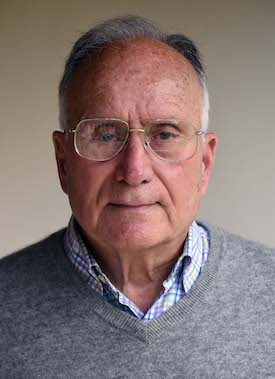
Vijay Kumar Stokes, PhD (Princeton, 1963), taught at IIT Kanpur (1964-1978), where he headed the Mechanical Engineering Department (1974-1977) and was the Convener of the Nuclear Engineering and Technology Program (1977-1978). He then worked at GE Corporate R&D (1978-2002). Besides setting up a world-class, science-based apple orchard at his ancestral home in Ilaqa Kotgarh, for over 25 years he has been documenting the local language, culture, and music and dance.

This is a truly Holy Tribute to local culture and civilization. Hats off sir!
Really insightful read about Kotgarhi culture and language, something that has been oft-overlooked in the written medium. Thank you and hope to read more in this series!
Incredibly outstanding as ever. A true tribute to our mother tongue.