
Governments never cease to surprise me, but they occasionally intrigue me, as in the two recent announcements by the Himachal govt. The first, in the middle of the devastating fury of the ongoing rains which has already claimed more than a hundred lives and inflicted damage worth more than 2000 crore rupees, stated that a Central team would be arriving soon to assess the causes for such disasters every year. The second was the revelation that the World Bank has approved a Rs. 2000 crore project to study the environmental impacts of hydel projects, particularly in the Beas river basin, and to suggest mitigating measures.
This is not just an example of shutting the stable doors after the horses have bolted, this amounts to opening the spillway after the dam has burst, to use a phrase appropriate to what is happening to the hydel projects in the state. For the fact is that the devastation, ruin and deaths that are occurring with frightening regularity every year now are something that experts and environmentalists have been warning about for more than a decade, but successive governments have refused to heed.
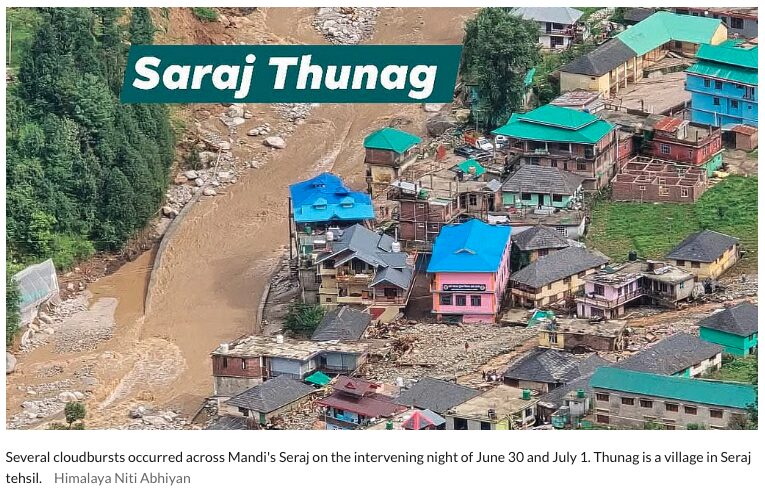
It is no coincidence that the so-called “cloudbursts” always occur in areas where there is, or has been, extensive and unscientific cutting of hills, deforestation, ramming through of roads, unregulated building activity, and construction of hydel projects. The most egregious and destructive has been the epidemic of four-lane highways- a goldmine, no doubt, for the NHAI, contractors and general officialdom, but highways to hell for the residents of the state. The millions of cubic meters of excavated earth and debris inevitably find their way to the rivers and water courses, constrict their flow and carrying capacity, and result in flooding and the misnomer “cloudburst”. Continuous subsidence, erosion, landslides, building collapses follow in its wake. These activities, along with denudation of the green cover, have robbed the mountains of their capacity to absorb and hold the rainfall, which thunders down the slopes as run-off, with horrific consequences.
We don’t need expert committees, hosted at the expense of a bankrupt state, to identify what is going wrong with the environment: the reasons are there in plain sight, carved on the denuded, crumbling mountain sides- stop the rape of the rivers, give up this maniacal fascination for more and more roads, cancel all four-lane projects, protect the green belts and forests, regulate construction with an iron hand (and Yogi’s bulldozers, where required). Pay attention to the fact that GSI has identified 17000 landslide-prone zones in the state. Recognize that climate change is now a reality which has arrived, it will exacerbate rainfall patterns, there will be more EWEs (Extreme Weather Events). Concentrate on sustainable planning and not reckless development at all costs. Send back the central expert committee, Mr. Chief Minister- the answers don’t lie with it, they lie in your office, in your files. Listen to the local citizens- those who have been opposing needless road construction, airports, hydel projects and multi-storeyed commercial projects, denotification of green belts, those whose lands and houses are getting washed away by your obstinacy, those whose family members are entombed in mud in the middle of the night. Trust them, not your mercantile advisors.
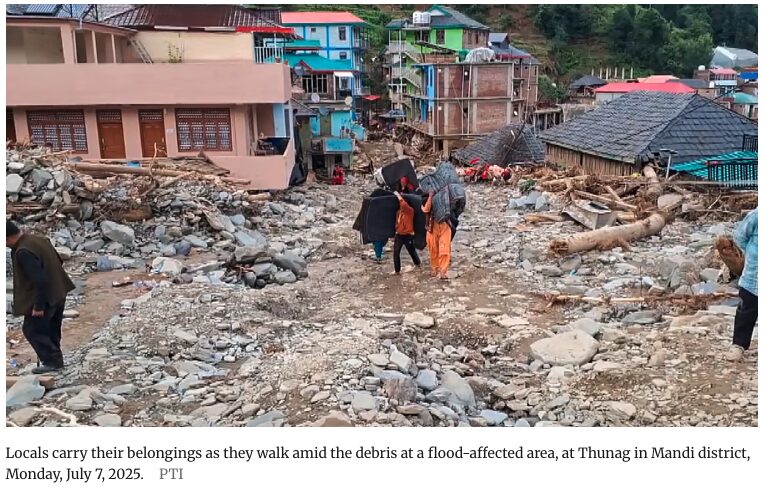
The second announcement about environmental impacts of hydel projects in the Beas basin is even more mystifying. Firstly, such a study should have been carried out BEFORE, and not AFTER, allotting the 359 hydel projects (operational and planned) on the Beas and its tributaries. Secondly, the environmental impacts of such projects are already known, and have been for the last 15 years. In 2010 the then Addl. Chief Secretary(Forests), on the directions of the High Court, had submitted a detailed report, listing out the deleterious and damaging impacts being witnessed today: muck dumping, unscientific cutting and blasting, weakening of the mountain strata, deforestation, reduction in carrying capacity of rivers, the need to restrict the number of hydel projects on a particular river, the necessity of cumulative impact assessments for the whole river basins instead of for just individual projects, declaration of no-go areas for hydel projects. The report was accepted by the High Court but was fiercely opposed by the state govt. and was quietly buried. Thirdly, no further study is required to identify these environmental impacts- they have been happening with frightening regularity every year- the whole stretch of the river from Manali to Mandi has been devastated and looks like Gaza- and are self evident. There is little point reinventing the wheel at a cost of Rs.2000 crore- exhume the 2010 report, get additional inputs from geologists and hydrologists, and implement the recommendations. The World Bank study appears to me to be just a smokescreen for avoiding any substantive action, and is simply kicking the can further down the river.
Neither of the two studies or inquiries is needed, and the state govt. certainly doesn’t have the money to pay for them. Instead, the govt. should commission studies on factors which have grave portents for the future of the state: the changing precipitation patterns, changed hydrology of the rivers, melting of glaciers, formation of glacial lakes which pose a danger to downstream areas, carrying capacity of major tourist destinations, a Cumulative EIA of the Chandrabhaga basin before proceeding to sanction another 4000 MW worth of projects on it. These studies will reveal how our geology and environment are being altered, and are necessary for all future planning. It should also heed the dire warning issued by the Supreme Court last week on a PIL, having ignored everyone, including its own citizens for decades: “Entire Himachal Pradesh may vanish soon; Revenue Earning can’t be at the cost of the Environment.”
Translated into simple English, that means that the time for post mortems is over, what is needed now is immediate and decisive action.

| The author retired from the IAS in December 2010. A keen environmentalist and trekker he has published a book on high altitude trekking in the Himachal Himalayas: THE TRAILS LESS TRAVELLED.
His second book- SPECTRE OF CHOOR DHAR is a collection of short stories based in Himachal that was published in July 2019. His third book was released in August 2020: POLYTICKS, DEMOCKRAZY AND MUMBO JUMBO is a compilation of satirical and humorous articles on the state of our nation. His fourth book was published in July 2021. INDIA: THE WASTED YEARS – chronicles all the missed opportunities in the last nine years. His fifth book – THE DEPUTY COMMISSIONER’S DOG AND OTHER COLLEAGUES – released in September 2023, portrays the lighter side of life in the IAS and in Himachal. He published his sixth book, DISAPPEARING DEMOCRACY-DISMANTLING OF A NATION in March 2024; it is a commentary on events from 2021 to the present, a sequel to THE WASTED YEARS. Shukla writes for various publications and websites on the environment, governance and social issues. He divides his time between Delhi and his cottage in a small village above Shimla. He blogs at avayshukla.blogspot.com |