In the mountains, life teaches its own quiet lessons of caution. A single glance along a winding trail is enough to notice how almost every traveler carries two indispensable companions: an umbrella and a bag. The umbrella, like a shield against sudden bursts of rain, speaks of the unpredictability of the weather in high altitudes, while the bag holds the small but vital essentials needed for the day. An umbrella may appear ordinary and a bag, unremarkable, but in these everyday items lie the foresight of those who live amidst such rugged beauty. These modest objects reveal how deeply mountain life is shaped by preparedness, for the steep paths and shifting skies rarely forgive negligence.
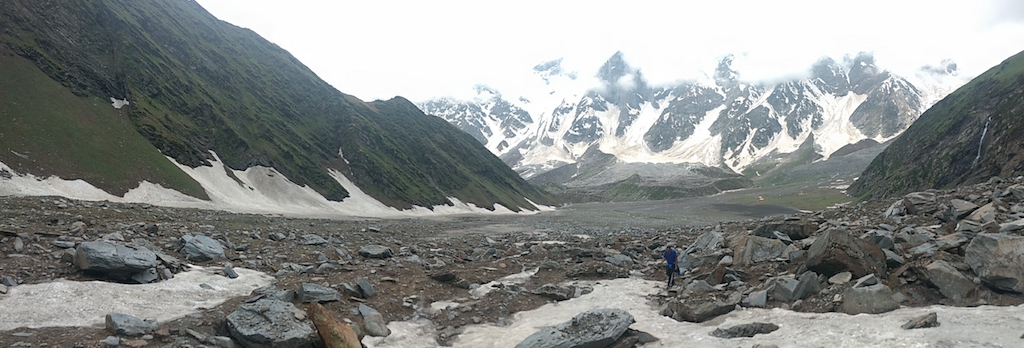
The Himalayas have always carried an air of permanence, those snow-bound peaks standing like ancient sentinels above the clouds. Yet in recent years, the mountains themselves seem restless, as if the old certainties have been shaken. Glaciers that once gleamed like timeless reservoirs of ice are shrinking before our eyes, springs that nourished villages for generations are drying up, and the weather, once unpredictable in the charming way of mountains, has turned menacingly erratic. For those who call these ranges home, climate change has not come as an abstract headline, it has arrived as a dangerous new layer of uncertainty woven into daily life. And for the tourists who travel to the Himalayas seeking solace, adventure, or the thrill of encountering the sublime, that uncertainty now shadows their journeys too.
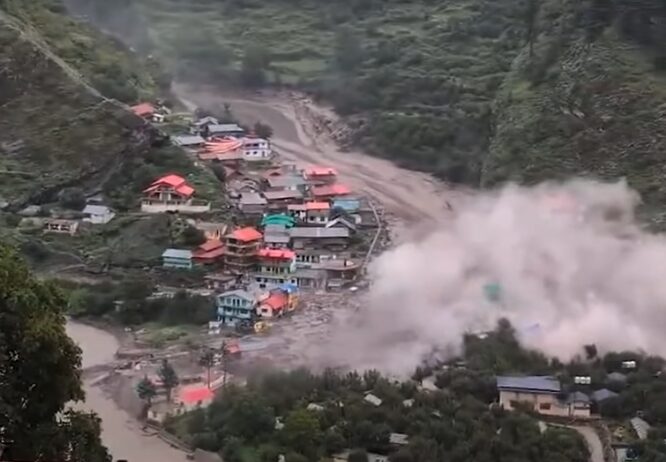
The changes in sky, soil, and pasture might still have been endured had the mountains not also grown more violent. Increasingly, every monsoon carries with it the threat of sudden devastation. Cloudbursts tear open the sky, rivers swell into roaring torrents, and slopes give way in landslides that bury fields and homes. When a sudden cloudburst and glacial flood sweeps away entire settlements are no longer rare. Families lose not only houses and livestock but also the fragile sense of security that makes endurance possible. In such times, tourists too are caught in the crossfire, pilgrims stranded on broken roads, trekkers airlifted from flooded valleys, rafters warned away from rivers that shift overnight from trickles to killers. Tourism, which sustains many mountain economies, is itself imperilled by the climate’s unpredictability.
Behind these changes lies an erosion not only of resources but also of knowledge. Mountain life has long been built upon ancestral wisdom—knowing when to sow, when to migrate, when to gather fodder, how to read the clouds. That knowledge, accumulated over centuries, begins to falter when the climate refuses to play by its old rules. What happens when the calendar no longer predicts the rain, or when pastures no longer appear at the expected time? For the farmer in his terraced field or the shopkeeper in a small tourist town, the answer is the same – anxiety replaces certainty. Tourists feel this anxiety in subtler ways. A family planning a holiday to the mountains now hesitates, reducing the trip “just in case.” Foreign visitors ask travel agents nervously about landslide zones. Trekkers pack with both excitement and dread, wondering if their adventure will end in awe or evacuation. And when fewer visitors venture to the remote villages and valleys, locals lose income and, with it, the encouragement to preserve their ways of life. In this way, climate change disturbs not only ecology and economy but also the cultural exchange that has long connected visitors with mountain communities.
Yet the story is not entirely one of despair. Across the Himalayan regions, examples of courageous fight against the odds shine through, finding compromise between tradition and survival. And tourism, too, is undergoing reinvention. Responsible travel movements encourage treks that respect carrying capacities instead of mass expeditions. Cultural festivals, folk music, and crafts—long overshadowed by the lure of snowy peaks—find renewed value as attractions that do not exhaust the environment. The adaptations remain fragile against the pace of change. Disaster preparedness is improving—early warning systems, stricter building codes, and community training are more common now—but the mountain’s fury often outstrips human readiness. A single landslide can undo years of effort; a single glacial burst can erase a town. The Himalayas seem to whisper a warning: adaptation alone will not suffice if deeper action on climate is neglected. What unites the fates of locals and tourists is the shared reliance on the mountains themselves. The Himalayas are not just a backdrop for human drama; they are the stage itself, and when the stage collapses, no actor escapes and both resident and visitor suffer.
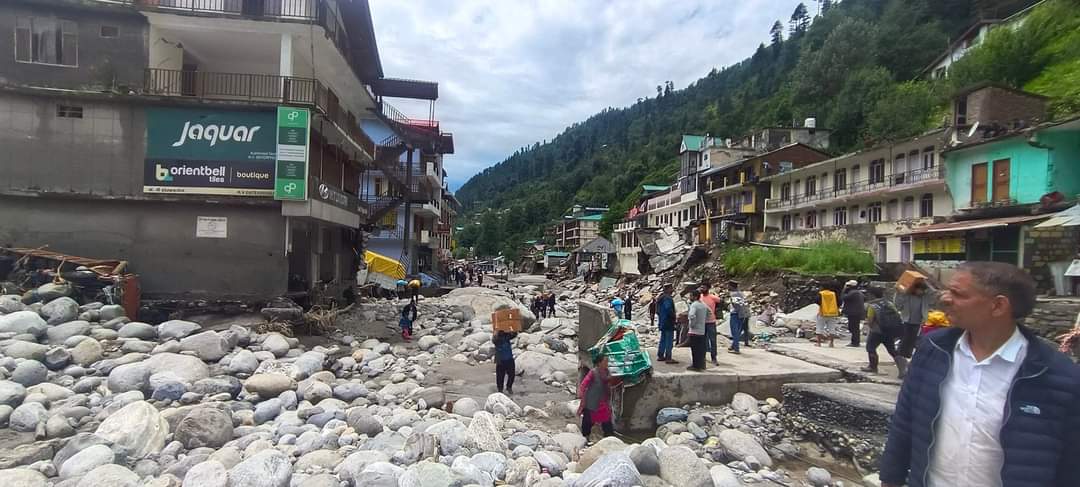
The mountains have always demanded humility, forcing those who climb them or live upon them to respect their limits. Perhaps climate change is amplifying that lesson, reminding us that the Himalayas are not eternal fortresses but living, fragile systems. Their glaciers, meadows, and rivers can vanish, and with them, the ways of life and the dreams they sustain. To protect them is not merely to save remote villages or tourist economies; it is to preserve one of the world’s last great sources of wonder and renewal.
To walk in the mountains is to understand that caution is not fear but wisdom, earned through generations of experience. The sight of a retreating glacier or a broken road may fill us with despair, but perhaps it can also fill us with resolve. For in the trembling of the mountains lies a call—to live differently, to travel with care, to support communities that hold the line against uncertainty, and to see the Himalayas not as an infinite resource but as a fragile gift. If we can hear that call, locals and visitors alike, then the mountains may yet stand, not as restless ruins, but as persistent teachers. When the clouds clear after the storm, perhaps both the locals and the tourists will find that the Himalayas still hold the power to heal, to inspire, and to endure. In every careful step taken, one can see the unwritten rule of the mountains- survival depends not on strength alone, but on respect for the unpredictable rhythms of nature.

Rachna Vinod is a multilingual poet, writer, blogger and broadcaster, proficient in Hindi, Urdu, English, and Dogri. Her works have been broadcast through multiple media platforms, including All India Radio. In addition to her books, her articles and creative pieces are regularly published in both print and online literary magazines. She has made significant contributions to literature with over 20 individual publications and participation in more than 25 collaborative anthologies.
A Few Published Works:
Urdu: Yasmeen-e-Sughandh, Mere Humsafar
English: Eternal Heritage, Shahada Aisha, I Am Here Only, Bridging The Gap, Lotus Lore, Kashmir Konnectivity: A Biosketch
Hindi: Ankahi Sargam, Pighalte Himkhand (poetry collection), Madhyaratrik Kshan, Parvaton Ke Dayare (short story collection)
Dogri: Adaya Madaya Geeten Bharya, Hirkhi Phuhar, Aakhi Lai Dile Di Gall