
For nearly seven decades, the Indian Republic recognised a foundational truth of federal governance: not all states are born with equal economic capacity, and some—especially mountain and border states—carry permanent structural disadvantages. The Revenue Deficit Grant (RDG) emerged from this understanding. It was not largesse. It was a constitutional instrument meant to balance geography, history, and national priorities.
The 16th Finance Commission’s decision to withdraw the Revenue Deficit Grant from Himachal Pradesh is therefore not a routine fiscal correction. It marks a profound rupture in India’s federal compact—one that threatens to push the state towards fiscal subordination and political marginalisation.
A 70-Year Constitutional Understanding Broken
Himachal Pradesh was never carved out on the assumption that it would be a revenue-surplus state. It was carved out because the Indian state believed that political integration, border security, ecological stewardship, and social development in the Himalayas were national responsibilities. From the earliest Finance Commissions onwards, revenue deficit support recognised that governing a mountainous, sparsely populated, climatically fragile region costs more and yields less by conventional revenue logic.
For almost 70 years, this understanding remained intact.
The 16th Finance Commission’s approach dismantles this legacy. Over the next five years, Himachal Pradesh is set to lose around Rs 50,000 crore. In the last financial year, the state’s total revenue receipts stood at roughly Rs 42,000 crore. Even a Rs 10,000 crore annual shortfall—the scale of RDG withdrawal—amounts to nearly 25% of the state’s revenue base.
This is not an abstract number. It will hit pensions, salaries, healthcare, education, and basic service delivery. A state government does not absorb a quarter of its revenue without severe social and political consequences. At this scale, fiscal autonomy collapses into fiscal survival.
The question therefore becomes unavoidable: Can a state continue to function as a state under such conditions?
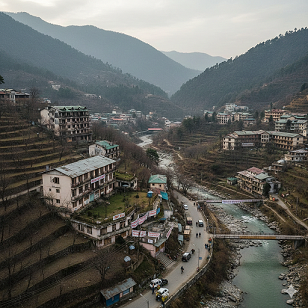
Border States and the Quiet Retreat of the Union
Himachal Pradesh is not just another administrative unit. It is a border state, historically supported by the Centre not as a concession but as a strategic necessity. The withdrawal of revenue support signals a dangerous shift—from shared responsibility to silent abandonment.
This move reflects a broader mindset of over-centralisation, where the Union consolidates fiscal power while states are reduced to implementation agencies. Federalism, in this vision, is no longer a partnership of equals but a hierarchy of dependence.
When states are stripped of predictable revenue flows, they are forced into debt, compliance, and political acquiescence. Autonomy becomes illusory. One is compelled to ask whether this fiscal strangulation is inadvertent—or whether it reflects an emerging imagination of states as administrative extensions of the Centre.
Is Himachal Pradesh being nudged, deliberately or otherwise, towards the status of a Union Territory in everything but name?
An Extractive Development Trajectory
This fiscal assault must be read alongside Himachal’s long experience with extractive development. Hydropower is the most glaring example. For decades, the state has borne the ecological, social, and infrastructural costs of dam construction—displacement, destabilised mountains, altered river systems, and irreversible ecological stress.
Yet the financial returns barely touch the state. The royalty—around 12% of generated power, misleadingly termed “free power” or “distress cost”—is negligible. There is no systematic equity participation for the state, except in a few exceptional cases. Revenues flow overwhelmingly to central utilities and private corporations.
The resource is local. The land is local. The risks are local. The profits are not.
This is extractive capitalism in its purest form: the periphery supplies resources, the centre accumulates surplus, and the state absorbs the damage. When revenue deficit support is simultaneously withdrawn, the cycle of extraction is completed.
Forests: National Asset, State Liability
The injustice deepens when one considers forest governance. Following forest nationalisation and regulatory tightening after the 1980s, states like Himachal Pradesh were left with vast green cover but no meaningful fiscal instruments to derive revenue from it.
Forests in Himachal are not merely state assets—they are national ecological shields, contributing to climate stability, water security, and biodiversity for the entire country. Yet the costs of protection, conservation, disaster management, and opportunity loss are borne almost entirely by the state.
No economic activity, no sustainable extraction, no revenue innovation is permitted—rightly, in ecological terms—but with no compensatory fiscal mechanism. In this context, the Revenue Deficit Grant is not a begging bowl. It is a legitimate constitutional compensation for providing national ecological services.
To withdraw it is to penalise environmental responsibility.
Punishing Human Development Success
Perhaps the most perverse feature of the 16th Finance Commission’s logic is its disregard for what Himachal Pradesh has achieved despite extraordinary constraints. From one of the remotest regions of India, the state has emerged second only to Kerala on key Human Development Indicators.
This did not happen accidentally. It was the result of decades of public investment in education, healthcare, nutrition, and social welfare. The very expenditures that built this success now appear to be treated as fiscal inefficiencies.
Instead of rewarding long-term social investment, the Finance Commission’s approach effectively punishes it. This is not merely technocratic blindness—it is a philosophical failure to recognise what development truly means.
The Sacrifice that cannot be Forgotten
Beyond numbers and balance sheets lies a deeper moral question. Himachal Pradesh has given more than resources—it has given lives.
Visit villages in Kangra, Hamirpur, Una, and adjoining regions. Attend gram sabha meetings. In many villages, you will find women assembling in overwhelming numbers, because generations of men have been lost—lost to wars, border conflicts, and continuous military deployments.
Himachal has one of the highest per capita representations in the Indian armed forces. Its people have guarded borders, served in hostile terrain, and paid a disproportionate human price for national security.
Is this how the federal government treats a state whose sons never hesitated to serve the Republic? The withdrawal of fiscal support, in this context, feels not just economically callous but morally indifferent.
Water, Land, and the Erosion of Rights
The fiscal hollowing is compounded by the steady erosion of the state’s legitimate claims over Bhakra-Beas revenues and land-based income linked to water flows. Water flows on land. Land is a state subject. Any serious federal arrangement would recognise land revenue as a legitimate income stream.
The systematic denial of these rights leaves the state with responsibility but no resources—a model guaranteed to fail.
A Precarious Social Moment
All this unfolds amid rising unemployment, youth anxiety, and social stress. Fiscal contraction under such conditions is not neutral—it is destabilising. When the Centre withdraws support without building alternative revenue pathways, it pushes the state towards alienation and political resentment. History teaches us that such alienation does not remain silent for long.
This is not an argument against the Centre. It is an argument for the Constitution. India’s federal system was designed to hold diversity together through equity, not uniformity.
The Himalayas are not a fiscal inconvenience. They are a national asset. Undermining the states that sustain them is not prudence—it is a historic mistake.
The question must therefore be asked, clearly and without euphemism: Does the Centre intend to reduce Himachal Pradesh to a fiscally dependent adjunct—or will it honour the constitutional promise that held the Union together for 70 years?
The present may choose to ignore this warning. The future will not.

Former deputy mayor Shimla.
National convenor, NCU, National Coalition for Inclusive & Sustainable Urbanisation.

Excellent article. But –
1. Were the CM and ministers in successive governments who allowed hyro power projects not dumb or incompetent to settle for 12 % revenue? Could they not see the risks ? Why did they not learn from experience?
2. Is forest department not permitted to gather and sell fallen trees? Why most of them keep rotting? I am not talking of those in accessible places. Even Deodar trees fallen in state capital rot on the roadside. What proposal state has made in front of centre or NGT to make a case for scientific profit generating forestry?
3. Why state has failed to develop tourism as a source of revenue inspite of best locations?
4. Why no IT industry could be attracted inspite of suitable environment, HR and enough electricity and water?
5. Why pharma industries of state fail on quality front?