

India’s solar energy sector is witnessing unprecedented growth in 2025. With 26.6 GW of new solar capacity installed in the first nine months alone, a 53.7% increase over 2024, solar power has cemented its role as a cornerstone of India’s clean energy future. Renewable energy companies like Avaada are at the forefront, developing high-efficiency solar modules and integrated manufacturing that support India’s ambitious 500 GW non-fossil capacity target by 2030.
Choosing the best solar panel involves understanding the different types of solar panels available in India today, their efficiencies, costs, and suitability for various applications.
Types of Solar Panels in India: An Overview
There are four main types of solar panels in India based on technology and material:
- Monocrystalline panels
- Mono-PERC half-cut panels
- Bifacial N-Type TOPCon panels
- Thin-film and amorphous silicon panels
Additional niche types include thin-film and amorphous silicon panels, as well as innovative building-integrated photovoltaic (BIPV) solutions, but these are less common in mainstream Indian installations.
Monocrystalline Solar Panels
Monocrystalline solar panels feature silicon cells cut from a single crystal structure, giving them a distinct black hue and high purity.
Advantages:
- High efficiency (typically 20-22%)
- Space-efficient due to higher power output per square foot
- Long lifespan, often supported by 25+ year warranties
Use Cases:
- Ideal for residential rooftops where space is limited
- Premium commercial installations
Cost: Generally priced at a premium in the Indian market due to higher manufacturing complexity.
Leading Indian manufacturers of monocrystalline panels include established players such as Avaada, which produce high-wattage modules (620W to 720W) incorporating advanced n-type TOPCon technology, ensuring optimal efficiency and durability.
Bifacial N-Type TOPCon Solar Panels
Bifacial N-Type TOPCon panels are the most advanced and widely accepted solar module technology in India today. They use high-purity N-type silicon and bifacial architecture to generate energy from both sides, significantly increasing total output.
Advantages:
- Ultra-high efficiency (22%+), outperforming Mono-PERC
- Up to 25% additional energy generation due to bifacial design
- Extremely low light-induced degradation (LID)
- Better temperature coefficient, ideal for India’s hot climate
- Longer operational life and superior durability
- Lower levelized cost of electricity (LCOE)
Use Cases:
- Ground-mounted commercial and industrial solar projects
- Utility-scale solar farms
- Locations with reflective surfaces, high irradiation, and large-scale installations
Leading manufacturers of solar panels in India, including Avaada, produce high-wattage (700W+) N-Type TOPCon modules through fully integrated silicon-to-module manufacturing. This ensures world-class quality, long-term stability, and reliable performance for both utility and industrial-scale solar projects.
Mono-PERC Half-Cut Solar Panels
A hybrid of monocrystalline technology enhanced by Passivated Emitter Rear Cell (PERC) design and half-cut cell technology.
Advantages:
- Improved light absorption and efficiency (up to about 22%)
- Better performance in low-light conditions
- Reduced heat loss due to half-cut cell architecture
Use Cases:
- Commercial rooftop installations with limited space
- Utility-scale projects seeking a higher return on investment
Renewable energy companies like Avaada are uniquely positioned in India as leading manufacturers of 700+ watt modules that employ n-type TOPCon cells, integrating these advancements to deliver superior efficiency and a long operational life. This gives companies pioneering these products a competitive edge in large markets like Maharashtra, Gujarat, and Rajasthan.
Must Read:- 5 Things You Should Know About Solar Energy in India
Bifacial Solar Panels
Bifacial panels harness sunlight from both front and rear surfaces, increasing total energy production by capturing reflected or scattered light.
Advantages:
- Potential gain of up to 25% more electricity compared to traditional panels
- Robust design with enhanced durability
- Increasingly favored for commercial and industrial installations
Use Cases:
- Open ground-mounted solar farms with reflective surfaces
- Large utility projects where maximizing output per panel is critical
Cost:
- Higher upfront cost balanced by lower levelized cost of electricity (LCOE) over time.
Manufacturers of solar panels in India are increasingly integrating bifacial technology into their large-scale projects, aligning with global best practices and helping them meet stringent certification and quality standards.
Thin-Film and Amorphous Silicon Panels
These lightweight and flexible panels use thin layers of photovoltaic material.
Advantages:
- Flexibility in design and easy to install on curved surfaces
- Cost-effective for specific niche applications
Limitations:
- Lower efficiency (~10-12%), requiring more space
- Less durable compared to crystalline silicon panels
These panels are suitable for locations with large space availability or for specialized industrial installations.
Building-Integrated Photovoltaic (BIPV) Modules
BIPV integrates solar cells directly into building materials, such as glass facades and roofs.
Advantages:
- Aesthetic appeal and dual functionality as a building material and a power generator
- Growing interest in urban projects emphasizing sustainability
Cost Considerations: Premium pricing makes BIPV a choice for specialized architectural projects
Comparing the Types of Solar Panels
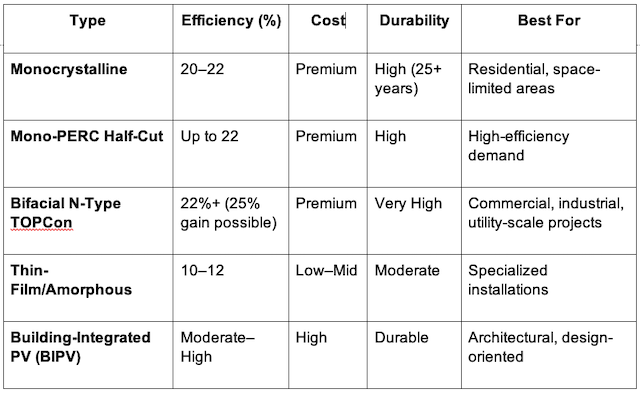
What’s the Best Solar Panel Type in India for 2025?
Driven by rapid technological advances and increasing demand for efficiency, Bifacial N-Type TOPCon panels stand out as the best options for most modern solar power projects in India. These panels offer a superior balance of efficiency, space utility, and long-term cost savings. Renewable energy companies like Avaada use advanced manufacturing technology to produce high-wattage, highly efficient bifacial N-type TOPCon modules, a proven technology with excellent track records in India’s largest solar projects and increasingly adopted by leading manufacturers of solar panels in India.
However, the choice depends on various factors:
- Budget: N-Type TOPCon panels offer the lowest LCOE over time, while Mono-PERC remains a cost-effective alternative for budget-sensitive projects.
- Space: For confined roof space, high-efficiency monocrystalline or Mono-PERC panels are ideal.
- Application: Ground-mounted commercial projects benefit from bifacial panels, maximizing output.
- Quality and Certification: Always choose manufacturers that offer certified panels with product warranties and adherence to standards such as IEC, BIS, and UL.
Consulting solar experts and suppliers is important to tailor the choice to your energy requirements, climatic conditions, and financial parameters.
About Manufacturers of Solar Panels in India
India’s solar manufacturing sector is burgeoning, with over 100 manufacturers and more than 120 production units. Renewable energy companies like Avaada are leading the charge in producing advanced solar modules aligned with domestic content requirements and government policies promoting Atmanirbhar Bharat (self-reliant India).
These manufacturers of solar panels in India have also begun investing in backward integration, from silicon wafers to modules, to reduce import dependence and ensure supply chain reliability and cost competitiveness.
Conclusion
In 2025, India’s solar industry will offer diverse solar panel technologies to meet varying needs and budgets. While monocrystalline solar panel continue to dominate, the emerging Mono-PERC half-cut and Bifacial N-Type TOPCon panels promise higher efficiency and better returns for projects.
Investing in the right type of solar panel today, backed by certified, high-efficiency modules and trusted manufacturers, is a step towards assured quality, long-term cost savings, and contribution to India’s green energy transition.

The opinions, beliefs and viewpoints expressed by authors, news service providers on this page do not necessarily reflect the opinions, beliefs and viewpoints of Hill Post. Any views or opinions are not intended to malign any religion, ethnic group, club, organization, company, or individual.
Hill Post makes no representations as to the accuracy or completeness of any information on this site page.