
Himachal Pradesh stands at a precipice. The mountain state is enduring a relentless cycle of environmental catastrophe, yet its stakeholders – government officials, developers, and citizens alike – continue to turn a deaf ear to nature’s increasingly urgent warnings.
The Supreme Court’s bench of Justice JB Pardiwala and Justice R Mahadevan delivered a stark prophecy in their recent judgment: “If things proceed the way they are as on date, the day is not far when the entire state of Himachal Pradesh may vanish in the thin air from the map of country. God forbid this does not happen.”
Their words were not mere judicial rhetoric but a damning indictment of the state’s environmental recklessness. The court chided both Union and state governments, emphasizing that revenue generation cannot supersede environmental protection. Yet the message appears to have fallen on deaf ears.
The Mounting Crisis
The statistics paint a terrifying picture. According to the disaster management department’s data, major landslide incidents have increased six-fold in recent years. From just 16 major landslides in 2020, the figure jumped alarmingly to 117 in 2022. When minor landslides are included, the numbers become exponentially more frightening.
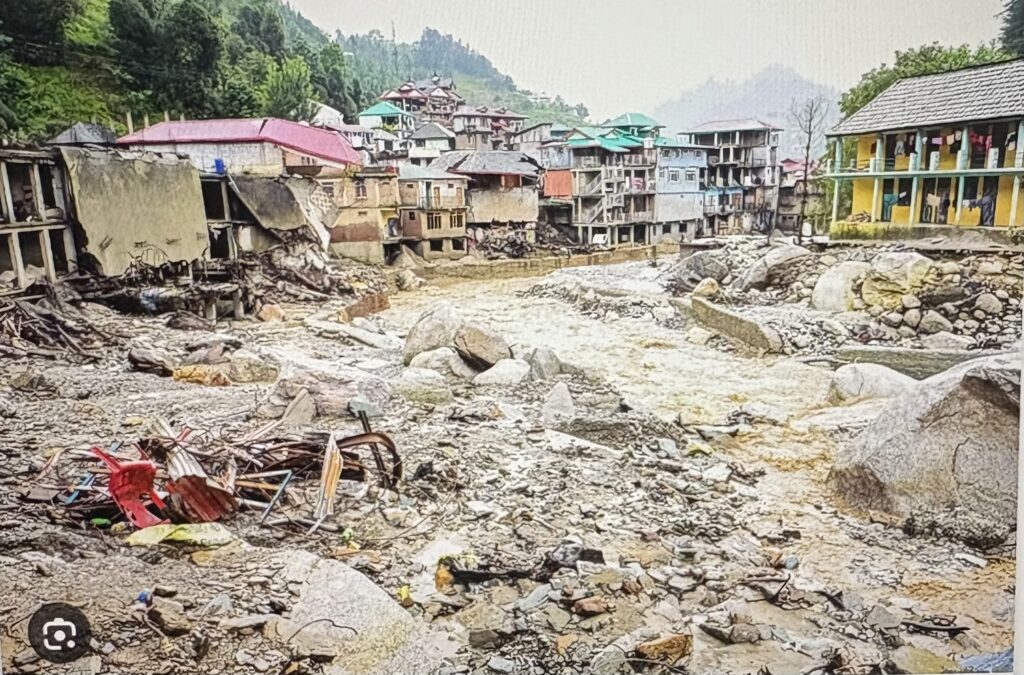
The state now harbours 17,120 landslide-prone sites, with 675 located dangerously close to critical infrastructure and human settlements. The distribution of these high-risk zones tells its own story: Chamba district leads with 113 vulnerable sites, followed by Mandi (110), Kangra (102), Lahaul and Spiti (91), Una (63), Kullu (55), Shimla (50), Solan (44), Bilaspur (37), Sirmaur (21), and Kinnaur (15).
During the 2025 monsoon season, Himachal received 730mm of rainfall between June and the end of the season, with total annual precipitation reaching 742mm. In just 55 days since the monsoon’s onset, the state witnessed 113 landslides – a sobering reminder of nature’s fury.
Scientific Validation of Disaster
An IIT-Ropar study has confirmed what many feared: 45 per cent of Himachal Pradesh is highly susceptible to natural disasters including floods, landslides, and avalanches. The research identifies specific vulnerability patterns – slopes between 5.9 and 16.4 degrees at elevations up to 1,600 metres face flood and landslide risks, while higher altitude regions between 16.8 and 41.5 degrees are prone to avalanches and landslides. Steep mountain slopes above 3,000 metres face the highest risk levels.
The study essentially declares the entire state vulnerable to disaster, making corrective action not just advisable but imperative for survival.
The Root of Destruction
The causes of this environmental apocalypse are manifold but interconnected. Unscientific exploitation of hill strata for four-laning national highways stands as perhaps the most visible culprit. The Pathankot-Palampur highway project, crawling along for five to six years, has transformed entire regions into disaster-prone zones through reckless hill cutting and haphazard earth disposal.
Similarly, the Kiratpur-Manali highway, designed as an alternate route to Leh and Ladakh, represents an engineering catastrophe visible to any observer. The project’s alignment cuts directly into riverbeds while steep hill cutting destabilises entire mountainsides. The results were devastatingly apparent during the 2025 monsoon.
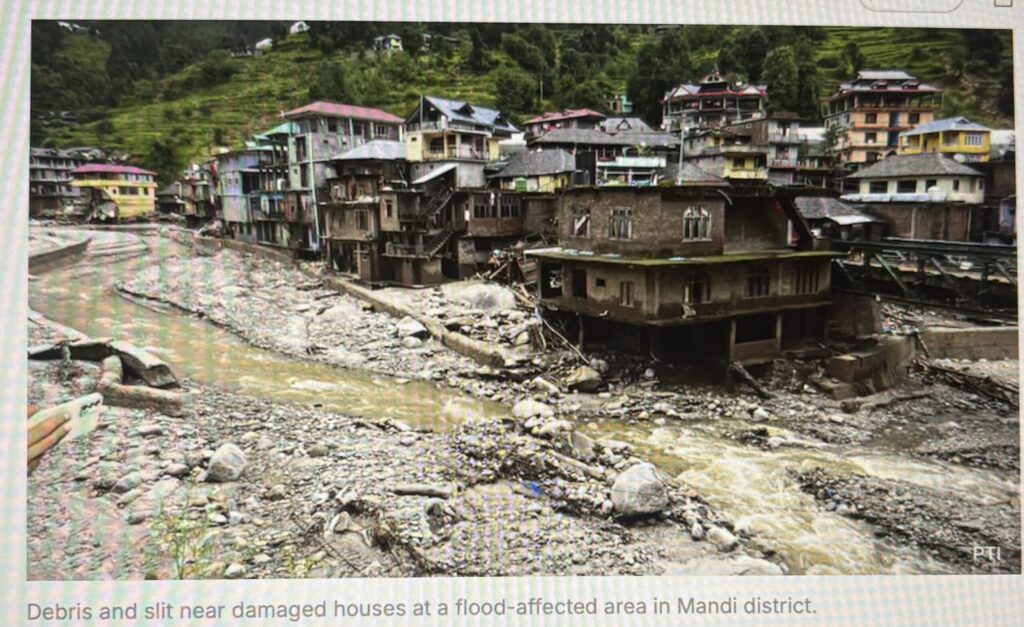
Hydroelectric power projects compound the problem. Many lack proper environmental impact assessments or studies of the earth’s weight-bearing capacity. Construction techniques involving blasting disturb local hill strata, exposing nearby communities to landslide and subsidence risks.
The state’s vast network of national highways, state highways, and rural roads – built without scientific consideration for the fragile Himalayan geology – creates a web of vulnerability across the landscape.
The Subsidence Menace
Land subsidence has emerged as 2025’s most disturbing phenomenon, affecting rural Himachal like a spreading plague. Entire villages watch helplessly as their homes develop massive cracks before collapsing, leaving families destitute after losing houses built with life savings.
Garder village, 35km from Palampur, exemplifies this crisis. Thirty-five houses, numerous cattle sheds, the local school, and government buildings have either collapsed or stand on the verge of collapse, with roads splitting open like wounds in the earth. Kunduni village in Joginder Nagar faces complete submersion as the entire area sinks. Chabutra in Hamirpur district tells a similar tale of destruction.
A 2023 study revealed that landslides and subsidence affect nearly 70 villages in Kullu district alone, caused by road construction on steep slopes, deforestation, and changing agricultural practices. The breakdown is alarming: 12 villages in Kullu, five in Manali, 15 in Nirmand, 24 in Banjar, and 13 in Anni subdivision face imminent danger.
Economic Catastrophe Looms
The continuing cycle of natural disasters threatens to cripple Himachal’s economy. Tourism, the state’s primary revenue source, faces inevitable decline as visitors lose confidence in their safety. The ripple effects will devastate employment in a state already grappling with unemployment.
Power projects – another major income source – suffer regular damage from disasters, with machinery destroyed, transmission lines snapped, and transformers rendered useless. Each incident places additional financial burden on an already cash-strapped state government.
Property values are likely to plummet as people lose faith in land stability. The prospect of mass migration to safer plains areas could create demographic upheaval while increasing pressure on remaining forest resources as displaced populations seek new settlements.
The Path to Redemption
Saving Himachal Pradesh requires unprecedented political courage and immediate action. Both union and state governments must embrace difficult decisions that prioritise ecology over short-term economic gains.
Immediate Moratorium: All new road construction – national highways, state highways, and rural roads – must cease until existing flood and landslide damage is scientifically repaired. Ongoing projects must adopt scientific construction methods immediately.
Comprehensive Assessment: Environmental impact assessments of all existing roads must evaluate stability and landslide vulnerability. Identified risk sites require immediate strengthening. Any roads encroaching on riverbeds, banks, or khud areas must be abandoned in favour of safer alignments.
Power Project Reform: New hydroelectric projects should require mandatory local consent and comprehensive environmental impact assessments. All assessment reports must enter the public domain for 2–4 months, allowing widespread discussion and feedback before final decisions. Projects with negative environmental impacts must be shelved permanently.
Construction Controls: No commercial, domestic, or government construction should be permitted on river surfaces, banks, khud areas, or hillslopes. Ongoing violations must be stopped immediately. Municipal authorities must launch drives to identify norm-violating buildings and demolish unauthorised portions. Officials who granted illegal permissions must face accountability.
Green Space Protection: Green areas must remain sacrosanct with no de-notification under any circumstances. Detailed scientific analysis of subsidence causes must guide corrective measures.
Enhanced Compensation: Current disaster management compensation is woefully inadequate. Amounts should increase at least threefold to provide meaningful relief to affected families.
A Call for Unity
The crisis demands bipartisan cooperation. Opposition parties must support government rehabilitation efforts and corrective measures rather than engaging in political point-scoring. Environmental protection transcends party politics when the state’s very existence is at stake.
Unless Himachal Pradesh embraces a detailed, thoughtful analysis of its ecological disaster and implements corrective steps with unprecedented urgency, 2026 may witness a repeat – or worse – of 2025’s devastation.
The Supreme Court’s warning rings truer with each passing day. Himachal Pradesh must choose between respecting nature’s laws and facing the consequences of continued environmental vandalism. The mountain state stands at a crossroads where the choice is stark: respect nature or risk perishing from India’s map entirely.
The time for half-measures and cosmetic solutions has passed. Only decisive action, political courage, and a fundamental shift in development priorities can save this Himalayan jewel for future generations. The question remains: will Himachal’s leaders find the wisdom and will to act before it’s too late?

Rattan Chand Sharma retired from the Border Security Force as a Commandant. A regular contributor to publications like Outlook, Deccan Herald, India Sentinels, Force Magazine, Chanakya Forum, Saveratimes, Seema Sanghosh, he writes mainly about defence and security personnel issues.

Construction of Roads is the main source of alround Development, Power Projects also are the major source of income for the development of the State, due to adoption of Non joint family system by new generation,construction of houses can not be stopped.
Dear Sir, your concern is very much right and suggestions are also scientific and valuable, Govt. of India and State Government should consider all the view point to make plan and policies for the development of our Hill State. We might have adopted family planning measures immediately after independence.
Your focus on construction of roads, Hydro power Projects scientifically, non construction of buildings near Rivers can also play important role to stop natural calamities if Government make policies positively.