
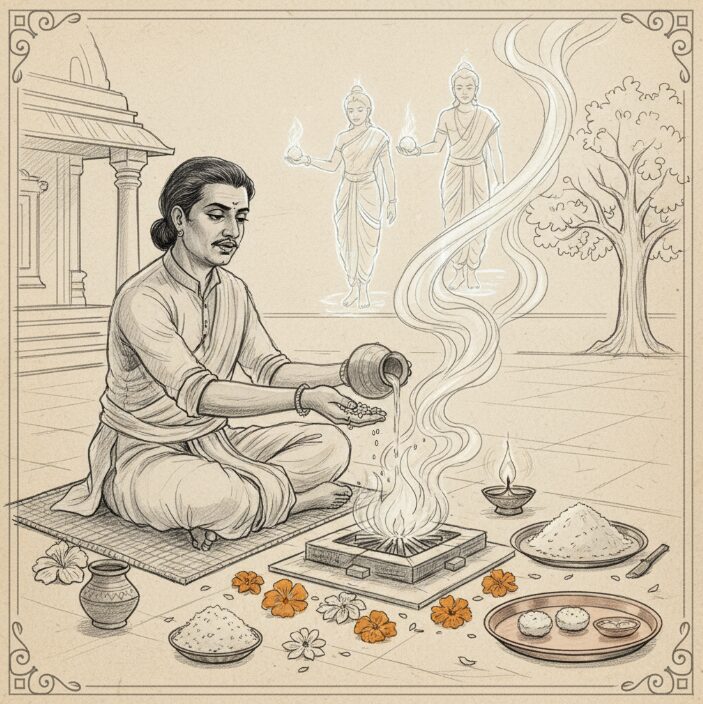
Every year, Shraddh invites us to pause—not only to honour our ancestors, but to reflect on the lives that shaped us. For me, these rituals are less about tradition than gratitude, about recalling those whose sacrifices, resilience, and vision made me who I am today. Seven lives shine brightly in my memory.
I begin with Pappaji, my paternal grandfather, whose gentle grey eyes reflected a kindness and quiet wisdom that seemed endless. A man of humility, he left Srinagar to begin anew in Delhi, believing only in the promise of education. Having had no guide himself, he could not shape his own career as he might have wished, yet he never carried regret. Instead, he devoted himself to others, helping his children and numerous relatives build careers, many of whom found places in the Indian services. No jealousy ever touched him; he was happiest when others succeeded. His favourite phrase, “Padoge likhoge to hoge nawab, kheloge koodhoge hoge kharaab,” was less a warning than a conviction that knowledge changes destinies. Hard work was his rhythm, composure his nature. Even his anger was measured—the height of it with my grandmother was when he would call her a “Strange Lady.” Beyond that, silence was his shield. In him I saw that true leadership is patient and selfless, and that humility can build futures.
Beside him stood Mummaji, my paternal grandmother, whose strong will and practicality held the family together. Married at 11, a mother by 16, and the eldest bahu in a large household, she carried immense responsibilities with grit and discipline. She often recounted making a hundred rotis daily, earning her father’s nickname Balkandur, the baker. With very few wants of her own, she lived simply and wisely, saving enough to build a home in Greater Kailash. A wonderful cook, she passed on not just recipes but traditions and culture to my mother, ensuring they would live on. Her home was a place of warmth and discipline in equal measure, a nurturing space where love was practical and steadfast. From her, I learned resilience and the quiet power of a homemaker whose influence reaches far beyond her kitchen.
On my mother’s side, my maternal grandfather, Gashaji, lived a life marked by both privilege and loss. Once, he had a thirty-room house in Srinagar, complete with a puja hall large enough for gatherings. But the exodus of 1989 reduced all that to ashes—his house burnt, land grabbed, business destroyed. With foresight, he had already built a home in Delhi, where he began again with quiet dignity. Deeply religious, he rose at brahma muhurta, visited temples, read newspapers at the library, and returned home only by late morning. Evenings were for walks and groceries, his energy tireless. He never owned a car, preferring thrift, but he was endlessly generous, opening his home for relatives’ weddings and sharing his resources freely. Known as the king of jugaad, he could solve problems with imagination and pragmatism. From him I learned that dignity lies not in possessions, but in faith, resourcefulness, and generosity.
The person who shaped me most deeply was my father. Brilliant almost beyond imagination, he cleared class 10 at 10, graduated at 16, became a lecturer, and soon entered the IAS on his first attempt. Handsome, witty, and sharp, he was equally at home with poetry, plays, sketching, and humour. Yet it was his generosity that defined him—securing jobs, transfers, and admissions for countless displaced Kashmiri youth after 1989, and shaping pension reforms that allowed thousands to retire with dignity. At 18, he gave me Autobiography of a Yogi, setting me on a lifelong spiritual journey. Later, his devotion to Sathya Sai Baba transformed him completely; any trace of ego dissolved, and he lived like a monk in the world. Even Parkinson’s could not diminish him. He bore it with silence, never a complaint, never a harsh word. From him I learned that greatness lies not in brilliance alone, but in humility, compassion, and grace in suffering.
When I married, Papa—my father-in-law—welcomed me not as a daughter-in-law but as a daughter. He told me, “I think I have got a daughter too now,” and over time, I realized he truly meant it. He confided in me his joys, regrets, and private thoughts, trusting me in ways he trusted no one else. I remember after my engagement, when I wore one of my father’s oversized T-shirts, my dad teased him that soon I’d be borrowing his clothes too. Later, after marriage, Papa opened his almirah and said warmly, “Take what you want.” Having lost his mother at seven and been raised by his maternal grandfather, he grew up pampered but carried no bitterness. Social and loving, he lived with kingly ease, happiest when hosting others and turning meals into celebrations. Content in life, he taught me that generosity of spirit is its own kind of wealth.
Another towering influence was my Chachaji, my father’s younger brother. A genius, he earned his PhD at IIT Delhi by 18 and became a professor at Princeton at a young age. Yet his idealism drew him back to India, where he founded the Plasma Institute in Ahmedabad. Brilliant but humble, he carried his achievements lightly. I recall during my IIT entrance exam, when the invigilator, seeing my surname, asked if I was related to Dr. Kaw. On hearing I was his niece, he looked impressed, perhaps imagining the exam was easy for me. I didn’t bother correcting him, but it showed the quiet respect my uncle commanded. His life taught me that true greatness lies in serving one’s country, living by values, and remaining humble while staying close to family.
And then there was my Chachaji-in-law, one of the warmest people I have known. Having risen to the top at TISCO, he never stopped encouraging others to reach higher. He pushed everyone—sons, daughters, nephews, and daughters-in-law—to excel, and took particular pride in the women of the family, ahead of his time in celebrating their achievements. His follow-up was legendary; he would check on each person’s progress with genuine concern, making them feel truly seen. During my sabbatical, his interest and encouragement left me both touched and nervous—I never wanted to disappoint him. In him, I experienced the rare warmth of someone whose pride in others’ success was his deepest joy.
Together, these seven lives form a mosaic of humility, resilience, faith, brilliance, generosity, and quiet strength. Shraddh reminds us that our ancestors live not only in ritual but in the values and love they leave behind. To remember them is not to mourn, but to celebrate—to honour the roots from which we grow and to carry their light into the life we are yet to live.
And perhaps that is the true purpose of remembrance: to pause and ask ourselves—Who are the people who have given you a part of yourself? To be grateful, to be thankful, and to carry forward the legacy they entrusted to us.

Iti Mattoo, retired after 30 years in the IT industry, now enjoying her creative pursuits.