
Each year, as the summer sun begins to melt the snows of the high Himalayas, a quiet yet powerful calling echoes through the mountains. From distant villages, bustling cities, and silent towns, people begin to prepare—not just for a physical journey but for a spiritual transformation. This is no ordinary trek. It is a pilgrimage unlike any other, to a cave of ice and silence, where divinity is believed to reside in frozen form. The journey to the holy cave of Amarnath is a sacred journey full of adventures that has captured the faith and imagination of generations.
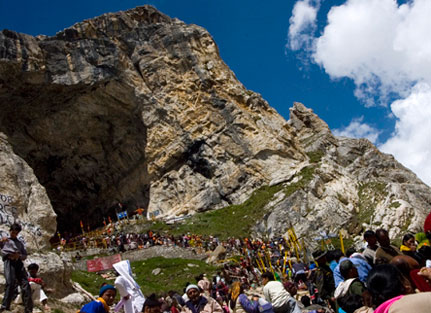
Tucked away at an altitude of nearly 3,888 meters in the folds of the Kashmir Himalayas, the Amarnath Cave houses a natural ice formation, revered as a manifestation of Lord Shiva. The cave is more than just a shrine—it is a symbol of deep mythology and devotion. According to ancient Hindu lore, this was the Lord Shiva chose to reveal the spot secret of immortality to Goddess Parvati. To protect the sacred knowledge, he left behind all his companions and possessions. And yet, in this mythical silence, two pigeons hidden under Shiva’s deerskin remained. So sanctified was the place, so spiritually charged the atmosphere, that the pigeons became immortal witnesses to the sacred discourse. To this day, many pilgrims claim to see pigeons near the cave—seen not just as birds but as divine emissaries of that eternal moment.
What draws lakhs of pilgrims to this icy abode is not just religious duty but a deeply personal yearning—a desire to connect with the divine in its most unadorned, elemental form. The journey, known as the Amarnath Yatra, begins not at the mouth of the cave but in the hearts of the devotees who undertake it. Preparation for the pilgrimage often starts weeks in advance. Medical check-ups, physical fitness routines, and spiritual practices become part of a routine shaped as much by discipline as by devotion. Prayers, chants of “Har Har Mahadev” and “Bam Bam Bhole,” and the quiet anticipation of darshan all become part of the inner landscape that mirrors the rugged path ahead.
There are two primary routes to reach the cave, each with its own challenges and enchantments. The traditional and longer route from Pahalgam spans about 46 kilometres and winds through some of the most beautiful yet difficult terrain—forests, streams, and glaciers. Each stop on this path holds mythological resonance. Chandanwari, where Shiva is believed to have left behind the moon, Sheshnag, the serpent-shaped lake and Panchtarni, representing the five elements—each step carries a story, each breath a blessing. The shorter but steeper route from Baltal, though only 14 kilometres, is far more physically demanding. Some pilgrims prefer it for its speed, others avoid it for its severity. Helicopter services are available for those unable to trek the distance, but many choose to walk—believing that the physical hardship is a necessary part of the spiritual reward.
The air grows thinner as the altitude rises. The paths are treacherous, often slippery with rain or snow. But through the mist and fatigue, there is always one constant—the chant. “Om Namah Shivaya.” The mountain resounds with it, and the very earth seems to absorb and echo back the faith of the pilgrims. Along the way, countless langars—free community kitchens—offer warm food, tea, and moments of respite. These are run service-minded volunteers from across India. This brotherhood in service is as moving as the pilgrimage itself. It reminds every traveler that the idea of Amarnath is an embodiment of shared humanity.
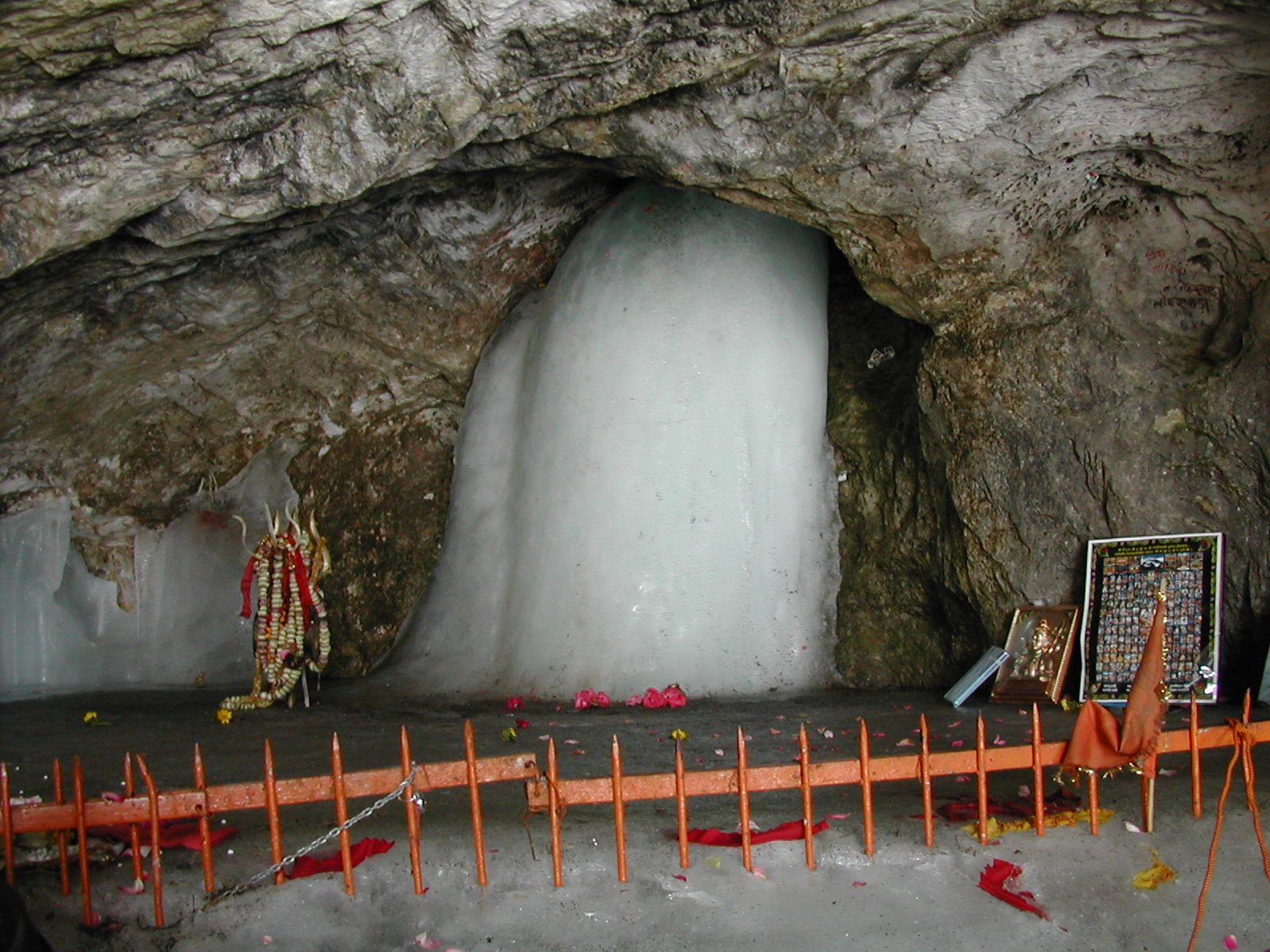
Reaching the cave is no small feat. The final stretch often tests the limits of the body. Icy winds howl across desolate ridges, and oxygen levels dip. And then, suddenly, the cave appears. Modest in size, yet grand in its presence. Inside, under the low-hanging rock ceiling, stands the shimmering ice lingam. In the dim light, surrounded by the murmur of prayers and the shuffle of tired feet, time seems to dissolve. The Shivalinga is no longer just a column of ice—it is the axis of the universe, the still center of all movement. For a few precious seconds, each pilgrim stands face to face with the eternal with silent mantras and even the most hardened doubters are softened by the raw power of the moment. Amarnath is not just about the final darshan. It is about the transformation along the way. It is about shared discomforts and shared miracles. In the face of the cave, all differences melt—of caste, language, wealth, and background. What remains is only bhakti—pure, unfiltered devotion.
In recent years, the growing number of pilgrims—reaching over 600,000 in some seasons—has also brought ecological concerns. The Himalayan region is fragile, and the rising human footprint poses a real threat to its delicate balance. Glacial retreat, littering, and disruption to local flora and fauna are issues that cannot be ignored. Responsible pilgrimage is the need of the hour. Carrying back our waste, respecting local ecosystems, limiting crowding, and listening to both environmental scientists and local communities are essential if we want future generations to walk this sacred path. The mountain must be preserved not just for religious reasons, but because it is a living, breathing entity—sacred in its own right.
Amarnath is more than a pilgrimage—it is an embodiment for life’s difficult but meaningful journey, for silence that speaks, for hardship that heals. It teaches us that the greatest truths are often hidden in the most unlikely places—in a cold, dark cave atop a perilous mountain. It teaches patience, surrender, and the beauty of collective resilience. And it teaches that sometimes, to find God, one must lose comfort, take the hard path, and walk with nothing but faith.
As pilgrims descend, tired but fulfilled, their faces carry something indescribable. A stillness, perhaps. Or a glow. The cave may be behind them, but something of it remains inside them. A whisper in the wind, a snowflake on the skin, a mantra etched into the soul. In a world full of distractions, the journey to the holy cave of Amarnath remains a reminder that the divine is still possible—that there exists a place where God appears not in gold and garlands, but in ice and silence. And long after the Lingam melts, and the snows return, and the paths empty out again, the echo remains: “Har Har Mahadev.” A cry as ancient as the mountains. A call that will ring, year after year, drawing new feet to old paths, new hearts to ancient truths.

Rachna Vinod is a multilingual poet, writer, blogger and broadcaster, proficient in Hindi, Urdu, English, and Dogri. Her works have been broadcast through multiple media platforms, including All India Radio. In addition to her books, her articles and creative pieces are regularly published in both print and online literary magazines. She has made significant contributions to literature with over 20 individual publications and participation in more than 25 collaborative anthologies.
A Few Published Works:
Urdu: Yasmeen-e-Sughandh, Mere Humsafar
English: Eternal Heritage, Shahada Aisha, I Am Here Only, Bridging The Gap, Lotus Lore, Kashmir Konnectivity: A Biosketch
Hindi: Ankahi Sargam, Pighalte Himkhand (poetry collection), Madhyaratrik Kshan, Parvaton Ke Dayare (short story collection)
Dogri: Adaya Madaya Geeten Bharya, Hirkhi Phuhar, Aakhi Lai Dile Di Gall