
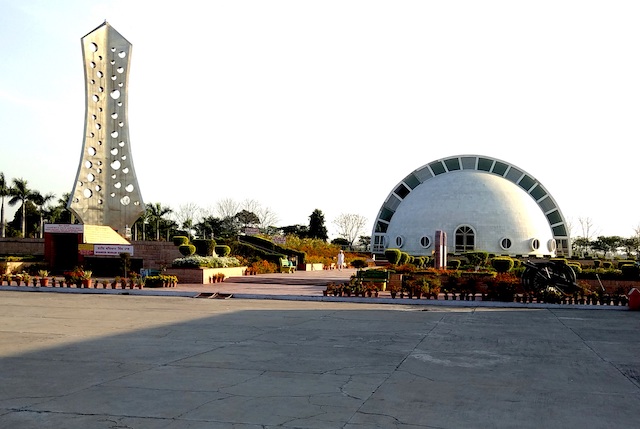
The Kuka Martyrs’ Memorial, also known as the Namdhari Shaheedi Smarak, in Malerkotla, Punjab, is a poignant tribute to the 66 Namdhari Sikhs executed by British colonial authorities on January 17 and 18, 1872. Located in the heart of Malerkotla city, accessible via the Khanna-Malerkotla Road, this memorial honours the courage and sacrifice of these early freedom fighters who stood against colonial oppression, embodying the Namdhari sect’s resistance to British rule.
The Kuka movement, led by Satguru Ram Singh, was a significant anti-British resistance effort in Punjab during the 19th century. Founded on April 12, 1857, in Ludhiana, the Namdhari sect, also called Kukas due to their high-pitched recitation of Gurbani, combined religious reforms with opposition to British rule and social vices like cow slaughter. The movement’s non-cooperation and civil disobedience tactics predate similar strategies later employed by Mahatma Gandhi, earning Satguru Ram Singh recognition as an early pioneer of India’s freedom struggle.
In January 1872, tensions escalated in Malerkotla, a Muslim-majority princely state, when Kuka Sikhs protested against cow slaughter, a practice permitted by the British that was deeply offensive to their beliefs. The situation turned violent after a pro-regime judge ordered an ox to be butchered in front of a protesting Namdhari, Gurmukh Singh. On January 14, approximately 200 Kukas raided the fort at Malodh, followed by an attack on Malerkotla the next morning. The conflict resulted in deaths, injuries, and the capture of many Kuka Sikhs.
On January 17 and 18, 1872, under the orders of Deputy Commissioner John Lambert Cowan and Commissioner Richard Temple, 66 captured Namdhari Sikhs, including 12-year-old Bishan Singh, were executed without trial. This massacre, occurring just 15 years after the 1857 Indian Rebellion, underscored the Kukas’ role as early freedom fighters and left a legacy of resistance.
Cruel Method of Execution
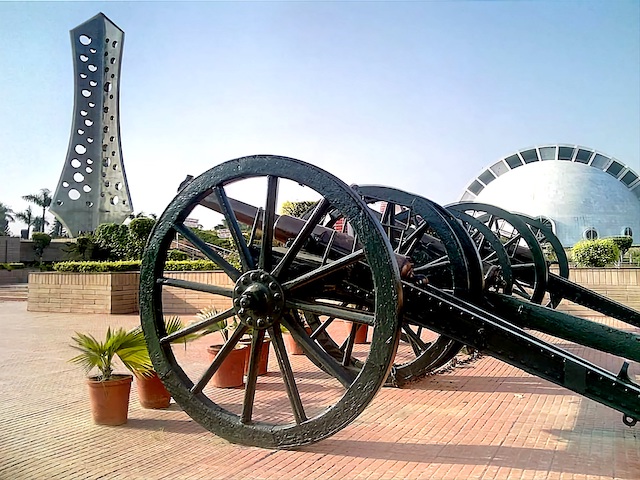
The execution of the 66 Namdhari Sikhs was marked by extreme brutality. The British authorities employed a method learned from the Mughals and used during the 1857 Rebellion: tying the prisoners to the mouths of cannons and blowing them apart. On January 17, 49 Kukas were executed on the Malerkotla parade ground, followed by additional executions the next day, totalling 66 martyrs. Many victims’ names were not recorded, and the lack of trials amplified the injustice. This gruesome act was intended to instil fear and suppress further dissent, but it instead galvanised the Namdhari community and inspired future resistance movements.
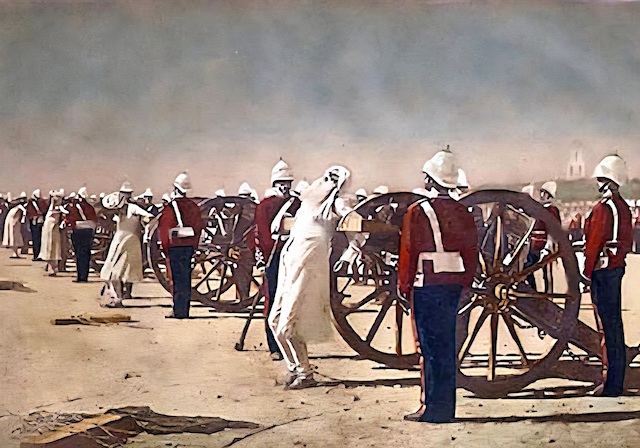
The first impartial record of the gruesome act by the Britishers was in the form of a painting by Vasily V. Vereshchagin – a Russian painter and war artist. Vereshchagin visited British India from 1982 to 1983, and after thorough research and understanding of the incident, he made the oil painting titled “Blowing from Guns in British India” in 1884. The painting depicts the execution of Namdhari Sikhs by being blown by guns in January 1872.
A Befitting Memorial: Architectural Wonder
To commemorate the supreme sacrifice of the 66 Bravehearts for the larger cause of attaining freedom from the cruel British Raj, the Namdhari Sikh community, with the cooperation from the central and state governments, has established a befitting memorial on the very grounds in Malerkotla where the 1872 executions took place, making it a site of profound historical and emotional significance. About 7 acres of defence land was handed over to the Namdhari Community on a long-term lease.
The Project Committee approached the Punjab Government’s Department of Architecture in 1990 to design a suitable memorial. Architects DK Bahl and Naresh Kumar Sehgal were chosen to design this prestigious work. The duo worked tirelessly for many years to accomplish this challenging task. Dr I.C. Syal assisted them in the preparation of the structural design.
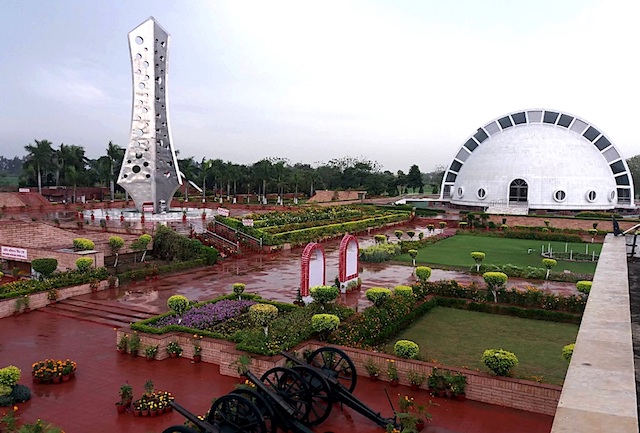
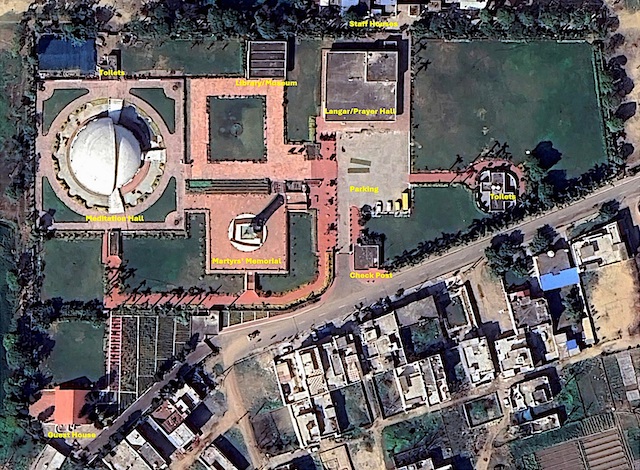
The campus layout was planned on a Cartesian pattern, with most components having square shapes – the square being the purist shape. These components are judiciously juxtaposed and are well connected through wide pedestrian pathways. Vehicular traffic has been confined near the entrance gate.
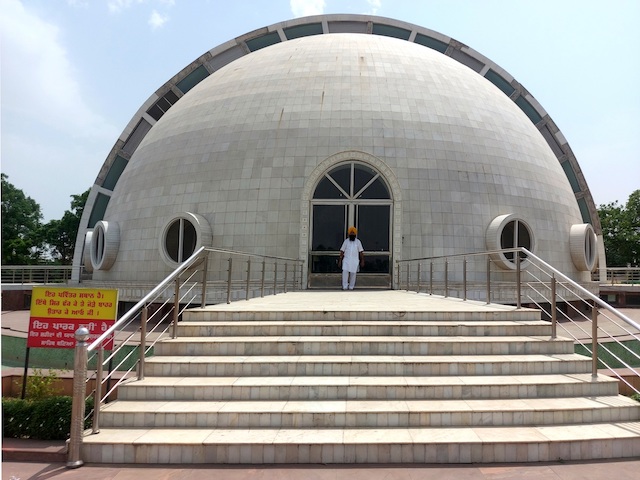
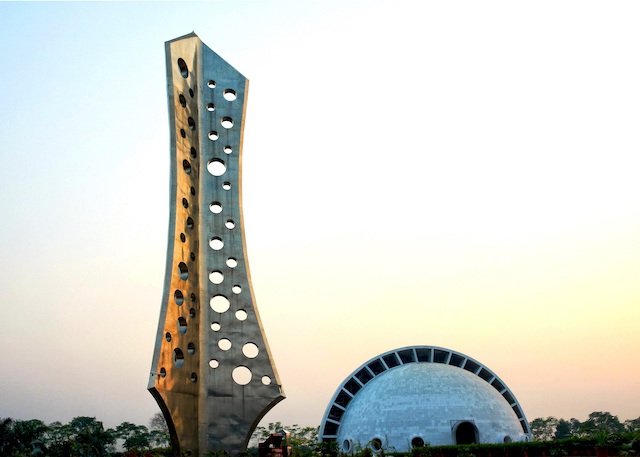
The campus comprises a large domical-shaped Meditation Hall and a 66-foot-tall Khanda Memorial with 66 holes symbolising the supreme sacrifice by the 66 Namdhari Sikhs. Apart from these, there is a Museum-cum-Library, a large Langar/Prayer Hall, a Guest House, a Check Post, spacious parks and public conveniences. The Memorial’s design ensures that the sacrifices of the Namdhari Martyrs remain etched in the collective memory, serving as both a tribute and an educational tool.
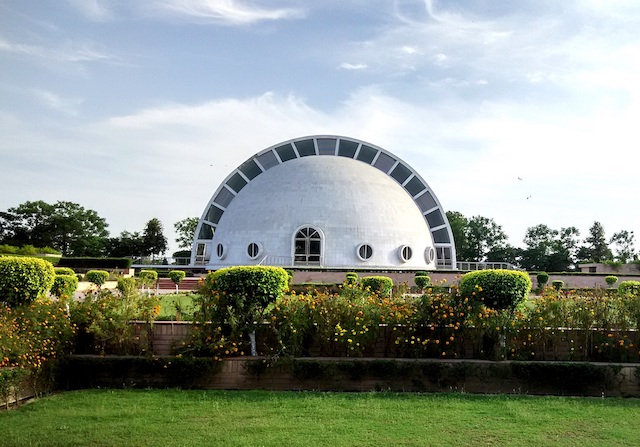
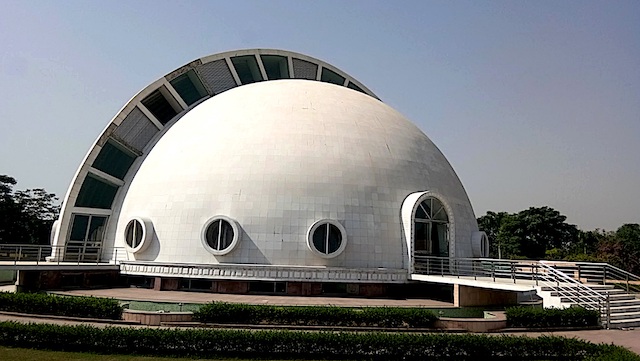
The Meditation Hall occupies the prominent place facing the main promenade on the southern fringe of the campus. Its rounded form in pure white echoes the typical style of turban of the Namdhari Sikhs thus making it a most sacred place in the premises. The plan of the Hall is about 100 feet in diameter. It comprises two interlocking hemispheres of varying sizes bound together by six feet deep RCC truss which accommodates clerestories facing the north and two entrances on the sides. This arrangement ensured the structure’s much-desired stability and provided abundant natural light inside the Meditation Hall. Its outer surfaces are clad in pure white marble, whereas the internal surfaces are applied with acoustic materials to reduce echo in the Hall. The perfection in the acoustic treatment obliterates the need for electrical sound amplification systems in the interiors. The Hall is sufficient to accommodate 750 persons during congregations.
Martyrs’ Memorial is a towering structure in stainless steel located prominently near the main entrance to the campus. It is a 66 feet tall monument shaped like a Khanda, a double-edged sword symbol central to Sikhism, representing spiritual and temporal authority. The Khanda features 66 holes, with 22 holes on each of its three sides, symbolising the 66 cannon balls fired during the executions. Larger holes represent adult martyrs, while the smaller ones denote minors, including the 12-year-old Bishan Singh. The memorial Khanda has been constructed in RCC with external cladding in stainless steel. It stands on a 100×100-foot platform with an equal-sized subterranean multipurpose hall below named after Martyr Wariam Singh. This Hall draws natural light through a continuous ribbon window around its periphery.
Among other prominent buildings on the campus are a 90×90-foot Langar/Prayer Hall and a 48×48-foot Museum-cum-Library. These buildings, too, follow the square pattern in plan and are kept low height so as not to distract visitors from the Martyrs’ Memorial and the Meditation Hall. Externally, these buildings are clad in Dholpur stone. The Langar/Prayer Hall caters to large gatherings during the annual congregations. In the other building the Library has been named after Martyr Bishan Singh and Museum after Martyr Gurmukh Singh. This building houses valuable literature, paintings, archival records and other artefacts related to the Kuka Movement. The campus is enlivened by extensive green lawns, plantations, flowers and waterbodies which complement the built forms.
Paying Homage to the Martyrs
Every year on January 17, the Kuka Martyrs’ Memorial becomes a focal point for remembrance during Kuka Martyrs’ Day, also known as Kuka Shaheedi Divas. Thousands of Namdhari followers, political leaders, and the public gather at the Namdhari Shaheedi Smarak to honour the 66 martyrs.
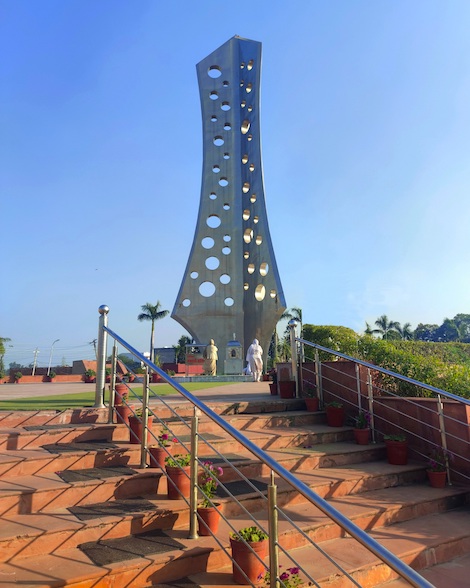
Attendees lay flowers at the Memorial to honour the martyrs. The event includes recitations of Sikh scriptures and prayers, reflecting the spiritual significance of the Kuka movement. Political leaders and community members deliver speeches highlighting the martyrs’ bravery and the Namdhari sect’s contributions to India’s independence. These gatherings emphasise the importance of adopting the teachings of Satguru Ram Singh, such as non-violence and social reform, in modern life, besides educating younger generations about the Kuka movement’s role in India’s freedom struggle and reinforcing the values of courage and resistance.
The Kuka Martyrs’ Memorial is emerging as a significant destination for grey tourism. Grey tourism, also known as dark tourism, involves visiting sites associated with death, tragedy, or suffering to gain historical insight and pay respects. The Kuka Martyrs’ Memorial is a prime example of such a site due to its connection to the 1872 massacre. It attracts historians, students, and tourists seeking to understand the complexities of India’s freedom struggle. The Memorial’s location in Malerkotla, a city with a rich history as a former princely state, adds to its appeal as a cultural and historical site.
The Kuka Martyrs’ Memorial in Malerkotla is a powerful symbol of sacrifice, resistance, and resilience against colonial oppression and offers a profound space for remembrance, education, and cultural exploration.
- Via inputs from Architect Naresh Kumar Sehgal.
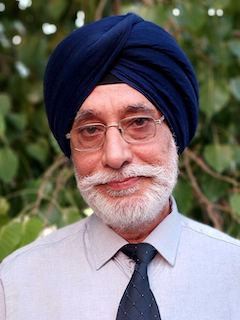
Sarbjit Bahga (b1957) is a Chandigarh-based architect, author, photo artist, and archivist. He is the Principal Architect of Bahga Design Studio LLP. Earlier, Bahga worked in the Department of Architecture, Punjab, Punjab Health Systems Corporation, and Punjab Mandi Board in various positions.
He has more than 42 years of practical experience designing various types of buildings, complexes, and large campuses. His completed works include an eclectic range of administrative, recreational, educational, medical, residential, commercial, and agricultural buildings. A monograph on his selected works titled “MODERN REGIONALISM: The Architecture of Sarbjit Bahga” has been published.
Bahga is also a keen researcher and a prolific architectural writer. He has 12 books to his credit, which include Modern Architecture in India, New Indian Homes, Le Corbusier, and Pierre Jeanneret: The Indian Architecture, Trees in Urban Habitat, Landscaping Human Habitat, New Indian Architecture -1947-2020, and Hand-Drawn Perspectives and Sketches. Bahga’s contribution to architecture has been largely recognized. He is a three-time recipient of the World Architecture Community Awards. His name has been featured in the Guinness Book of World Records for designing the “longest covered concrete corridor” in Vidya Sagar Institute of Mental Health, Amritsar.