
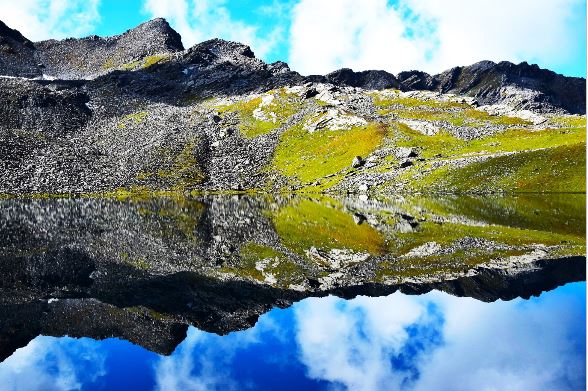
‘Bharara Sar’ or ‘Baraadsar’ Lake is also referred to as the ‘Lake of Dreams’ – where dreams are fulfilled and supposedly sacred for its healing powers. It is a high-altitude glacial lake that lies amidst the craggy Himalayan Mountain ridges at an altitude of 4,300 m (14,500 ft.), that is much revered by the hill people. This sacred lake marks the boundary of Himachal from Uttarakhand – Dodra-Kwar valley of Rohru area of Himachal and the boundary of the Govind Wildlife Sanctuary National Park in Uttarkashi district of Uttarakhand. It also demarcates the catchments of the Rupin and Supin rivers, which meet downstream at Naitwar, forming the Tons, the largest tributary of the Yamuna. Some decades ago, much interest was shown in rediscovering the Saraswati-vanished River of the Vedic period. Some researchers had argued that the present-day Tons represented the upper reaches of that mythological river. The origin of Rupin is traced to a glacier in the environs of the Rupin Pass on the border of Uttarakhand and Kinnaur, while Supin has its origin from a glacier near the Har-ki-dun valley in Garhwal. ‘Bharara Sar’, is undoubtedly a hidden gem – one of the region’s best-kept secrets, a lesser-known lake that has remained off the radar for most trekkers and adventurers.
The Trek:
The rain was pouring from the skies, pounding the old dilapidated tin roof of the forest Inspection hut at Kwar. Kwar, the headquarters of Dodra-Kwar, the remote region of Shimla district, not long ago landlocked from the other parts of the state by the mighty Chanshal. I got up from my bed, assuming that the trek for the day would not be possible, but to my utmost surprise, Dr. G.S. Goraya was standing in the veranda, adjusting his raincoat, and ready to move. I at once rushed to the area where the porters and other team members were sleeping, and told them to get ready, as we had to move irrespective of the rains.
It was decided that Dr. Goraya and myself would start ahead, while the others would get together their camping gear, and catch up with us further up on the trail. After covering some distance, the rain stopped and the sky opened to a sparkling blue. The narrow, winding trail took us beyond the habitation into the forest. First came the blue pine forests, which further up gave way to the devdar, fir and spruce mixed forests associated with the rich variety of broadleaved species (maples, oaks, walnut, bird cherry, hazelnut, horse chestnut, horn beam and birch). The walk through this pristine forest was just amazing, with breathtaking views across the valley, taking away the fatigue of the trek. Along the trail, we came across a ‘gaddi’ shepherd, who offered us goat milk tea, which was a welcome treat, wholeheartedly relished.
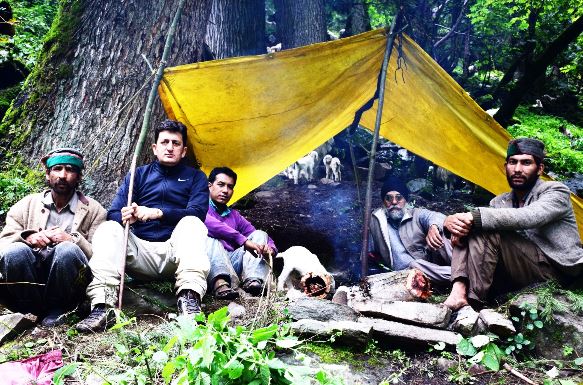
By evening, the rest of the team had caught up with us, which was a great relief as the forest had now become thicker, and at the same time the distance from any nearby habitation further away. Soon we reached our destination for the first night’s halt, an opening etched in the rocky mountain side. Maple leaves were collected and spread in the cave for cushioning the sleeping bags. As nightfall approached, the skies again started to thunder with lightning, followed by heavy downpour, intermitted with hail and sleet, which lasted well past midnight. The lightning flashing across the night sky was absolutely scintillating, its jagged streaks illuminating the darkness with sudden bursts of blinding brilliance. Each flash carved a fleeting pattern of white fire through the rains, casting eerie shadows around the mountainside. It was both loud and beautiful—a raw display of nature’s power that left the sky trembling and the earth below in awe.
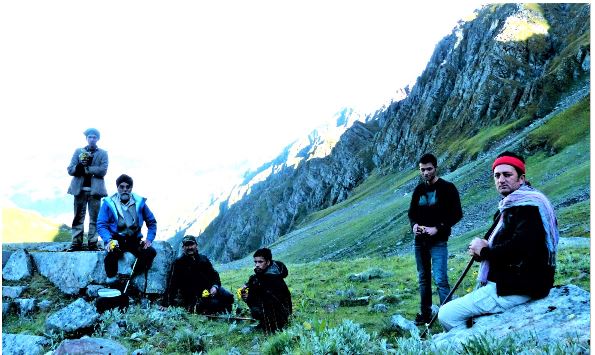
The next morning, me and Dr. Goraya started early, it was an arduous steep mountain trail up the slope, with twigs of Salix as natural toothbrush jutting from our mouths. It was a slow and steady, gated climb with frequent stops to gather energy for the steps ahead. By noon we reached the alpine meadows near ‘Bishting’, where we rested and ate our lunch of Maggi, with spoons crafted from birch twigs. Thereafter, the trek was a a slow, measured walk across expansive alpine meadows, unfolding sweeping views of the Rupin valley below and the vast Pabbar catchment beyond. With the evening approaching, the trail now felt endless, each step growing heavier as fatigue settled deep into our legs. Darkness had fully fallen by the time we arrived at our halt for the night—a cave once again, but this one was far larger, with two or three levels carved into the rock, each forming a separate chamber stacked one above the other.
Next morning, I wriggle out from my sleeping bag, and as I rub open my eyes – before me is a utopian view of a tall milky waterfall, as if falling from the blue sky above. I was informed that it flowed from the sacred lake, Bharara Sar. Such experiences get etched in any traveler’s mind, and remain for eternity. A simple breakfast of jam and bread with tea, and we move ahead towards the lake. The trail winds past the base of the waterfall, where our ascent toward the lake truly begins. With each step, the altitude climbs, and our pace naturally slows—every movement growing more deliberate with altitude, under the thinning air. Eventually, we crest the mountaintop and are met with a breathtaking sight before us – vast green meadows unfurling in all directions, scattered with delicate anemones and golden cinquefoil dancing in the crisp mountain breeze. It was just raw, untouched nature—an endless expanse that humbles and stirs the spirit. Little wonder that the great sages and hermits of India were drawn to such secluded realms to seek solitude and perform their penance.
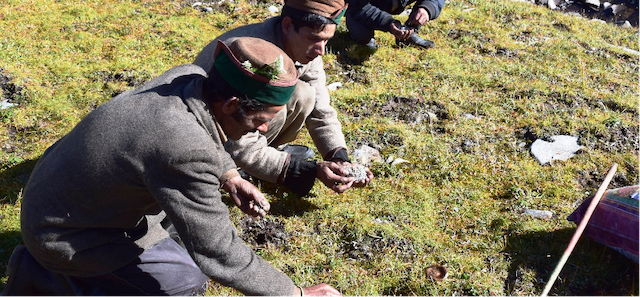
The local porters set down their loads and start scouring the meadows, dropping to their knees and carefully scanning the ground. Curious, I ask what they’re searching for, and they tell me it’s ‘heun shali,’ which they believe falls from the sky, and is used for medicinal purposes back home, especially to treat skin burns. Upon closer examination, though, it turns out to be a high-altitude lichen—Thamnolia vermicularis—a species from the Icmadophilaceae family, which includes around six genera and 58 species worldwide. Literature also points to the lichen as snow tea in ancient China, which was drank to digest the large amount of meat consumed during the times.
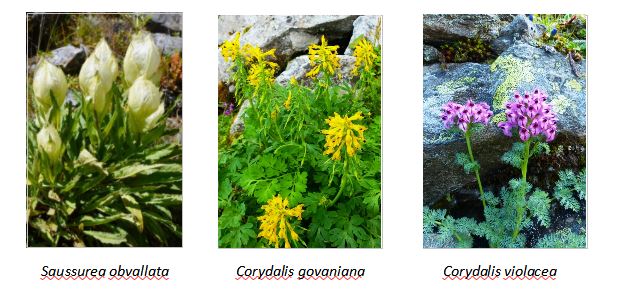
What’s truly fascinating is how the lake remains hidden from view until you’re barely 200 – 250 m away. It is so perfectly concealed, it feels like the mountain’s own magic trick—its final flourish in an already spectacular performance, just for you. And then, suddenly, you’re standing there, awestruck, gazing at the crystal-clear, electric blue waters of the lake shimmering before you. The lake is cauldron-shaped, formed by snowmelt from the surrounding peaks, with several high ridges intersecting at its edges. The lake’s aquamarine blue hue, combined with its pristine setting, gives it an otherworldly appearance. The crystal-clear waters provide a great frame for photography. Dr. Goraya and I offered our obeisance at the small temple on the lake’s edge, before turning our attention to exploring the area in search of unique plant life. We came across numerous alpine flowers, some striking ones included Delphinium brunonianum, Aconitum violaceum, Corydalis govanianum, Corydalis violacea, Saussurea gossypiphora and Saussurea obvallata.
In the present fast paced, and stressful urban atmosphere, nature walks and treks can be a life-changing experience for the better—it helps one grow as a person, bonds people together for eternity (like the bonding between me and Dr. Goraya), and lets you really connect with nature. Many people share stories about their journeys, often highlighting the tough moments, the amazing views, and how such adventures make a lasting impression. These experiences not only highlight the physical and mental effort it takes, but also how rewarding it feels when you finally reach the destination. It is also one of the virgin treks not travelled by many, especially from the Dodra-Kwar side. The trek takes you through last remnants of the Himalayan slate roofed hamlets, dense moist temperate forests, sprawling lush green meadows with numerous flowering herbs dancing with the cool breeze, and vistas to mountain passes and peaks like Chanshal, Buran Ghati, Chander Nahan and the mountain ranges of Uttarakhand, with sighting of Bandarpoonch from the Lake top (towards Uttarakhand side).
The lake is a stunning surprise, but the journey itself is just as rewarding. The trail offers unforgettable views and with every step on this trek, a new marvel reveals itself—each day weaving a tapestry of nature’s wonders and tranquil beauty across untouched mountain landscapes, where Mother Nature softly whispers her ancient tales, leaving behind memories to cherish for a lifetime.
(Dr. G.S. Goraya was then the Dy. Director General, Indian Council of Forestry Research & Education, Dehradun)

Dr. Vaneet Jishtu, a field botanist specialising in high altitude himalayan flora, conducts a wide range of research at Himalayan Forest Research Institute (HFRI), where he works. At Shimla he has pioneered in setting up an arboretum, a botanical garden where a vast collection of Himalayan trees have been planted. He lives in Shimla
A magical journey deep into the untouched Himalayas..Bharara Sar feels like a dream woven by nature. Untamed beauty, Gaddi hospitality, and the symphony of storms and silence… simply unforgettable..
I can imagine the trek you had been,leaving behind mesmerizing memories for the rest of the life and fairy tale for non followers.
Sometimes feel jealous of not being part of the team and missing the most treasured wealth and beauty of Nature.
Wish you many more such adventures, hoping for atleast one for me as well.
Tremendous work and dedication 👏
In this fast-paced digital world, this article reminds us that returning to nature is not a luxury but a necessity.
What a memory Vaneet? So many details of this September 2014 still fresh in your mind! Great write up, made me relive this rather arduous trek, competition with sheep herd to stay in ‘handu ku odaar’ – the cave; nature’s silvery display after rain stopped in the midnight; second night halt in the 3-storey rock shelter; lush green meadows, floristic richness, and all. I wish I could always remain a ‘budlu’, as one of the local guides addressed me on this trek, and be able to enjoy many more such treks in your enthusiastic and adorable company!
It it treat to my eyes always to read your articles and listen to your experiences Sir.I feel so lucky to have you an amazing mentor and motivator.