
Once, having kids wasn’t a choice. It just… happened. You studied, married, had kids, and everyone assumed you’d follow the script. No questions asked.
Now, something shocking is happening. People are thinking. That hesitation makes people nervous.
From “It’ll Happen” to “Have You Thought This Through?”
Once, children appeared without notice. Today, they come with Excel sheets and one friend saying, “Are you sure about this?”
Because children are not hobbies. You can’t do them on weekends and return them by Monday. They are full-time humans with infinite needs and zero-refund policy. You don’t just raise a child. You grow alongside your child, learning things again with them—only this time with anxiety, Google, and less sleep.
When you’re already juggling work, traffic, ageing parents, EMIs, and umpteen WhatsApp groups, adding a baby doesn’t feel romantic. It feels like a start-up, run mostly on hope and emotion.
Middle-Class Parenting, Upgraded
Parenting isn’t just expensive anymore. It’s competitive.
Middle-class India doesn’t simply raise children; it curates them. Private school is the default, because “government school” doesn’t sound good over paneer tikka. Tuitions start almost as soon as childhood begins.
Then come the “activities”: sports (for fitness), music (for culture), coding (for the future), public speaking (for LinkedIn), and personality development (because God forbid they have an ordinary personality).
And of course: foreign education. Ideally announced like, “Oh, she’s going to Boston,” while everyone else quietly multiplies by 90.
Affordable options exist, but “affordable” has been rebranded as “Are you not ambitious for your child?” So people do the math, pause, and close the laptop.
Gender Equality: Looks Better on Paper
Women today are educated, ambitious and earning. The future looks fabulous. Then motherhood enters and taps them on the shoulder: “Quick break? Say, five to ten years?”
Career breaks are still mainly taken by women. Men proudly “help” with their own children, like guest lecturers in a full-time course. Girls grow up knowing that one baby can cost them a promotion, a pay jump, or the respect they finally built at work.
For many women, choosing not to have children is not rebellion. It’s self-defence.
When Life Was More Flexible
Children and spontaneity do not coexist.
Trip plans bow down to school timetables. Evenings revolve around homework. Projects are due “tomorrow” which secretly means “yesterday.” Sports Day enthusiasm is compulsory, especially for parents whose last race was to catch a bus in college. Fevers arrive at 2 a.m., just when your presentation is at 9 a.m.
Physical needs come first. Emotional needs trail close behind. Your own mental health usually comes third, if it makes the cut. Parenting today is less “Spare the rod, spoil the child” and more “Did I just emotionally scar them for life by saying no to ice cream?”
Parenting in the Age of Overexposure
Our parents worried about where we were. We worry about what our kids are seeing.
Drugs, alcohol, Instagram, pornography, online bullying, 24×7 news, influencers explaining heartbreak at age seven—children now meet adult problems before adult teeth. Parents are unsure how to handle these complicated issues.
And if anything goes wrong, the world asks just one question: “Where were the parents?”
When “Forever” Comes With Paperwork
No one tells you that some marriages don’t last as long as promised.
Once there’s a child, every fight comes with a long list of things to be sorted—custody, weekends, sports day, school PTM, who gets Diwali, who gets New Year, who’s the “fun parent.”
You watch friends frantically managing lawyers and school obligations and think:
Dating = two people + a bill.
Marriage = two people + furniture.
Child = two people + a kid + a court order.
The Sandwich Generation Is Toast
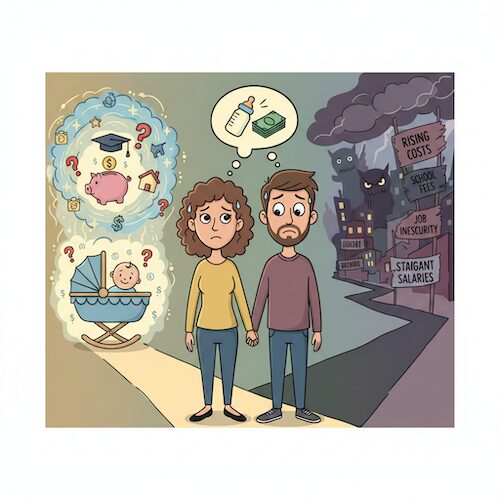
Many adults are stuck in the middle: parents on one side, potential children on the other.
They’re managing hospital visits and health insurance for ageing parents while trying to imagine school fees and piano classes for future kids. Medical costs are up. School fees are up. Only salaries seem to be on saturation mode.
Homes have shrunk. Travel times have grown. There’s no joint family, no aunty next door to help. So the question slowly changes from “Why don’t you want kids?” to “But where, exactly, will they fit?”
When the World Feels Uncertain
Then there’s the world we’re living in.
Heatwaves. Floods. Pollution. Wars live-streamed between ads. Layoffs every quarter. Rent, prices, instability. For many, it’s not fear. It’s thoughtfulness.
They’re not asking, “What if I can’t handle it?”
They’re asking, “Is this a kind enough world to invite someone into?”
The Labels We Use Now
Modern life loves labels, and the child-free have plenty.
DINKs: Double Income, No Kids.
SINKs: Single Income, No Kids.
DINKWADs: Double Income, No Kids, With A Dog (or cat, plants, or all three).
These adults travel. Save. Sleep. Fund NGOs. Pay for their house helps kids’ education. Build careers. Keep pets. And occasionally finish a book in the same month they started it.
Children Still Have a Way of Winning
And yet, in the middle of rising costs, global chaos, and a future that feels anything but simple, some people still choose children.
And when they do, they get things no spreadsheet can calculate: a hug or a kiss for no reason. Late-night questions that begin softly and end somewhere deeper. The surreal joy of watching your child become a person—with their own jokes, politics, music, and unfortunately, your temper.
Children aren’t just a responsibility. They’re a continuation of you—your nose, your walk, and even that annoying habit.
Let People Choose
Maybe this generation is not “afraid of commitment.” Maybe they read the fine print before signing up.
In a country like India, both paths will always exist. And both should be respected.
Some people will want children, and they should be allowed to go for it—with open eyes, open hearts, and a little less advice from everyone else. Others won’t, and they should be allowed to live fully too—without guilt, without awkward wedding questions, and without being treated like something is missing.
Change isn’t the issue. The way we judge it is.

Iti Mattoo, retired after 30 years in the IT industry, now enjoying her creative pursuits.
Hi Iti,
Veru well summarized , uour style of writing is amazing… inhumourous way you unfolded many things which people are facing these days…thanks ton for writing.
brilliant