
There is no single way to see the Himalayas. The truest way to know these mountains is not in a moment, but in the slow turning of their seasons — to feel the first snow silence a valley, the first blossoms open after a long winter, the first rain touch the dust and the first golden stalks bend before harvest. In a year among these peaks, the senses learn the language of altitude i.e. how air thins yet scents sharpen, how light changes not just by the hour but by the month, how the sound of a river in July is not the sound it makes in October. This is the Himalayan year — a journey not by road or trail, but by colour, scent, taste, and light.
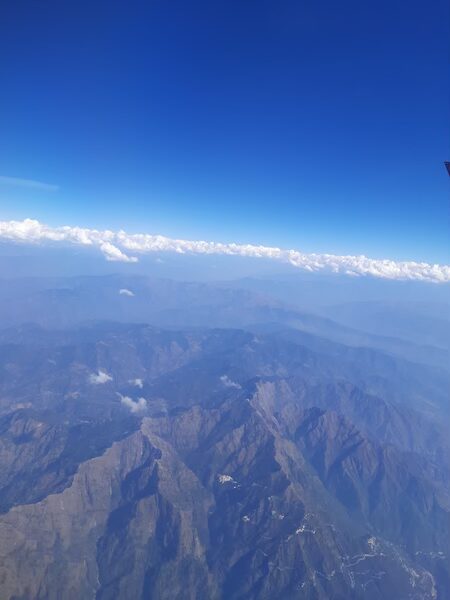
The year in the Himalayas begins in the snowy cuddle. Winter arrives not as a date but as a deepening hush, when the mountains draw a white shawl around themselves. Time slows, roads disappear, and the world turns inward. Snow measures the days more faithfully than any calendar—layer by layer, silence by silence. Homes become islands of warmth, breath turns visible, and endurance becomes a daily ritual. In this season, the Himalayas teach patience, reminding life that rest, waiting, and quiet strength are also forms of movement.
By early winter, frost collects on the grass, and the first snow often arrives silently, as though the world has agreed to a brief pause. One morning, a ridge that was dark and bare the night before will be capped in white, and the transformation feels both sudden and ancient. Smoke curls from chimneys, children stamp their feet by the hearth, and elders sit wrapped in thick shawls, talking softly as the wind rattles the wooden shutters. The forests are hushed, pine needles brittle under frost, and the high passes are sealed in white silence. The mountains seem to pull back from the world, offering only their stillness to those who remain.
Then, imperceptibly at first, the thaw begins. A trickle runs where there was ice; a pale green haze appears on the bare branches of willows. The first flowers are tentative — tiny white blooms in the grass, shy clusters of primula along a wet wall — but each day brings more. Spring in the Himalayas is a painter with a fast hand: meadows flush with anemones, forests blush with rhododendrons in crimson, pink, and cream. Snowmelt streams run fast and bright, their sound carrying for miles in the thin air. Villages stir; fields are turned, seeds planted, and paths once blocked by drifts are opened again. The air is filled with birdsong — the flute-like call of the whistling thrush, the chatter of bulbuls, the liquid notes of the Himalayan cuckoo. Warmth seeps back into the stones, and the smell of damp earth is replaced by the sweetness of blossoms and young grass. Days lengthen, and light plays differently on the ridges, softer in the morning, brilliant at noon, and gold-tipped in the evenings. The sky burns gold at sunset, peaks blush and then turn violet, and the stars return in their clear, cold brilliance. By late summer, the fullness of life shifts again, this time toward gathering and preparation.
In the embrace of the monsoon, the first drops fall on dry earth and the entire valley exhales. The scent rises immediately — deep, mineral, and alive as if the soil has been waiting months to breathe again. Paths that were dusty and pale become slick ribbons of dark clay, and every surface darkens under the rain’s touch. Leaves gleam, roofs glisten, and the stones of old steps shine like wet slate. The sound of water becomes constant — not just the rush of rivers but the drip from pine needles, the gurgle of roadside drains swollen overnight. From distant slopes, waterfalls appear where none existed the day before, white threads tumbling through green. Mornings are often folded in mist, with ridgelines dissolving into cloud, and by afternoon the valleys smell of wet wood, moss, and the faint sweetness of wild ginger. Life slows in the rain; yet the mountains feel more awake than ever.

When the rains begin to recede, the change is gradual, like a curtain slowly lifting. The air turns cooler, the sky begins to hold longer patches of blue, and the nights acquire a fine edge of chill. Autumn arrives as a long sigh after the rain, the air suddenly clear enough to see the farthest peaks with startling sharpness. The terraces ripple in gold, heavy with grain, and orchards glow with the red and green of ripe apples. The scent of harvest rises — warm straw, drying chilies, crushed stalks underfoot. Maples and poplars turn brilliant yellow; birch leaves fall like coins, scattering across forest paths. In the high pastures, grasses fade to tawny, and the last wildflowers stand vivid against the dry stems. The days are perfectly balanced — warm in the sun, cool in the shade — but the nights remind you that winter is never far.
A year in the Himalayas is never just a sequence of weather changes. It is a cycle of moods, colours, and scents that teaches the traveler to slow down and notice. Rain on pine needles smells different from rain on slate; snow muffles sound differently in open meadow and deep forest; spring light touches apple blossoms with a tenderness; autumn light saves for golden grain. For locals, these changes are more than beautiful — they are the rhythm of life, deciding when to plant, when to store, when to travel, when to stay home. For the visitor willing to linger, each season offers its own invitation, its own way of being in the mountains. And for those who stay the whole year, the seasons do not feel separate at all, but like four movements of the same, unending song — a song written in rain, snow, flowers, and harvest light. And the winter returns, folding the land back into silence—and the calendar closes where it began, in snow.

Rachna Vinod is a multilingual poet, writer, blogger and broadcaster, proficient in Hindi, Urdu, English, and Dogri. Her works have been broadcast through multiple media platforms, including All India Radio. In addition to her books, her articles and creative pieces are regularly published in both print and online literary magazines. She has made significant contributions to literature with over 20 individual publications and participation in more than 25 collaborative anthologies.
A Few Published Works:
Urdu: Yasmeen-e-Sughandh, Mere Humsafar
English: Eternal Heritage, Shahada Aisha, I Am Here Only, Bridging The Gap, Lotus Lore, Kashmir Konnectivity: A Biosketch
Hindi: Ankahi Sargam, Pighalte Himkhand (poetry collection), Madhyaratrik Kshan, Parvaton Ke Dayare (short story collection)
Dogri: Adaya Madaya Geeten Bharya, Hirkhi Phuhar, Aakhi Lai Dile Di Gall