
High-mountain regions across the world are entering a new era of climate-linked hazards, and the Himalaya is no exception. A recent Nature Geoscience correspondence by Fan et al. (2025) article highlights how traditional disaster frameworks—such as the Sendai Framework for Disaster Risk Reduction, the Sustainable Development Goals (SDGs), and the Paris Agreement—continue to treat hazards largely as isolated events. This approach, the authors argue, is no longer adequate in rapidly changing mountain environments where disasters increasingly unfold as interconnected chains rather than standalone incidents. For a state like Himachal Pradesh, where terrain, climate, and human settlements intersect in complex ways, this insight is particularly relevant.
The Himalaya is witnessing accelerated glacier retreat, permafrost degradation, and shifts in extreme rainfall patterns. These changes mean that a landslide is no longer just a landslide; it can trigger a rock–ice avalanche, block a river, form a temporary lake, and ultimately culminate in a devastating outburst flood downstream. The Chamoli disaster of 2021, though situated in Uttarakhand, demonstrated how a single slope failure can cascade into a large-scale event with little warning. In Himachal Pradesh, smaller yet similar examples are now increasingly recorded—landslides that alter drainage channels, cloudburst-generated debris flows that create temporary dams, and the rapid expansion of glacial lakes in upper catchments.
Himachal Pradesh’s State Disaster Management Plan (SDMP-2017) is aligned with the major global frameworks adopted in 2015, ensuring the state follows widely accepted international standards on preparedness, resilience, and climate adaptation. However, as the Nature Geoscience article argues, these global frameworks themselves contain conceptual gaps. They rely heavily on single-hazard models, even though the real threats in high mountains involve multi-hazard cascades intensified by climate change. Consequently, state-level plans, while modern in structure, may unintentionally inherit the same limitations.
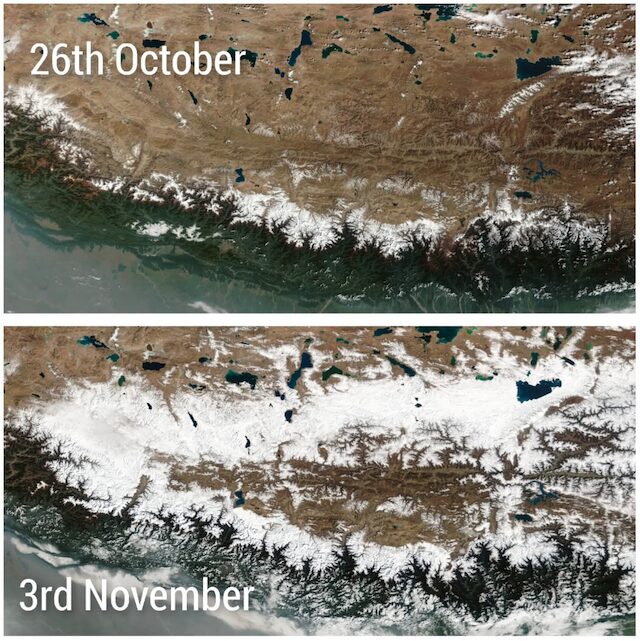
In Himachal Pradesh, preparing for cascading mountain hazards requires more than departmental action. Risk assessment must be conducted by multidisciplinary teams—geologists, engineers, hydrologists, climate scientists, and faculty from local colleges who study these processes firsthand. In resource-limited regions, the focus should shift toward basic training, knowledge sharing, and support from a regional advisory group. Ultimately, managing cascading hazards in the Himalaya demands cooperation across institutions, as no single agency can anticipate or respond to such linked disasters alone. This requires moving beyond static hazard maps toward dynamic risk pathways that trace how one event may trigger another.
Equally important is the role of communities. Mountain villagers possess strong environmental awareness, often noticing early signs of instability long before formal systems do. Integrating this local knowledge with scientific monitoring can create a powerful early-warning ecosystem. The successful evacuation of Blatten village in Switzerland after a rock–ice avalanche—highlighted in the paper—demonstrates what becomes possible when communities, scientists, and authorities collaborate seamlessly.
Himachal Pradesh stands at a critical juncture. Climate-driven cascading hazards are not distant possibilities—they are unfolding now. Updating the SDMP in its next revision cycle to explicitly address cascading processes, strengthening inter-departmental coordination, investing in cryosphere-specific monitoring, and institutionalizing community engagement will allow the state to stay ahead of emerging risks. In a warming Himalaya, resilience will depend not only on understanding individual hazards but on preparing for the chains of events that connect them.
Reference
Fan, X., Bhuyan, K., Wang, X., Cook, K. L., Ozturk, U., Loew, S., Gyamtsho, P., Jansen, J. D., & Xu, Q. (2025). Rethinking policy on high mountain cascading hazards. Nature Geoscience. Published 7 November 2025.
Authors: – Shubham Choudhary and Shailza Choudhary
Shubham Chaudhary is a geologist. He teaches geology to undergraduates at a government college in Himachal Pradesh. He lives in Shimla.