
Hills of Himachal are weeping for third consecutive year, however, cries of hills have not moved deaf and blind state and union apparatus. Hills are left with no option except roar devastatingly, let their displeasure known to all and sundry through massive devastation causing irreparable loss of life and property. Unfortunately, none in establishment at union and state level, in political spectrum and citizenry has time and inclination to pay attention towards sorrow of hills and their continued exploitation for development. Since none cared for hills, hills spoke for themselves, let their displeasure known through cloudbursts and flash floods and let, humans know that they will react violently to human excesses.
It is a fact that Himachal has experienced massive development with four lane road projects being executed at jet speed ignoring environmental concerns. Roads, tunnels and vertical cutting of hills ignoring soil strata and digging hills unscientifically have led to massive erosion leading to landslides causing massive inconvenience to commuters, blockage of roads and blocking of nullahs and khuds with massive mud volumes falling down from hills. Forests too have endured development with massive deforestation taking place for construction of roads, hydroelectric projects and for human resettlement of displaced population.
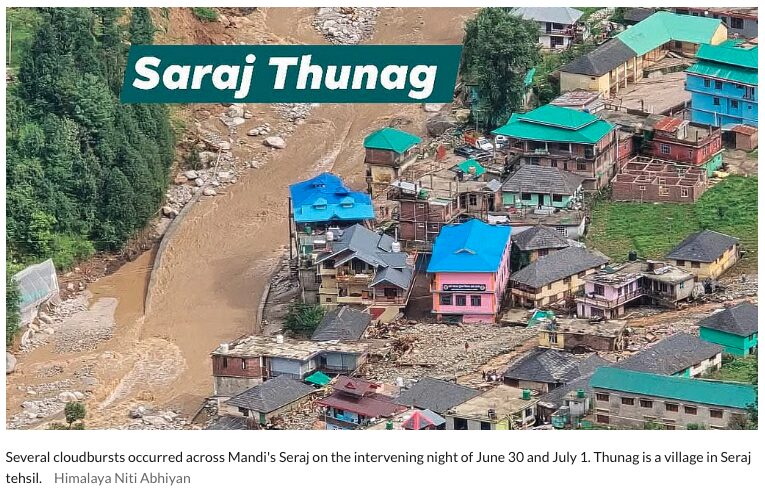
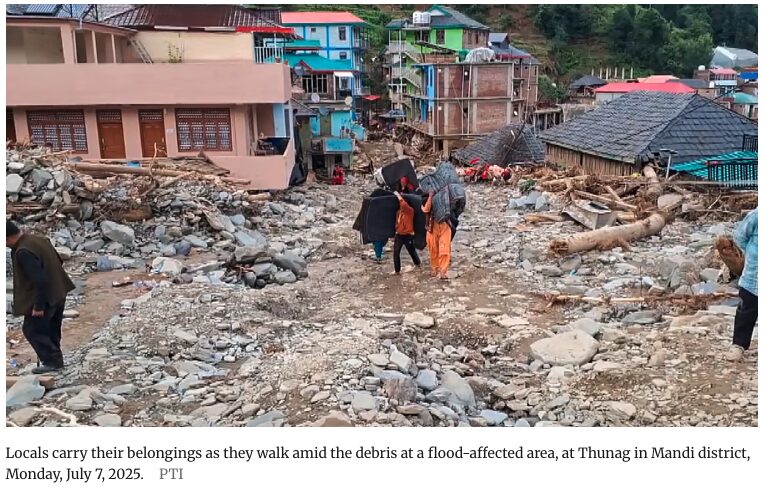
During current monsoon, Seraj block of Mandi district have seen unprecedented devastation with houses and humans washed away by cloudbursts and resultant debris of wood, stones, boulders and muck, which accompany gushing volumes of water giving no time for hapless victims to survive nature’s fury. Seraj block saw massive development and now it is reaping the perils of unscientific development, which affected hill strata as deforestation accompanied development. State and union led disaster management will never be able to heal the scars of survivors of losing hearth and dear ones.
Who is responsible for this sorry state of hills of Himachal, ruling establishment at centre and state, parties occupying opposition space in the state or citizens?. All are collectively responsible for jet speed environmental degradation. How is the question? Who are executing development projects in the state? It is either state or union government. Both are equally responsible for present state of environmental degradation heaped upon hapless citizens of state. Let us analyse causes, which are multifarious and interrelated. What does four-lane of national highways projects involve? It is unscientific cutting at ecologically fragile slopes and hills with state of art precision but environmental deafness, dumbness and blindness. What does this vertical cutting achieve or dis-achieve? Destabilization of entire hill strata and hillsides creating future disaster zones and disaster spots. Deforestation or massive tree felling for development have undressed hills of natural protection against soil erosion and landslides.
As youngster, have seen unoccupied river and khud banks with no human habitation near river and khud banks with lot of space available for flow of water. Now riverbanks have shrunk with widespread construction along them. Similarly, khud banks are occupied and roads construction through khuds in many areas leaving limited space for water flow. Come monsoons these rivers and khuds, show their fury punishing those occupying their natural space. Palampur is prime example where Bhiral and Mol khuds have lost their identity with massive construction not only on their banks but also literally within their surface. Following what criteria such construction plans are cleared by municipal authorities is mystery. There are spots in Palampur wherein massive concrete structures are coming up. Their clearance defies common logic since clearance seems odd and against environmental and civic norms. State is losing battle against nature and may see more devastation in future unless timely steps are taken to regulate development. Political leadership need to come out of vote bank syndrome, show statesmanship for protecting state and its natural heritage.
Citizens cannot escape blame for environmental degradation in Himachal Pradesh. Litter and garbage is thrown all around. It not only affects physical and mental health, also causes unmitigated environmental degradation with choked drains, kuhals and hill littered with trash and garbage causing erosion major cause of landslides. Despite garbage collection by municipal authorities, whole panorama is splashed with garbage and trash. If one carefully views, the banks of Bhiral and Mol khuds in Palampur are littered with tons of garbage. Same state is noticed in Paprola and Baijnath hills while driving along highway with hills littered with trash. Though municipal authorities in Palampur organise cleanliness drive in collaboration with local NGOs like Hilldari and Palampur welfare and environmental protection forum (PWEPF), an intensive effort is needed to rid towns and rural areas of garbage and trash, which is causing massive environmental degradation including polluting water sources. State also need to play a proactive role in dealing with waste management by installing state of art waste management plants and modern garbage collection vehicles instead of present day methods which are not only unhygienic and unscientific also cause health hazard to workers involved in the task.
How to check massive environmental degradation in Himachal Pradesh. There is need to sensitize officials of National highway authority of India (NHAI), National Hydroelectric Power Corporation (NHPC), Electricity board, PWD, IPH and their contractors of delicate nature of hill strata of Himachal Pradesh and need to use scientific methods for hill cutting and waste disposal. Fix accountability of officials for environmental overreach and unscientific exploitation of hills. After completion of ongoing four-lane road projects, stop sanction for new projects and resort to widening of existing roads wherever required. It also goes for power projects. Union Government deputes central teams for damage assessment to provide financial aid for disaster management but there is need to provide timely aid. Providing assistance for 2023 floods in July 2025 is injustice to people of state and aid of Rs 2006.40 crore for recovery and reconstruction is too meagre a relief considering degree of devastation.
Union Home ministry, the nodal ministry responsible for disaster management belatedly has recognised the seriousness of environmental degradation in Himachal Pradesh reflected in massive devastation caused by flash floods. It has ordered the formation of multi sectoral central team comprising of experts from National disaster management authority (NDMA), Central Building Research Institute (CBRI), Roorkee, Indian Institute of Tropical Meteorology (IITM), Pune and Indian Institute of Technology (IIT), Indore. Need is for multi sectoral team to work on war footing to suggest measures to mitigate disasters caused by cloud bursts ,flash floods and landslides. Their recommendations must be binding and should not remain consigned to files. Now is time for both state and union governments to work as team to restore balance between nature and development burying political differences for the sake of future of state and its people?
Rattan Chand Sharma retired from the Border Security Force as a Commandant. A regular contributor to publications like Outlook, Deccan Herald, India Sentinels, Force Magazine, Chanakya Forum, Saveratimes, Seema Sanghosh, he writes mainly about defence and security personnel issues.

Very well elaborated the effect on ecology due to unplanned construction activities on hills. To mitigate these impacts, sustainable construction practices, including careful site selection, erosion control measures, and responsible waste management, are crucial. Environmental Impact Assessments (EIAs) should be conducted before any major construction projects to identify potential risks and develop appropriate mitigation strategies.