
Faith must inspire unity, not arm mobs or silence dissent
The Punjab government is set to unveil a dangerous sacrilege law in the Vidhan Sabha on July 10 and 11, 2025, with punishments so severe they could include the death penalty. Aimed at shielding religious scriptures and symbols from desecration, this law raises a haunting question: Who defines sacrilege? Fueled by raw emotion and political pressures—like Gurjeet Singh Khalsa’s 270-day protest atop a Samana tower—this legislation threatens to gut free speech, fracture Punjab’s pluralistic heart, and hand a legal baton to mob lynchers. Can anyone climb a tower and blackmail the government into passing a law?
Punjab has walked this treacherous path before. In 2016, the SAD-BJP government tried amending the Indian Penal Code with Section 295AA, pushing life imprisonment for sacrilege, narrowly focused on the Guru Granth Sahib. In 2018, the Congress government broadened it to cover the Bhagavad Gita, Quran, and Bible, but both attempts were rejected by the President of India for being vague, unconstitutional, and excessive. Now, the AAP-led government is charging ahead with the “Punjab Prevention of Offences Against Holy Scripture(s) Act, 2025,” wielding penalties from 10 years to life—or even death. This isn’t progress; it’s a reckless leap backward.
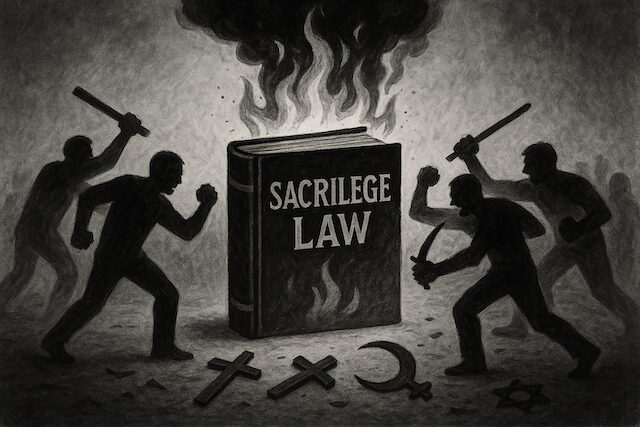
Sacrilege: A Word Too Vague to Wield
What is sacrilege? Who defines it? A policeman? A vigilante? A politician? A jealous neighbor? For one, it’s ripping a sacred “Ang” (not merely a page) of the Guru Granth Sahib; for another, it’s quoting scripture in a song, critiquing it in a classroom, or sketching a provocative cartoon. This ambiguity isn’t just a flaw—it’s a fuse waiting to ignite. A loosely worded law could be twisted to snare anyone: Journalists, poets, professors, or everyday folks caught in a misunderstanding. In a state where emotions run high, fanatism and radicalisation is high, such vagueness invites vendettas, turning personal grudges or political rivalries into legal traps. The boundary between protecting faith and crushing expression isn’t just blurred—it’s obliterated. Beware: this law is ripe for misuse.
Punjab’s Mosaic, Shattered by One Law
Punjab’s soul lies in its diversity—Sikhs, Hindus, Muslims, Christians, Jains, and Buddhists, each with distinct rituals and reverence. A gurdwara demands a covered head; a temple doesn’t. Eating beef is sacred to some, sinful to others. In 2023, a woman was barred from the Golden Temple for having the Indian flag painted on her face, sparking a firestorm. Would this law brand her—or an unaware tourist ignorant of local customs—a criminal? A blanket sacrilege law risks imposing one faith’s rules on all, sidelining minorities and emboldening vigilantes to play moral police. In a land of many beliefs, this approach doesn’t unite—it divides.
Free Speech on the Gallows
This law’s draconian penalties, including death, are a brazen attack on free speech, enshrined in Article 19(1)(a) of India’s Constitution. If every daring idea, artwork, or critique can be slapped with a sacrilege charge, what’s left of democracy’s lifeblood? Journalism wilts, debate dies, dissent vanishes. The Supreme Court’s 2015 Shreya Singhal vs. Union of India ruling struck down a vague law for strangling expression, and this proposal is on the same collision course. By criminalizing thought, it risks turning Punjab into a graveyard for ideas.
Mobs Emboldened, Justice Betrayed
The stakes are grim. Since 2015, at least 14 lives have been snuffed out in Punjab over alleged sacrilege—lynched, burned, or gunned down in savage mob attacks. The 2021 lynchings at the Golden Temple and Kapurthala, often stoked by political agendas, are scars on the state’s conscience. These weren’t legal judgments but vigilante fury. This law doesn’t curb that bloodshed; it pours fuel on it, giving mobs a legal pretext to act as executioners. Legitimizing such mayhem isn’t justice—it’s anarchy cloaked in piety.
A Warning from Pakistan’s Playbook
Pakistan’s blasphemy laws are a stark cautionary tale. Designed to protect religious sentiments, they’ve unleashed a nightmare of false accusations, mob lynchings, and brutal punishments, often targeting minorities without evidence. Historically, Islamic law prescribed harsh penalties for offenses like theft (amputation) or blasphemy (death, sometimes with public display of the body for three days), deemed haqq Allah (divine rights). These required strict legal conditions—witnesses, confessions, or judicial oversight—but in practice, accusations often sparked mob violence before courts could act. Punjab’s proposed law risks a similar fate, where a neighbor’s spite or a politician’s ploy could trigger a legal witch hunt, unraveling trust and harmony.
A Blueprint for Harmony, Not Harm
Punjab’s leaders must pause and reflect: Is this law about safeguarding faith or chasing votes? Faith flourishes through dialogue, not dread. Existing laws, like IPC Section 295A, already punish deliberate religious insults. The answer lies in rigorous enforcement, community bridge-building, and education, not a sledgehammer statute. If a new law is needed, it must be surgical:
- Define sacrilege narrowly—deliberate, physical desecration with proven intent.
- Explicitly exempt scholarly, journalistic, and artistic expression.
- Require court oversight before arrests to prevent misuse.
- Strongly penalize false or frivolous claims to deter weaponization.
- Fast-track investigations and trials for religiously charged cases.
- Strengthen community outreach to build trust and reduce polarization.
Without these guardrails, the law becomes a noose around Punjab’s neck. The state deserves a future where faith and freedom stand shoulder to shoulder, not one where belief fuels division and mobs rule with impunity. Faith should lift us up, not tear us apart. This law isn’t Punjab’s salvation—it’s a betrayal of its spirit.
References
- Third Time, Tougher Law: Punjab to Table New Anti-Sacrilege Bill; May Propose Death Penalty – The Daily Pioneer, July 7, 2025
- Punjab govt to introduce stringent anti-sacrilege bill, proposes life term or death penalty – The New Indian Express, July 7, 2025
- Woman denied entry to Golden Temple over Tricolour painted on face – The Tribune India, October 30, 2023
- Shreya Singhal vs. Union of India – Indian Kanoon, 2015
- What is sacrilege? Incidents and law in Punjab explained – India Today, December 20, 2021
- Punjab sacrilege cases: 14 murders in 8 yrs, the perils of jungle justice – Hindustan Times, February 21, 2023
- Capital Punishment: Muslim Law as in Force at the Advent of British Rule – AdvocateKhoj

Gurpartap Singh Mann, a former Member of Punjab Public Service Commission (2018–2024) and an ex-Chief General Manager of Punjab Infrastructure Development Board wherein he played a key role in infrastructure development through Private Public Partnerships.