
The Deputy Commissioner Shimla announced last Tuesday that 300,000 vehicles had entered Shimla in the last two weeks due to the tourist rush. That is 15000 vehicles per day. Shimla has parking for just about 5000 vehicles, and if we assume that a tourist family/group stays for just two days, the daily parking requirement is for 30000 vehicles- six times what is available. (This does not include the locally registered vehicles numbering about 70000!)
The situation is no different in Dehradun, Nainital, Mussoorie, Manali, Dharamshala and other hill stations. And it’s getting worse every year.
The tourists, of course, suffer, stuck in jams for hours, sometimes for nights, without food, water or toilet facilities. Half their vacation time is spent on the roads. The real and continuing price, however, is paid by the permanent residents of these once quiet, idyllic, British-era towns, who are practically imprisoned in their houses for half the year, with no space left on the roads even for walking. I live near Mashobra, about 12 kms from Shimla for six months every year, and have decided to never, but NEVER, drive into Shimla during my stay here-there’s no telling if I’ll ever be able to make it back to my house!
States like Himachal and Uttarakhand bear the brunt of this vehicle-driven overtourism; their proximity to the northern states is their undoing, while Kashmir is spared the deluge because of its distance and the on-again, off-again security situation there.
The state governments should have foreseen this, with tourist numbers growing by 43% ( 2023 figure over the previous year),rising incomes, and the desperation of families to escape the heat and pollution of our deteriorating cities. But the govts never planned for this nightmare, content with collecting their GST and Luxury taxes. And when they did start making some plans, they were all the wrong ones.
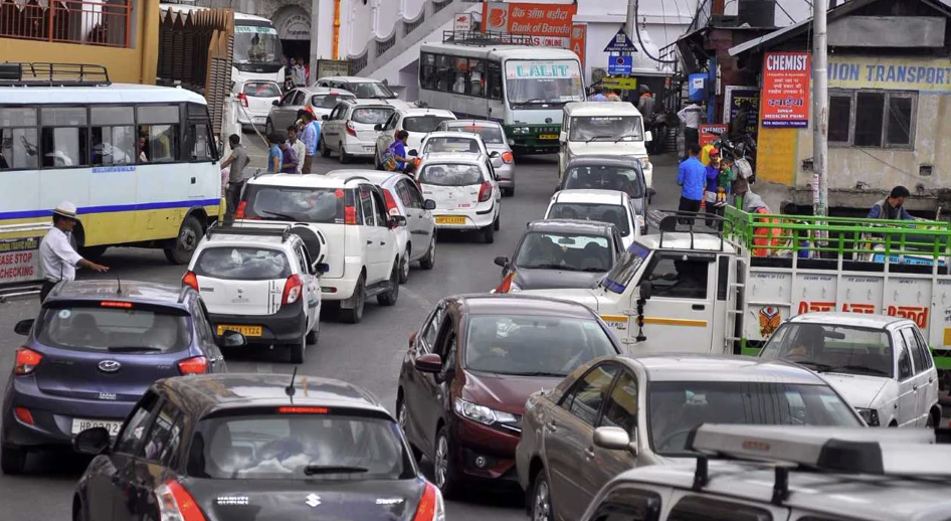
The biggest planning blunder has been the construction of expensive, environmentally disastrous four-lane highways and expressways in the mountainous terrain of Himachal and Uttarakhand to reduce driving time and make access easier for tourists. This has led to an explosion in the number of vehicles coming to these destinations: before the Kalka-Shimla four-lane highway was built (it is still not complete) the average number of cars entering Shimla every day was about 4000 to 5000- it is now 15000 to 20000. And when these vehicles enter Shimla there is just no space for them to park. It’s even worse in Manali, with 25000 vehicles crossing the Atal tunnel (below Rohtang pass) every day during peak season. The state govt. is a silent spectator: it took the National Green Tribunal to impose a daily cap of 1500 vehicles for the Rohtang pass to prevent it from becoming another Karol Bagh, in more ways than one.
The Shimla and Manali mistake is now being repeated, with Mussoorie being the victim this time. A 26 km elevated expressway has been approved to connect Dehradun and Mussorie: we are told this shall reduce the driving time to just 26 minutes. This is a disaster in the making, even without the 17000 trees that will be felled and the 250 families who shall be displaced by the project. The Shimla/ Manali experience shows that the number of vehicles headed for Mussoorie shall triple or quadruple; what happens to them once they reach Mussoorie? The town has even less parking space than Shimla, and can barely accommodate those who come just to meet Ruskin Bond!
Bureaucracies are loath to think out of the box, and politicians are happy to sanction capital intensive projects like roads and multi-storeyed parkings to their favoured contractors. But this comfortable, parabiotic arrangement has to change: given the geology and terrain, one cannot keep “widening” roads and excavating more parking spaces indefinitely, and the limits have already been reached. What our mountain destinations need are fewer highways and more cable/ rope-ways- that way they can keep getting more tourists but fewer vehicles. A Dehradun-Mussoorie cable system would have served the purpose of the elevated highway, with no addition of vehicles, at one tenth of the elevated highway cost. It is to Himachal’s credit that it has seen the light and has approved four major rope-way projects: Parwanoo-Shimla, Dharamshala-McLeodganj, Manali-Rohtang, and Kullu-Bijli Mahadev. Many more are needed, including one from Parwanoo/Kalka to Kasauli.
The Union government too needs to play a role in curbing this vehicular overtourism. It should NEVER AGAIN approve a monstrosity like the Char Dham Highway which is effectively a death warrant for Kedarnath, Badrinath, Gangotri and Yamunotri. It should put a hold on all four laning projects in these states (even at the risk of annoying Mr. Gadkari) and fast track central approvals and funding for ropeways. More flights should be started to these states- in Himachal currently all its four airports are being utilized at below 50% of their capacity.
More helicopter services should be introduced, and not just to religious places. Most important, the govt. should expand the skeletal rail network in all mountain states which have tourism potential, and not just for strategic reasons. In 75 years not an inch of rail line has been added to what the British left behind. This shall not only reduce the vehicular tsunamis in the mountains but shall also add an entirely novel experience for the visitors.
Harsh physical or fiscal barriers such as e-passes, capping numbers of vehicles entering a state or even excessive tolls or entry fees should be avoided as they cause inconvenience and will not serve the purpose in the long run. It is better to provide the tourist an attractive alternative to using his car rather than simply taxing him or embroiling him in red tape. The lazy solution is usually the worst. ( Though these tough measures will become inevitable if the numbers continue to expand at the present rate).
The vision should be: we welcome tourists, but not their cars.
(This piece was published in The Times of India on the 21st of June 2025 under the caption ‘Tourists Welcome, Not Their Cars.’)

| The author retired from the IAS in December 2010. A keen environmentalist and trekker he has published a book on high altitude trekking in the Himachal Himalayas: THE TRAILS LESS TRAVELLED.
His second book- SPECTRE OF CHOOR DHAR is a collection of short stories based in Himachal that was published in July 2019. His third book was released in August 2020: POLYTICKS, DEMOCKRAZY AND MUMBO JUMBO is a compilation of satirical and humorous articles on the state of our nation. His fourth book was published in July 2021. INDIA: THE WASTED YEARS – chronicles all the missed opportunities in the last nine years. His fifth book – THE DEPUTY COMMISSIONER’S DOG AND OTHER COLLEAGUES – released in September 2023, portrays the lighter side of life in the IAS and in Himachal. He published his sixth book, DISAPPEARING DEMOCRACY-DISMANTLING OF A NATION in March 2024; it is a commentary on events from 2021 to the present, a sequel to THE WASTED YEARS. Shukla writes for various publications and websites on the environment, governance and social issues. He divides his time between Delhi and his cottage in a small village above Shimla. He blogs at avayshukla.blogspot.com |

Well said Sir – the reason to head to Shimla is for walks in the fresh air – not to choke in traffic fumes! Even 100 years ago, wise heads ensured cars were banned in Upper Simla.
The Kalka–Shimla Railway has 5 passing places along its route, and 6 trains each way per day. Investment into building more passing places on the line and increasing the signalling and rolling-stock capacity to run trains in series on the same track section could dramatically increase the capacity of the train service. It took only 5 years to build the whole line in the era before mechanised construction (1898-1903), so these modifications could surely be achieved in a fraction of that time.
But clearly what is shown, is the Indian appetitie for enjoying the hills and escaping the cities. We need to follow the lead of the British and develop more environmentally friendly “Hill Stations” so that pressure comes down on the existing towns while more families get to stay and walk in the cool country.
Lastly, we should applaud The Himachal Pradesh government for actively replacing diesel buses with electric buses (e-buses).