
Nestled amidst the lush deodar forests and snow-capped peaks of Jammu and Kashmir, Baisaran is a breathtaking meadow located about 5 kilometres from Pahalgam. It is often compared with Switzerland because of its long, dark meadows looking similar to those found in Switzerland. The thick timberland that lends the green-carpet look to the glade gives a differentiating hue to snow-topped crests of the encircling mountains. one among the highest places to go to in Pahalgam, Baisaran is a treat for the senses.

Pahalgam literally means “village of the shepherds” in Kashmiri, with “Puheyl” meaning shepherd and “goam” meaning village. In Hindu literature, the region is mentioned as “Bailgaon”, meaning “village of the bull”, to indicate where the Hindu god Shiva left his bull on the way to Amarnath. The region has historically been inhabited by nomadic herders, and its traditional lifestyle revolves around pastoral practices, with shepherds herding their flocks across the meadows. The lush green meadows and abundant pastures have historically provided ample grazing grounds for sheep and goats, making Pahalgam a haven for shepherds and their livestock. It is located on the banks of Lidder River at an altitude of 2,200 m (7,200 ft) in the Vale of Kashmir. The town is the starting point of the annual pilgrimage to the Amarnath Temple, which takes place in July–August.
Baisaran’s rolling grassy meadows create a stunning contrast against the backdrop of towering Himalayan ranges. The landscape feels almost surreal — endless carpets of green under a wide-open sky, with cool, fresh air that carries the scent of pine and deodar trees. During spring and summer, the meadow bursts into life with colorful wildflowers, while in winter, it sometimes transforms into a snowy wonderland. There still exists a place where time forgets to move, where the grass could hold your weight like a mother’s arms, where the sky stooped low enough to kiss your forehead and the heart learns how to breathe again. That place is a meadow called Baisaran, cradled between pine and prayer. Kashmir’s hidden dream, just beyond the known charms of Pahalgam. Here, the earth wears a robe of emerald, stitched with towering deodars and stitched tighter by the white peaks that guard it like gentle sentinels. The wind speaks in whispers, carrying with it the scent of damp earth, wildflowers, and an ancient kind of peace — the kind we have almost forgotten. The journey here is its own slow unfolding: a horseback ride along misty trails, or a quiet trek where every step feels like stepping deeper into a lost innocence. And if you stand very still, you might hear the land itself breathing. A rhythm older than memory, a lullaby for tired souls. Not to be seen, but to be felt.
This is Baisaran, not a tourist spot, but a sacred hush. A valley so enchanting, so achingly pure, it seemed touched by some forgotten god’s hand. A place where the soul — tired of scrolling, tired of running — finds a meadow wide enough to rest in. And as you lie back on the earth, the clouds begin to move slowly across the sky, as if they too have nowhere urgent to be. The air smells cleaner, sweeter. Horses graze lazily. The mountains stand at a distance, silent witnesses in robes of snow. Above them, the sky wears a blue so pure it feels almost forbidden to touch. You sit. You breathe. You forget the clocks.
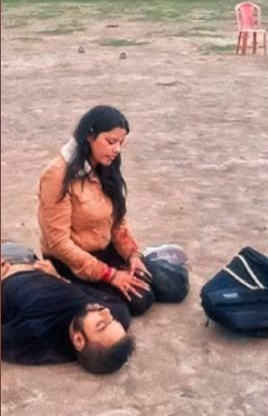 Today, that same valley stands wounded. Preying on an evil eye, Baisaran reels under the weight of its own beauty.
The meadows still roll in green waves. The mountains still rise like silent prayers. The deodars still murmur ancient songs when the wind brushes through. But if you listen closely, you hear a soft, almost imperceptible sigh — the sigh of a land exhausted. Baisaran is never meant to carry this burden — not of fame, not of greed, not of reckless admiration. It is meant to be a sanctuary.
People come to Baisaran looking for something — maybe a break from the noise, maybe a place their heart could finally be quiet, to breathe in wonder, to leave no trace but gratitude. They find it — the green velvet of the earth stretched endlessly, the trees whispering secrets, the mountains standing guard like timeless sentinels. They find a piece of the world that still remember how to be wild, how to be pure.
But now, Baisaran stands at the edge of exhaustion. It adds weight to a valley that was never meant to carry this much thoughtlessness. Today, the valley asks for more than admiration. It asks for protection. It asks for respect. It asks for restraint.
Baisaran does not cry out. It does not fight back against the footsteps that scar it, the noise that tears through its silence, the bruises across its face. But it reminds us — gently, painfully that nature, in her oldest wisdom, simply endures — not because she is powerless, but because she understands something we have forgotten: that true strength lies in patience, and true beauty lies in fragility. Fragility is to be handled with care. Otherwise it will harden, it will silence itself. The loss will be of innocence, of wonder, of a place where we once believed the world could still be pure. To tread on beauty is to be trusted with it. To be trusted is to tread lightly. The meadow does not ask for our love; it asks only that we do not destroy it. We do not conquer beauty by claiming it, but by protecting what we cannot hold. And yet — hope lingers. Let Baisaran heal. Let Baisaran live. Baisaran does not need noise, clutter, endless wanting. It needs only gentleness. To walk through Baisaran is to be given a rare trust — a trust to protect, not to possess. Every careless act is a betrayal, not just of the meadow, but of the innocence we still claim to carry. When we crush it under careless hands and hurried footsteps, we wound something silent and sacred within ourselves. It never asks for more than kindness. True belonging comes not from taking, but from protecting.

Rachna Vinod is a multilingual poet, writer, blogger and broadcaster, proficient in Hindi, Urdu, English, and Dogri. Her works have been broadcast through multiple media platforms, including All India Radio. In addition to her books, her articles and creative pieces are regularly published in both print and online literary magazines. She has made significant contributions to literature with over 20 individual publications and participation in more than 25 collaborative anthologies.
A Few Published Works:
Urdu: Yasmeen-e-Sughandh, Mere Humsafar
English: Eternal Heritage, Shahada Aisha, I Am Here Only, Bridging The Gap, Lotus Lore, Kashmir Konnectivity: A Biosketch
Hindi: Ankahi Sargam, Pighalte Himkhand (poetry collection), Madhyaratrik Kshan, Parvaton Ke Dayare (short story collection)
Dogri: Adaya Madaya Geeten Bharya, Hirkhi Phuhar, Aakhi Lai Dile Di Gall