
Whenever the earth shakes beneath the Jaintia Hills, an ancient invocation can still be heard:
“Khai-San Khai-Heh.”
Awake, Elders, Awake.
This powerful ancestral call is more than a response to an earthquake. It reflects a deep cultural memory- a reminder that the land beneath the people has a story, a history, and a sacred connection with the generations that came before.
Within Jaintia oral tradition, there are two important Paroms (traditional narratives) that speak about the creation and preparation of the earth for human existence. Though they differ in emphasis, both describe a world that was once incomplete and had to undergo transformation before humanity could establish life upon it.
The first Parom tells of an earth that lacked fertility and stability. When the Niaw Wasa first descended through Ka Tangnoob Tangjri, they found only rocks, water, and air. There was no fertile soil to cultivate and no firm ground upon which to build their homes.
The people struggled because every attempt to establish settlements failed. This ancient condition is remembered in the Pnar saying: “Chna Yung i step pat i miet, chna yung i miet pat i step.” (Build a house by day, it falls by night; build a house by night, it falls by day.)
The saying expresses a profound idea: the difficulty was not because people lacked the ability to build. The earth itself was not yet prepared for human habitation.
The people therefore approached U Syiem Lakriah, the mediator between humanity and the Creator, who carried their plea before U Tre Kirot. Hearing their concern, the Creator called upon Ka Bei Rymaw, the Earth Mother, to provide the sacred soil known as Ka Le Khoh Le Sun. Through this gift, the barren earth became fertile and capable of sustaining life.
The second Parom expands the story by describing not only the fertility of the earth but also the dramatic transformation of the landscape itself.
According to this tradition, the present-day Jaintia Hills was once a vast watery and swampy region filled with large lakes. The ground was unstable, and whenever people-built houses, they collapsed by the following morning. Humanity was living on a landscape that had not yet reached its final form.
The people again turned to U Tre Kirot. This time, the transformation came through the powerful forces of nature. The Creator commanded U Syiem Pyrthat (Thunder) and U Khmi (Earthquake) to reshape the land. The waters of the ancient swamp were drained towards the southern sea, while the rising of Loom Makachiang in the north – associated in tradition with the Himalayan region changed the geography of the earth.
This great event became remembered as the Jaintia Deluge, which scattered people in different directions.
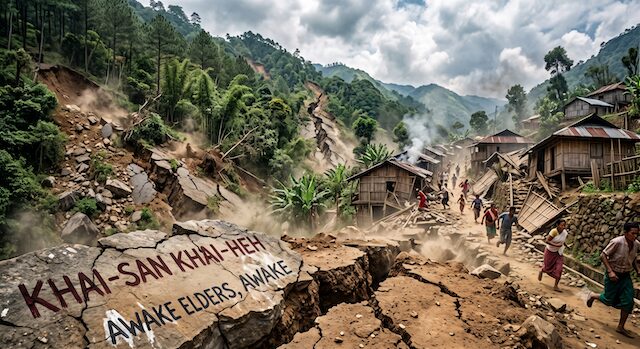
It is during such moments of earth movement that the ancestral cry “Khai-San Khai-Heh” is invoked. The phrase reflects the belief that earthquakes are not isolated events but part of the continuing relationship between humanity, the earth, and ancestral forces.
Interestingly, this second Parom carries themes that invite comparison with modern geological understanding. Today, science explains that continents move, oceans change, and mountains rise through immense geological processes. The theory of continental drift and plate tectonics describes how the Indian Plate moved northward and collided with the Eurasian Plate, contributing to the formation of the Himalayas.
The Jaintia Parom describes these transformations through the language of sacred forces: thunder, earthquake, water, and divine action. While it is not a scientific explanation, it preserves an indigenous memory of a changing earth and the awareness that landscapes are shaped by forces far greater than human beings.
The two Paroms, therefore, should not be seen as competing versions. They represent two connected stages of creation.
The first Parom focuses on the preparation of the earth for human life. It describes how the earth, initially barren and unsuitable for habitation, was transformed through the arrival of fertile soil and the creation of stable ground. Through this process, the land became capable of supporting human settlements, agriculture, and the continuity of life.
The second Parom focuses on the shaping of the physical landscape itself. It tells of the movement of waters, the transformation of the land, the formation of mountains, and the establishment of the natural world. Through these great changes, the earth took its present form and became an environment where humans, animals, plants, and other living beings could exist in harmony.
Together, they describe a complete journey: from an unfinished earth to a living world.
After the earth was prepared, U Tre Kirot called upon Ka Bei Wabooh, the Goddess of Fertility, to fill creation with life. Forests, rivers, birds, animals, and fish appeared. The earth became a place where humanity could live in harmony with nature.
The sacred guardians that followed represented the essential forces of existence. The stone deities- Ki Soodwar Sooluti symbolised the strength and permanence of the land, while the river deities- Ki Tawiar Takan represented the life-giving power of water.
The message carried by both Paroms is profound: the earth is not merely a place where humans live. It is a sacred creation shaped by countless forces, remembered through stories, landscapes, and ancestral voices.
The next time the ground trembles and the people call “Khai-San Khai-Heh -Awake, Elders, Awake,” they are not only remembering an earthquake. They are remembering the ancient story of how the earth itself became a home for humanity.

Dr Omarlin Kyndiah is an Associate Professor in the Department of Biochemistry at St. Edmund’s College, Shillong, India, where he has been teaching since 1997. Beyond academia, he served as General Secretary of Sein Raij Niamtre Shillong (Meghalaya) from 2008 to 2024, a congregation representing the indigenous Niamtre faith