
Every summer, as India heats up, our passports cool down.
The schools shut, the mercury touches unbearable highs, and suddenly every second WhatsApp status features boarding passes, airport lounges and captions announcing, “Europe, here we come!” Airports resemble crowded railway stations. Flights to Switzerland, Japan, Vietnam and Bali are bursting at the seams. Foreign holidays, once a once-in-a-lifetime dream, have become an annual ritual—and, thanks to social media, a public announcement.
There is absolutely nothing wrong with that. Indians are travelling more than ever before, and that’s a wonderful thing. Travel broadens the mind, introduces us to different cultures and reminds us how large—and how beautiful—the world really is.
Unfortunately, it also reveals something about us.
For years, we’ve bristled whenever travel blogs or foreign newspapers describe Indian tourists as loud, untidy, queue-jumping or inconsiderate. We dismiss it as stereotyping. We accuse them of prejudice. And to be fair, some of that mockery is lazy stereotyping dressed up as etiquette policing—the same behaviour from a European tourist rarely gets written up with the same relish.
But if we’re brutally honest, perhaps the more uncomfortable question is this:
Have we earned some of that reputation?
I’m beginning to think we have.
Volume Is Apparently Included in Our Visa
Many years ago, I joined a Thomas Cook group tour through Europe. One morning, everyone had settled into the coach, ready for another day of sightseeing. The tour manager counted heads. Once. Then again.
Two passengers were missing—the husband and his young son. The wife, we quickly gathered, had wisely gone ahead and was already seated comfortably inside the bus.
As we all waited, a hotel window suddenly flew open three floors above us, with the husband giving a thumbs-up sign.
“Bachche ko susu kara rahe hain!” she bellowed across the street.
The entire neighbourhood now knew why her husband was late.
The Europeans strolling past looked up in surprise. The rest of us became deeply fascinated by our shoes. A few minutes later, the husband appeared, blissfully unaware that his son’s bladder had just become international news.
The poor child hadn’t merely relieved himself. He had represented India.
Why are we so loud?
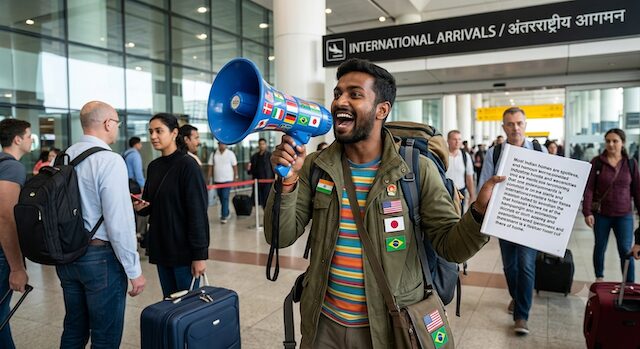
Perhaps because silence is a rare commodity back home. We grow up competing with traffic, wedding bands, temple loudspeakers, political rallies and neighbourhood construction. If you don’t raise your voice in India, chances are nobody hears you.
Unfortunately, we forget to lower the volume after immigration.
Queues Are Decorative Suggestions
There is something about a queue that awakens our competitive spirit.
A perfectly straight line outside a museum or cable car somehow becomes an invitation to negotiate.
“My family is ahead.”
“I’m just joining them.”
“We were here only.”
One person squeezes in, then another, and soon an entire extended family has materialised from nowhere. We are probably the only people capable of forming a queue and breaking it at the same time.
The irony is that we become furious when somebody does exactly the same thing to us.
Clean at Home, Careless Everywhere Else
This contradiction fascinates me.
Most Indian homes are spotless. Shoes stay outside. Floors shine. We wipe kitchen counters twice a day and wouldn’t dream of dropping a wrapper inside our living room.
Step outside, however, and somehow the world becomes someone else’s responsibility.
A coffee cup is left on a park bench. A tissue finds its way into a flower bed. A water bottle is abandoned because, surely, an invisible cleaning fairy will appear shortly.
Then, with complete sincerity, we spend the next ten minutes admiring how wonderfully clean Singapore or Japan is.
Clean countries are not clean because they employ magical cleaners. They’re clean because ordinary people don’t behave as though somebody is permanently following them with a broom.
The Buffet Is Not a Disaster Relief Camp
Breakfast buffets deserve a chapter of their own.
I’ve watched perfectly sensible, educated people transform into survival experts the moment they see the word “Complimentary.”
Suddenly, breakfast isn’t just breakfast. It is breakfast, lunch and possibly tomorrow’s snacks.
Croissants disappear into handbags “for later.” Bananas quietly migrate into backpacks. Tiny jars of jam, butter portions, tea bags and sugar sachets begin their mysterious journey towards India.
Never mind that half the loot is discovered three days later—squashed, stale and entirely inedible.
We’ve all seen it. Someone filling two extra water bottles “just in case.” Someone wrapping muffins in tissue paper with the precision of an archaeologist preserving ancient artefacts.
Perhaps this comes from a generation that grew up valuing every morsel of food. Scarcity teaches thrift. But somewhere between thrift and greed lies a line, and we seem remarkably talented at stepping over it.
Travel or Performance ?
Then there is the relentless need to prove that we are abroad.
Every airport deserves a photograph. Every boarding pass deserves another. The hotel lobby. The breakfast buffet. The shopping bags. The hotel slippers.
The Eiffel Tower patiently waits while fifteen versions of the same family photograph are taken. Poor strangers are recruited as photographers. Children lose the will to smile by Picture Number Twelve.
Sometimes I wonder whether we’ve travelled to Europe or merely shifted our drawing room to Instagram.
If social media disappeared tomorrow, would we still travel in exactly the same way?
I’m not entirely sure.
The Souvenir We Forgot to Pack
None of this means Indians are bad people. Far from it.
We are generous, warm, curious and endlessly enthusiastic travellers. We make friends easily. We embrace new food, new cultures and new experiences. Those are qualities worth celebrating.
But enthusiasm without consideration quickly becomes entitlement.
The waiter in Prague doesn’t remember our names. The museum guide in Florence doesn’t know which city we came from. They simply remember “the Indian family.”
Every polite interaction improves that image. Every careless one strengthens a stereotype.
As we pack our passports, jackets, power banks and shopping lists this summer, perhaps we should remember one more thing: good manners occupy no luggage space and never go out of fashion.
Because every Indian travelling abroad is an unofficial ambassador for 1.4 billion people.
Let’s make sure the next time someone remembers an Indian tourist, it isn’t because the entire street discovered that bachche ko susu kara rahe the.

Iti Mattoo, retired after 30 years in the IT industry, now enjoying her creative pursuits.