
The farm laws were not born overnight. They were the result of a decades-old demand for farmer freedom. S. Bhupinder Singh Mann stood for that reform when the mob called it betrayal.
We were at a wedding.
It was January 12, 2021. Like any Punjabi wedding, there was noise, laughter, relatives, phones ringing, people meeting after months, and that familiar warmth which only a family gathering can create. Then suddenly, the mood around us changed.
The news had come.
The Supreme Court had constituted a committee to talk to the agitating farmers on the three farm laws. The names were announced: S. Bhupinder Singh Mann, Ashok Gulati, P.K. Joshi and Anil Ghanwat.
Within minutes, the calls started pouring in.
Some calls were from journalists. Some were from friends. Some were from relatives. Some were from political people who had known us for years. But very quickly, it became clear that many of those calls were not really calls of inquiry. They were calls of pressure. Calls of accusation. Calls of warning. Some came wrapped in concern. Some carried veiled threats. Some came from people who otherwise remained very close to us.
The question was the same: why did your father become a member of this committee?
As if dialogue had become a crime.
As if talking to farmers had become betrayal.
As if a man who had spent his entire public life fighting for farmers had suddenly become anti-farmer merely because he had agreed to be part of a process to hear all sides.
That day, I saw what a false narrative can do. It can make friends suspicious. It can make relatives restless. It can make political leaders nervous. It can turn a lifetime of work into a single accusation.
Today, years later, Montek Singh Ahluwalia has said something which has reopened that buried debate. He has said the repealed farm laws were good, though he believes they were rushed through.
This is not just one more interview. This is not a casual comment by an economist. This is Montek’s interview and the truth Punjab buried.
Montek Singh Ahluwalia is not a BJP voice. He is not part of the Sangh Parivar. He belongs to the Congress-Manmohan Singh reform school. He worked closely with Dr Manmohan Singh. He served at the highest levels of economic policymaking. He was Deputy Chairman of the Planning Commission during the UPA years. Capt Amarinder Singh had appointed him to head Punjab’s economic revival expert group at the very time when the farm laws agitation was unfolding.
So when Montek says the farm laws were good, it is not BJP politics speaking. It is the old Congress reformist economic line speaking.
It is also a vindication of S. Bhupinder Singh Mann.
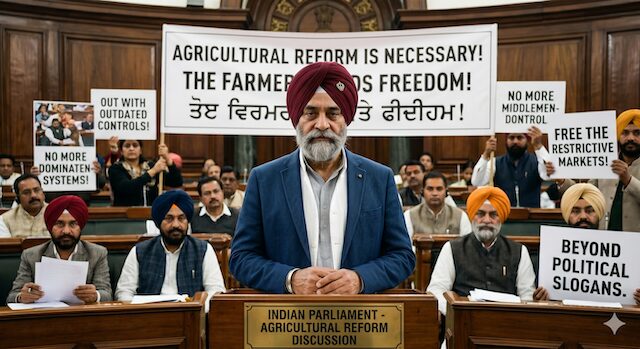
For decades, Mann Sahib had taken a clear and unambiguous stand. Indian agriculture needed reform. The farmer needed freedom. Agriculture could not remain tied forever to outdated controls, restrictive markets, middlemen-dominated systems and political slogans. He had raised these issues in Parliament. He had spoken again and again about the injustice done to Indian farmers.
One of the most important issues he had highlighted was that Indian agriculture was subjected to negative subsidy, or negative AMS in WTO language. In simple words, the farmer was not being pampered in the way the popular narrative suggested. The farmer was often being forced to sell cheap so that consumers could eat cheap, inflation could remain controlled, and governments could claim food security. The farmer was paying a hidden tax.
Yet the same farmer was being told that he survived because of government charity.
This was the great deception.
Industry was liberated in 1991. The licence-permit raj was dismantled. Private investment was welcomed. Entrepreneurs were told to grow, compete and export. But agriculture remained bonded. The factory owner got freedom. The farmer remained trapped.
He could produce, but not freely sell.
He could take risk, but not freely negotiate.
He could feed the nation, but not freely discover the best price.
He was praised as annadata, but treated as a controlled supplier of cheap food.
That is why the three farm laws were important. They were not perfect. They were not beyond improvement. They were not above discussion. But they were certainly a step in the direction of long-pending agricultural reform.
This was Mann Sahib’s stand. Not blind acceptance. Not surrender to government. Not betrayal of farmers. His position was simple: agriculture needed reform, the farmer needed choice, MSP concerns needed to be addressed, safeguards were necessary, but the direction of reform should not be rejected.
That is why I do not agree when people say the farm laws were suddenly rushed as policy ideas.
Maybe the final parliamentary handling could have been better. Maybe the communication should have been stronger. Maybe wider consultation and trust-building should have come first. But as policy ideas, these reforms were not rushed. They had been discussed and demanded for decades.
Farmer leaders like S. Bhupinder Singh Mann, Sharad Joshi, Shetkari Sanghatana, the All India Kisan Coordination Committee and many serious agricultural economists had demanded freedom for farmers long before 2020. The old BKU itself had once been a broad farmer platform before it fragmented into many factions. Over time, Punjab’s farmer politics splintered. Ajmer Singh Lakhowal, then General Secretary went his way in 1989. Balbir Singh Rajewal, then General Secretary, later formed his own group in 2006. Other factions like Ekta, Ugrahan emerged from Lakhowal’s group. Today, the number of BKUs and farmer unions in Punjab is almost impossible for an ordinary person to count.
With this fragmentation, the nature of farmer politics also changed. In my view, ideological groups and political interests entered the farmer space and altered its original farmer-first thinking. Once, the group carried red flags. When the red flag lost appeal, the same style of politics began appearing under the green flag. The colour changed. The method of perpetuating Chaos remained.
But the old question remained unanswered: who was speaking for the farmer’s freedom?
Even Atal Bihari Vajpayee understood that agriculture needed liberalisation. His government formed a high-level task force on agriculture headed by Sharad Joshi. Later, model APMC reforms, direct marketing, private markets, contract farming frameworks and reforms in the Essential Commodities Act were discussed again and again. These were not ideas invented overnight in 2020.
The demand was old.
The courage to implement it came late.
But when it came, reform became betrayal.
That is the real tragedy.
The farm laws debate Punjab refused to have was replaced by a campaign of fear. Farmers were told their land would be taken away. They were told MSP would end immediately. They were told mandis would vanish. They were told corporations would enslave them. They were told that anyone who supported reform was anti-farmer.
The text of the laws became irrelevant.
The fear became the law.
Those who were in power in Punjab at that time, the Congress government, had earlier responded favourably to similar reform ideas. Many political voices had spoken of opening markets, giving farmers more choice, reducing dependence on old procurement structures and bringing investment into agriculture. Capt Amarinder Singh had appointed Montek Singh Ahluwalia to head Punjab’s economic revival expert group. That group was also looking at the deeper crisis of Punjab agriculture.
But suddenly, the line changed.
Why?
Under whose pressure?
Under whose strategy?
Was it fear of losing a political moment?
Was it the greed of converting agitation into votes?
Was it some foreign forces and funding behind it?
Was it pressure from vested and political interests?
Was it the strength of the old procurement ecosystem which feared dismantling?
Was it the calculation that a movement at Delhi’s borders could create political capital in Punjab?
These questions must be asked.
Because what followed was not a mature policy debate. The farmer was pushed to the borders of Delhi. The protest grew. Emotions rose. A political and media ecosystem turned the issue into a battle of good versus evil. In that atmosphere, anyone asking for discussion was shouted down. Anyone who dared to disagree with the agitation was treated as an outcast, a gaddar, a traitor.
That is exactly how my father and our family felt in those days.
The Supreme Court then created a committee. Its purpose was simple: talk to the agitating farmers, understand their objections, hear the government, examine the laws and suggest a way forward.
But the farmer leaders refused to recognise the committee even before engaging with it. They refused to talk. They did not want to place objections clause by clause. They did not want dialogue.
They wanted repeal.
Yes or No.
No dialogue. No discussion. No debate.
Even in the meetings with the government, the mood had hardened. Farmer leaders used “Yes” and “No” placards. They refused to share government food. Symbolism replaced conversation. The message was clear: repeal first, everything else later.
When Mann Sahib realised that the farmer leaders were not willing to talk, he decided there was no point in remaining in the committee. He understood that if the very people for whom the committee had been created were unwilling to engage, his continuation would serve no meaningful purpose. He also understood the atmosphere of hysteria, pressure and threats that had been created.
He spoke to Chief Justice Hon’ble Bobbde, explained and stepped out with his consent.
But even that was twisted.
The same people who had refused to talk claimed victory. The same ecosystem that had built the fear narrative continued to attack. People who knew nothing of his decades of work for farmers suddenly began issuing certificates of loyalty and betrayal.
That period was personally painful. I saw people who knew our family, who knew Mann Sahib’s life and his commitment, repeat the same propaganda they had heard on television, social media and protest stages. Some were sincere but misled. Some were political. Some were simply afraid to stand against the crowd (mob)
This was Montek’s remark and Mann’s lonely stand, separated by years but joined by the same truth.
Dr Sardara Singh Johal also kept his stand clear. He too said the farm laws were good in intent, though he felt the implementation had been mishandled and hurried. He too was trolled, abused and attacked. Ashok Gulati, Anil Ghanwat and others who spoke of reform were painted as enemies. The Shetkari Sanghatana, which had fought for farmer freedom for decades, was ignored. The All India Kisan Coordination Committee’s long struggle for agricultural reform was dismissed.
Why?
Because the narrative had to show only one farmer voice.
The protesting voice.
But India has never had only one farmer voice. There is the farmer who depends on MSP. There is the farmer who grows fruits and vegetables. There is the farmer who wants export freedom. There is the farmer crushed by stock limits. There is the farmer who wants direct market access. There is the farmer who wants to escape the wheat-paddy trap. There is the farmer who wants the right to choose.
Their voices were drowned.
Unfortunately, much of the media also failed to see the true picture. Print, electronic and digital media went with the tide. Many YouTube channels mushroomed by presenting the false narrative as the ultimate truth. A few voices in the media did try to ask harder questions, but they were outnumbered and outvoiced by the mob.
Let us also be honest about another uncomfortable truth. Much of the agitation was not only about the farmer. It was also about the old procurement system, the arthiya network, the foodgrain procurement lobby and the political economy built around wheat and paddy. The farmer became the face. But many others had a stake in ensuring that the farmer never got an alternative route and remain bonded.
If the farmer could sell outside the old channels, who would lose control?
If private buyers entered with competition, who would lose monopoly?
If storage, processing, contract arrangements and direct purchase expanded, who would lose commission?
If diversification became real, who would lose the comfort of the old mandi-centred system?
These questions were buried under emotion.
Some leaders began to believe that the movement would carry them to political power. Some were made to believe they could become the next great saviours of Punjab, even CM. The leader with delusional disorder believed it. But when elections came, reality exposed the difference between protest noise and public mandate. The slogans that sounded invincible at Delhi’s borders collapsed before the voter. The delusion still continues though.
Yet by then, the damage had been done.
The farm laws were repealed. The reform debate was poisoned. Punjab remained trapped in the same cycle: wheat, paddy, falling groundwater, rising input costs, stressed farmers, fiscal burden, free power politics and no real diversification.
This is why Montek’s recent interview matters.
It has reopened the reform truth that Punjab buried.
Farm laws were good: Montek’s words, Mann’s vindication.
Yes, safeguards were needed. Payment security was needed. Dispute resolution had to be farmer-friendly. Small farmers needed protection. State governments needed to be brought on board while framing national agricultural policy. Communication had to be better. But these are arguments for better reform, not arguments against reform.
Punjab must now ask itself: what did we achieve by killing the debate?
Did diversification happen?
Did groundwater recover?
Did farmer income rise dramatically?
Did farm debt disappear?
Did the young farmer see a brighter future?
No.
We only returned to the same old system and called it “victory”.
The truth is that Punjab agriculture needs a new road. The wheat-paddy model gave food security to India, but it has exhausted Punjab. Our soil, our water, our fiscal health and our youth have paid the price. We cannot solve this crisis through slogans. We need markets, processing, storage, exports, pulses, oilseeds, fruits, vegetables, dairy, farmer producer organisations and direct value chains.
The farmer does not need to be protected from markets.
He needs to be protected within markets.
That was Mann Sahib’s stand.
That was the stand of serious farmer reformers.
That was the stand for which many were abused.
The wedding day, the farm laws, and a vindication years later are now part of my memory. When Montek Singh Ahluwalia’s statement brings the debate back, it also brings back that painful day: the phone calls, the pressure, the hysteria, the accusations and the sudden loneliness of standing on the side of an unpopular truth.
But it also brings a quiet satisfaction.
Because truth may be delayed, but it is not defeated.
Bhupinder Singh Mann stood where he believed the farmer’s future lay. He stood for reform when it was unpopular. He stepped out of the committee when dialogue became impossible. He did not compromise his conscience. He did not surrender to the mob. He did not change his stand for applause.
Years later, the same reform argument is returning through voices that even his critics cannot easily dismiss.
That is not just vindication.
It is a reminder that Punjab must learn to distinguish between farmer interest and political noise, between reform and conspiracy, between genuine protection and vested-interest protectionism.
The farmer was misled in the name of saving him.
Punjab cannot afford to be misled again.
But many questions remain unresolved and unanswered.
Who turned a policy debate into mass hysteria?
Who benefited from keeping the farmer afraid?
Who gained from protecting the old procurement system?
Who funded and sustained such a long agitation?
Will the agriculture sector ever be reformed?
Will any leader now dare to reform agriculture honestly?
And most importantly, will Punjab have the courage to say that the farmer does not need chains in the name of protection?
He needs freedom with safeguards.
That was the truth then.
That remains the truth today.
References
- Repealed farm laws were good, but rushed through: Montek Singh Ahluwalia, The Tribune
- All four members of SC-appointed panel on farmers’ protest support new farm laws, ThePrint
- Bhupinder Singh Mann opts out of Supreme Court-appointed committee on farm laws, NDTV
- Bhupinder Singh Mann recuses himself from SC committee on farm laws, Indian Express
- Bhupinder Singh Mann’s expulsion from own farm outfit was waiting to happen, Indian Express
- Will always stand with farmers: Bhupinder Mann recuses himself from SC-appointed panel, India Today
- First meeting of Supreme Court-appointed Committee on Farm Laws, PIB
- Report of the Supreme Court Committee on Farm Laws, Swatantra Bharat Party
- Press release on Supreme Court Committee report, Swatantra Bharat Party
- Farm Laws Repeal Bill, 2021, PRS Legislative Research
- Farm Laws Repeal Act, 2021, India Code
- Three farm bills aimed at transformation of agriculture, PIB
- With ‘Yes/No’ placards, a silent protest from farmers at government meet, NDTV
- Indian government, farmers fail to break impasse on farm laws, Reuters
- Lack of clarity on mandis failed farm laws: Montek Singh Ahluwalia, Indian Express
- Montek to head Punjab post-Covid economic revival group, Indian Express
- Punjab government to act on Montek report, Indian Express
- How Congress is justifying its stance against farm bills after backing reforms last year, ThePrint
- A tale of U-turns on the three farm laws, India Today
- PM Modi quotes Manmohan Singh to defend farm laws, India Today
- Agricultural economist Sardara Singh Johal says farm laws were good, Jagran
- Punjab Bills have complicated matters further: Dr Sardara Singh Johal, Indian Express
- Constitution of High Level Task Force on Agriculture headed by Sharad Joshi, PIB Archive
- Sharad Joshi: Leading Farmers to the Centre Stage
- From Plate to Plough: Atal Bihari Vajpayee was a big agriculture reformer too, Financial Express
- Submission to the Supreme Court Committee on Farm Laws, Centre for Civil Society
- Negative Subsidies in Agriculture, Centre for Civil Society
- Current WTO Negotiations on Domestic Support in Agriculture, ICRIER Working Paper
- Doha Negotiations and Domestic Support to Indian Agriculture, Centre for WTO Studies, IIFT
- Model APMC Act salient features, Directorate of Marketing and Inspection
- Model Act provides for direct purchase, contract farming and private markets, PIB
- Farmers’ Produce Trade and Commerce Bill legislative brief, PRS
- Standing Committee on Agriculture report on agriculture marketing, Lok Sabha
- Farm unions and Punjab: A long history, Indian Express
- How BKU Ekta Ugrahan outdid many other farm outfits, Times of India

Gurpartap Singh Mann, a former Member of Punjab Public Service Commission (2018–2024) and an ex-Chief General Manager of Punjab Infrastructure Development Board wherein he played a key role in infrastructure development through Private Public Partnerships.